
AI agents at work
– 9 min read
Webinar recap: The agentic marketer playbook — a new playbook for the AI-powered team

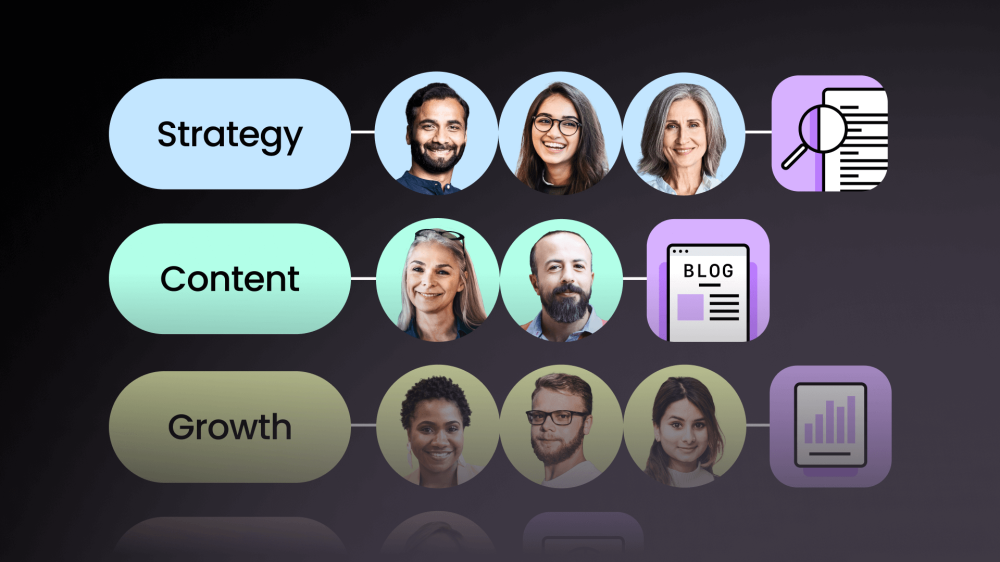
AI promises to make marketing faster and more efficient. But if everyone is using the same AI tools, how does your brand stand out? How do you avoid becoming just another voice in an ocean of AI-generated content?
That’s the question at the heart of our latest webinar with WRITER CMO Diego Lomanto and Director of Enterprise Content Alaura Weaver. Using examples from marketing leaders at KPMG, American Eagle, and Qualcomm Technologies, they shared how Fortune 500 companies are navigating this tension — using AI not just for productivity, but as a catalyst for genuine brand differentiation.
- The biggest risk is using AI to join a race to the bottom where every brand sounds the same.
- Fortune 500 marketing leaders are achieving 80% faster delivery, 250% search increases, and managing 6X more strategic initiatives with the same team size.
- The shift from 1X to 10X marketing isn’t about doing more work — it’s about building intelligent systems that free your team for strategic, creative work.
- The “agentic mindset” means moving from passive tool user to active system architect, fundamentally changing how you approach every marketing workflow.
- Brand differentiation will become the most valuable competitive edge as AI makes productivity gains accessible to everyone.

This isn’t another webinar about AI hype. It’s about strategy. And the insights from these leaders reveal a fundamentally different approach to marketing in the age of AI.
Meet the speakers: Diego Lomanto leads WRITER’s own marketing transformation using the agentic approach, while Alaura Weaver demonstrates how she went from managing two initiatives to orchestrating six simultaneously. They’re joined by Lauren Boyman, who’s spearheading KPMG’s “people-led, AI-powered” AIQ program, Craig Brommers, who scaled American Eagle from six pictures to 500 pieces of content weekly, and Qualcomm’s marketing leaders, who reduced team workload by 30-40% while maintaining brand consistency.
The race you’re in (whether you realize it or not)
Every marketing team right now faces a choice, and most don’t even realize they’re making it. Lomanto frames it starkly — “That’s not a strategy, it’s a race to the bottom.”
He’s talking about the common approach to AI — using it to churn out more content, faster, without thinking about what that content is supposed to achieve. It’s the path of least resistance — leading to reverse-engineered SEO articles, derivative social posts, and templated campaigns that all start to sound eerily similar.
“The real question is no longer about what AI can do for us,” Lomanto explains, “but what we as marketers are prepared to do with the freedom that it provides.”
That freedom is the key insight. Beyond simple productivity gains, strategic AI empowers you to reclaim your team’s time, redirecting it towards the brand-differentiating work that truly matters. This means focusing on developing creative strategy, building genuine customer relationships, and crafting messaging that resonates on a human level — the kind of work AI simply can’t perform.
The webinar unpacks how this mindset shift plays out in practice, showing the specific framework Fortune 500 companies are using to turn AI productivity into a competitive advantage. It’s the difference between racing to the bottom and racing to the top.
The results that made Fortune 500 CMOs take notice
Craig Brommers, CMO of American Eagle, offers a striking before-and-after. “When I was at Calvin Klein, a campaign meant six beautiful pictures, a Soho billboard, a double page spread in Vogue, high five, and you move on to the next,” he explains. “Now at American Eagle, we’re producing at least 500 pieces of content a week.”
That’s not a typo. Six pictures to 500 pieces per week. And it’s not just volume — it’s strategic volume. The team manages 34,000 stock keeping units (SKUs) and recently achieved a 250% search increase for a single campaign. This is what scaling with AI looks like when it’s done right.
But it’s not just retail seeing these results. At KPMG, the transformation is just as dramatic. What used to take a full day of research now takes an hour. Marketing materials that once took weeks to reach clients now arrive 80% faster. Maral Devian, associate director of tax marketing at KPMG, shares a telling moment — “He thought it would take me all day long, which it probably would have had I not had WRITER.”
And at Qualcomm, the focus is on quality of life as much as productivity. Their teams have reduced workload by 30-40% while maintaining brand consistency across 1,200 trademark terms.
One team member puts it simply — “WRITER has really helped to create happier employees out here at Qualcomm, especially on my team, and happier employees are more productive, they’re more creative, and they’re more satisfied.”
These aren’t isolated wins. They’re following a framework — what Lomanto calls the agentic marketing engine. The webinar breaks down exactly how this framework turns productivity into differentiation, with live examples and specific use cases from each company.
The five pillars that change everything
The framework Lomanto reveals details a new kind of marketing operating system, evolving past a simple reliance on AI tools. It rests on five core pillars: speed, scale, humanity, high touch, and relevance.
The first two — speed and scale — are where most companies stop. They use AI to move faster and produce more. But that’s the productivity trap. As Lomanto explains, “Productivity isn’t why customers choose you. In a world where everyone is using AI, the winners will be those who stand apart.”
That’s where the other three pillars come in. Humanity, high touch, and relevance are about differentiation. They’re about using the time you’ve saved through AI to focus on what makes your brand unique.
Lauren Boyman, CMO of KPMG, frames it perfectly.
“Too many companies treat AI like just another tool for efficiency or for cost-cutting, but if you don’t see AI as a disruptor, you’re really missing the true potential of it.” Her team’s AIQ program — “small A big IQ intentionally, because it’s powered by people and driven by AI and not the other way around” — embodies this philosophy.
The webinar goes deep into how these five pillars work together as a system. Rather than choosing between productivity and differentiation, the focus is on using productivity to fund differentiation. Lomanto shares the specific questions leaders should ask to identify where to apply this framework, and the real-world examples show what happens when you get it right.
A day in the life of an agentic marketer
The most compelling story comes from Alaura Weaver, WRITER’s director of enterprise content.
“Before WRITER, I could probably only keep up with one, maybe two of these at a time, and definitely not at the pace of demand,” Weaver shares. “At the moment, I’m orchestrating half a dozen major strategic initiatives.”
How? Through what she calls a movement between “efficiency engine” and “creative collaborator” modes. In the morning, she uses AI agents to handle high-volume, repeatable tasks — generating sales enablement kits, drafting content briefs, and creating campaign assets. By afternoon, she’s using AI as a thought partner for strategic work. This involves developing go-to-market strategies, shaping messaging, and getting audience critiques.
Take one of her playbooks as an example. She inputs a single piece of pillar content — let’s say a research report or webinar — and the system automatically generates a blog brief, pulls relevant data from HubSpot, drafts social posts for three channels, creates a Slack summary for her team, and updates her project management tool with next steps. What used to require jumping between five tools and half a day of work now happens in minutes.
And the results speak for themselves. Her team’s content drove nearly 40% of blog traffic from ideal customers in Q2. They dominate high-intent search terms. In a fascinating twist, their single largest referral source is now AI discovery engines — the very platforms that many marketers fear will replace them.
Weaver’s day-in-the-life walkthrough in the webinar shows the actual workflows, tools, and more “playbooks” that make this possible. It’s the difference between using AI as a tool and building an AI-powered system. And critically, it’s replicable — she demonstrates how any marketer can start making this shift.
The future of marketing isn’t about doing more
As the conversation wraps up, it’s become clear that the future of marketing won’t be defined by who produces the most content or who adopts AI the fastest. It will be defined by who uses AI most strategically — to free their teams for the work that truly differentiates their brand.
“Find the Alauras on your team,” Lomanto concludes. “Find those power users who are pushing the boundaries of what’s possible. Give them the freedom to explore. And then talk with us at WRITER about how to give anyone and everyone those superpowers.”
The path from 1X to 10X marketing is clearer than you might think. It starts with a mindset shift — from passive user to active architect — and builds from there with a proven framework and real-world playbooks.
What you’ll learn from the full webinar
In this webinar, you’ll discover actionable strategies and groundbreaking insights that will redefine your marketing efforts. You’ll learn:
- The complete 5-pillar framework for turning AI productivity into brand differentiation, with specific examples from KPMG, American Eagle, and Qualcomm
- The three questions that shift your mindset from passive tool user to active system builder
- A minute-by-minute walkthrough of how a 10X marketer structures their day, with live workflow demonstrations
- The agentic marketing starter kit — a practical template for mapping your high-impact opportunities and prioritizing where to start
- Real playbooks and custom agents that you can adapt for your own team
Don’t miss the complete conversation with Lomanto, Weaver, and marketing leaders from KPMG, American Eagle, and Qualcomm. Watch the full on-demand webinar to get the framework, examples, and starter toolkit you need to build your own 10X marketing engine.
More resources

AI agents at work
– 6 min read
As AI content creation explodes, invest in trust and differentiation

Diego Lomanto, CMO

Enterprise transformation
– 12 min read
AI Leaders Forum: Inside the playbook of the 6% winning AI at scale

Alaura Weaver