
AI agents at work
– 17 min read
How to build an AI-native marketing engine: The platform capabilities that make it possible

The pattern is becoming clear across enterprise marketing teams. Some organizations are achieving transformative results with AI—producing 10-20x more content without adding headcount, collapsing multi-day research projects into hours, maintaining brand consistency across thousands of assets that were previously impossible to govern at scale.
But most teams are stuck. They’re running pilots that show promise but can’t get to production. They have access to AI tools but can’t figure out how to integrate them into actual workflows. They’re getting marginal productivity gains—10-15% faster at individual tasks—but not the systemic transformation they keep reading about.
The difference isn’t better AI models or bigger budgets. It’s understanding that AI-native marketing requires a fundamentally different approach than “using AI to speed up your current process.”
It’s not about faster execution. It’s about rewiring your operating model.
The teams getting breakthrough results have made a specific shift: they use AI to drive productivity gains through speed and scale, then deliberately reinvest that reclaimed capacity into brand differentiation—creative work that sets them apart, deeper customer relationships, and contextual relevance that generic content can never achieve.
When everyone has access to the same AI tools, productivity alone won’t save you. What matters is what you do with the capacity AI creates.
That’s the strategic shift. But strategy doesn’t create transformation. The right platform foundation does.
The implementation question
You’ve been researching AI marketing platforms. You’ve sat through demos. You understand that AI can help with content creation, campaign management, research synthesis—the use cases are clear.
But when you dig deeper, you start asking different questions:
“How does this actually integrate with our Salesforce data and our content management system?”
“What happens when Legal asks how we’re ensuring brand and compliance standards?”
“Can our marketing team actually build and manage these workflows, or do we need engineering resources?”
“Does this get smarter as we use it, or does every interaction start from zero?”
These questions reveal something critical: the challenge isn’t finding AI capabilities. It’s finding the infrastructure that lets you operationalize those capabilities at enterprise scale.
Consumer AI tools excel at individual tasks but can’t handle enterprise requirements. Point solutions for specific use cases create fragmentation and integration chaos. Custom builds require engineering resources most marketing teams don’t have and timelines that kill momentum.
Here’s what we’ve learned after working with marketing teams at hundreds of Global 2000 companies: AI-native marketing at enterprise scale requires five foundational platform capabilities that most marketing leaders don’t think about until they hit a wall six to nine months into their transformation.
The five platform requirements for AI-native marketing
1. Multi-step orchestration (Not just assistance)
What this means:
Your agents must be able to handle multi-step processes end-to-end with appropriate decision-making, quality gates, and human oversight where needed. Not “suggest what to do next” but “complete the workflow and surface results for approval.”
Critically, you need visibility into how agents arrive at decisions—the ability to drill into the reasoning and context behind each action, understand what data informed the choice, and course-correct mid-execution when needed. True autonomy requires traceability, not opacity.
Why consumer AI tools can’t do this:
ChatGPT can draft content. But it can’t:
- Pull data from your CRM to personalize that content
- Check it against brand guidelines stored in your knowledge base
- Route it through your approval workflow
- Publish it to the right channels
- Track performance and feed insights back into the next iteration
What this looks like at scale: KPMG’s research assistant
KPMG’s marketing team needed to compress research timelines from 8 hours to 1 hour. Using WRITER Agents, they built a workflow that:
- Searches all KPMG knowledge bases simultaneously for relevant research
- Analyzes data and identifies patterns
- Creates initial summary with source citations
- Routes to consultant for strategic context and client insights
- Generates talking points for client meetings
The agent handles steps 1–4 autonomously. The human adds strategic value in step 4.
Total time: 60 minutes instead of a full day.
The platform requirement: Agents must integrate with your systems (CRM, CMS, knowledge bases), orchestrate multi-step workflows, include configurable human oversight gates, and provide visibility into their reasoning so teams can course-correct as needed.
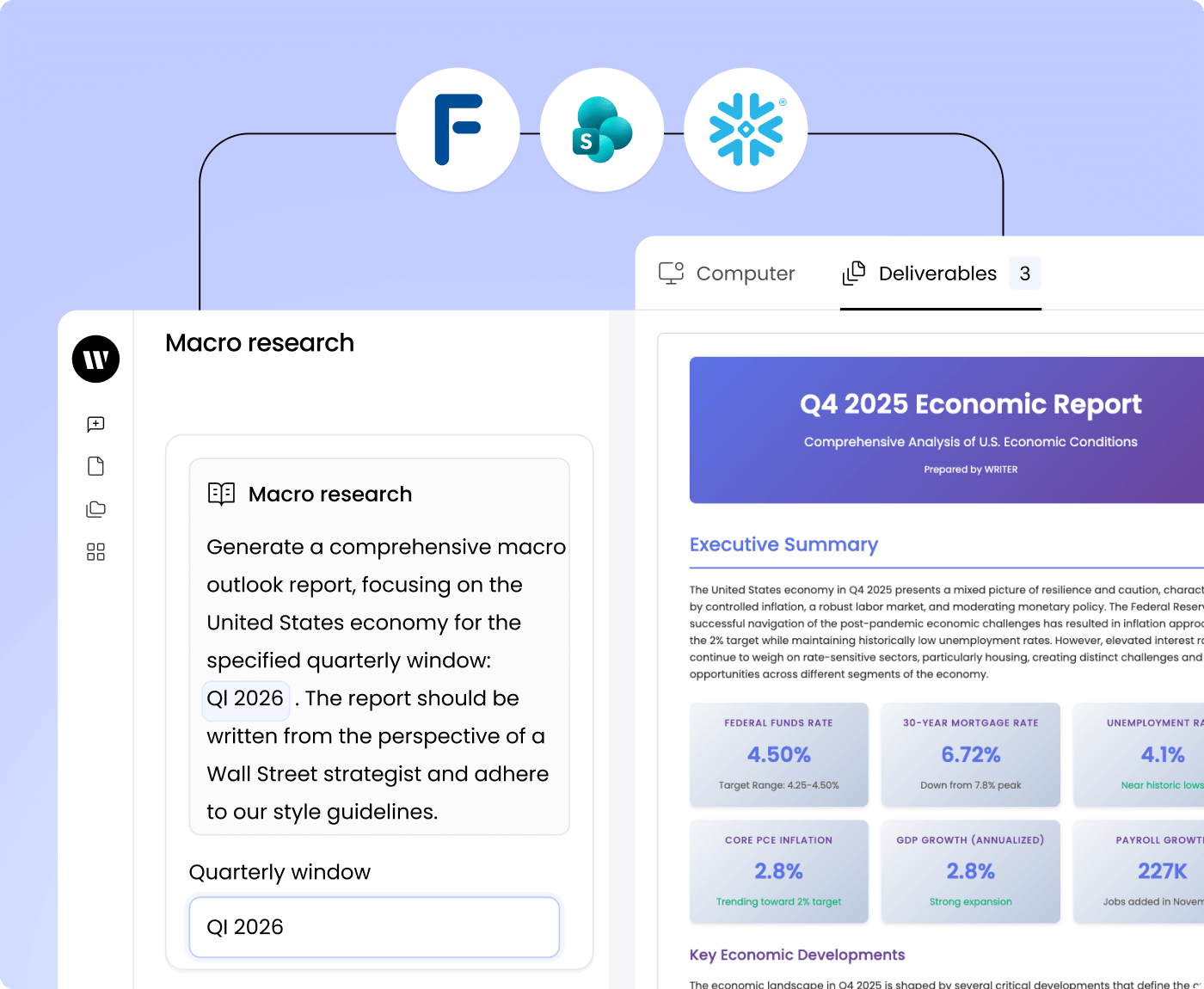
WRITER’s approach: WRITER Agent doesn’t require prompting or coding expertise. Marketers simply start with an outcome in natural language — “create personalized ABM email sequence for enterprise prospects” —and WRITER works backwards, building a multi-step plan that executes across your data and tools. You can inspect each step, understand the reasoning, guide the process, and course-correct as it runs. Agents can access your knowledge base, integrate with 50+ enterprise tools via Connectors, and execute complete processes with human-in-the-loop checkpoints where needed.
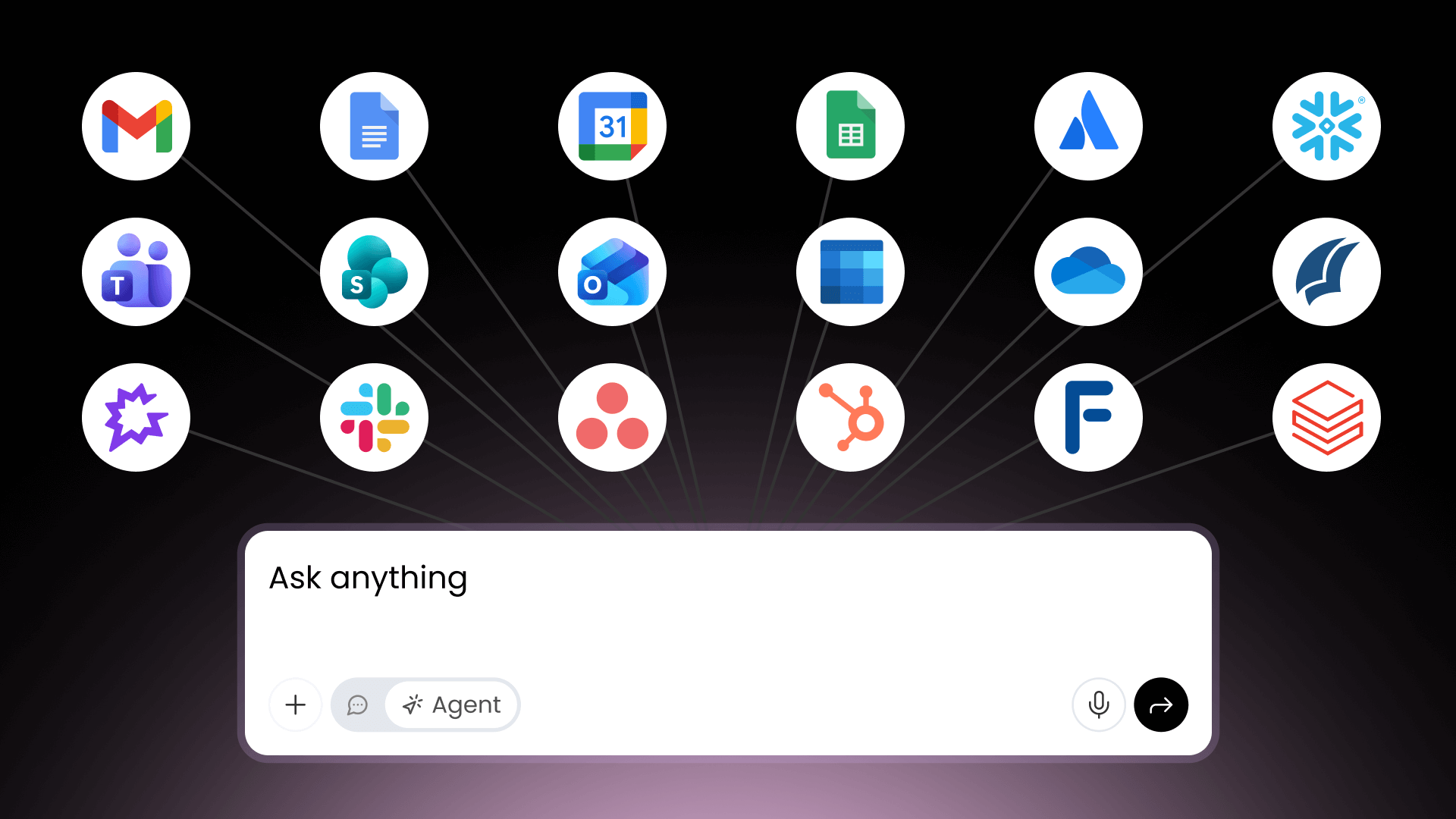
WRITER connectors: Governed agent access across enterprise systems
Learn More
2. Playbooks (Not one-off prompts)
What this means:
Many AI tools are optimized for individuals working with one-off prompts. Each person crafts their own approach, reinvents the wheel, and produces inconsistent results. This makes it impossible to scale best practices across regions, channels, or teams.
What you need is a way to capture your best ways of working—the workflows that actually deliver quality results—and standardize them so the whole organization benefits. That’s what allows you to scale from one quality deliverable to thousands without degrading consistency or requiring every person to become a prompting expert.
The one-off prompt problem:
You build a lead nurture workflow for North America. It works brilliantly. Now EMEA wants it. APAC wants it. Product marketing wants a version. Partner marketing needs something similar.
If each team starts from scratch—writing their own prompts, building their own logic, testing their own quality standards—you’re not scaling organizational capability. You’re creating fragmentation, inconsistency, and wasted effort rebuilding what already works.
What this looks like at scale: American Eagle’s content multiplication
American Eagle produces 500+ pieces of content weekly. They don’t rebuild workflows for each campaign or channel. They have replicable templates that teams customize:
- Content atomization workflow (one hero asset → variants for every channel)
- Product description generation (works across all 34,000 SKUs)
- Localization workflow (adapts content for different markets while maintaining brand guidelines)
Once built, these workflows become organizational assets that any team can use—ensuring consistent quality, capturing best practices, and eliminating the need to reinvent successful approaches.The platform requirement: Reusable workflow templates (Playbooks) that capture your organization’s best practices and allow teams to customize for their specific needs without starting from zero or relying on individual prompting skills.

WRITER’s approach: WRITER Playbooks let you build workflow templates that codify how your best work gets done. Build the lead nurture workflow once—with the right brand guidelines, quality standards, and approval gates built in. Your EMEA team clones it, adjusts for regional specifics, and launches in 20 minutes instead of 20 hours. No prompting expertise required. No quality inconsistency. No reinventing the wheel.
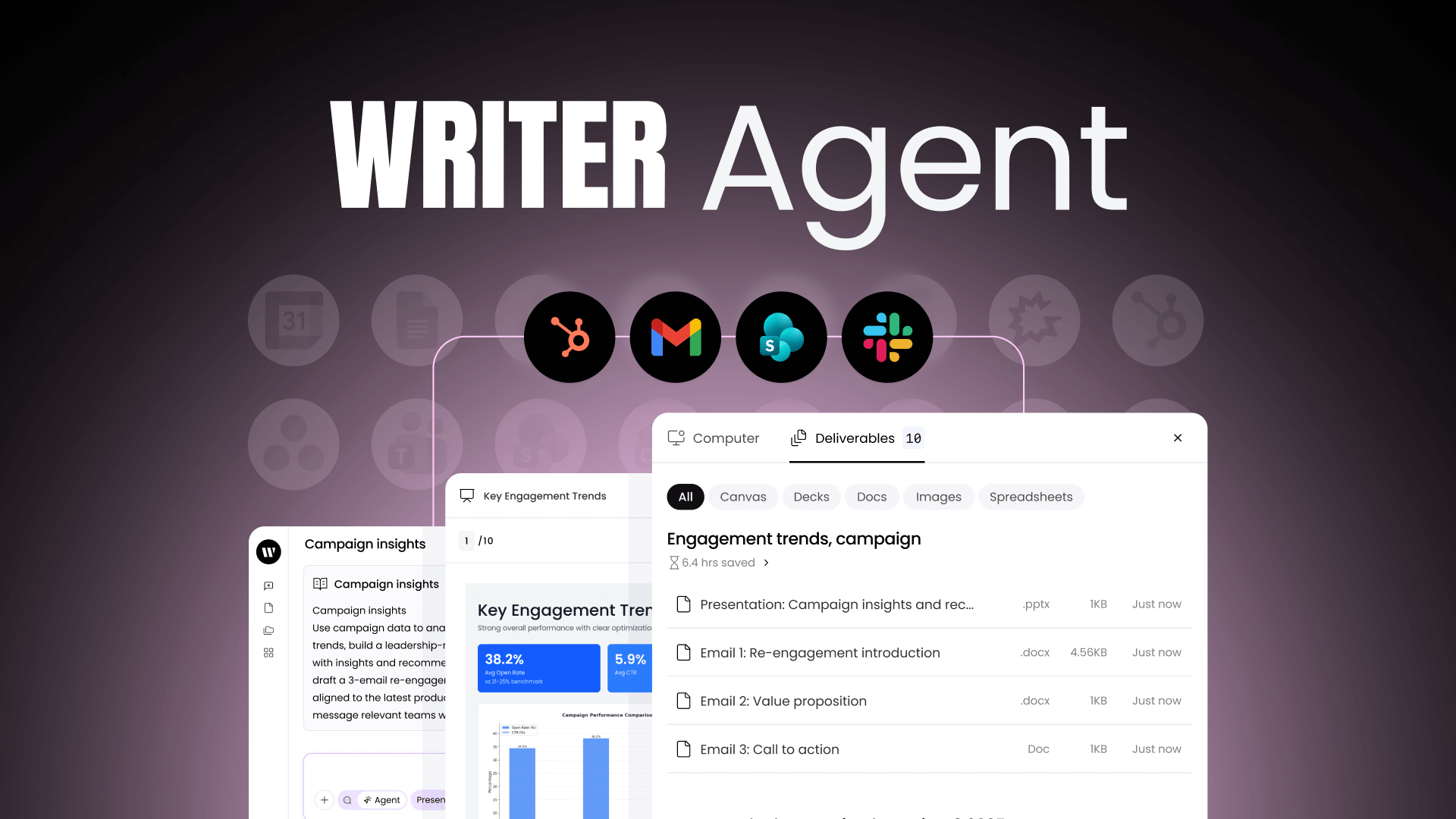
Introducing WRITER Agent: A new agent design pattern for enterprise scale
Learn More
3. Natural language creation (No engineers required)
Once you can standardize workflows at scale, the next question is: who can actually build them?
The wrong answer: “Our IT team or technical consultants build agents for marketing.”
This creates dependency. Marketing waits for IT to have capacity. IT doesn’t understand marketing workflows deeply enough. Velocity dies.
The right answer: “Marketers build agents themselves.”
Real example: Brent Summers at Qualcomm
Brent Summers, Staff Manager – Marketing at Qualcomm, is not an AI engineer. He’s a marketer who saw workflow bottlenecks his team faced daily—brand compliance reviews that delayed campaign launches, legal approval processes that required multiple manual handoffs, content routing that consumed hours of coordination.
He built an agent to orchestrate the entire workflow: intake content, check against 1,200+ Snapdragon trademark terms, route through appropriate review gates based on content type, surface only exceptions that need human judgment, and track everything for compliance reporting.
Four weeks from idea to scaled deployment across hundreds of users. His agent became the #1 most-used at Qualcomm—built by a marketer, not an engineer.
How? The platform let him think in terms of Tasks, Inputs, and Outputs instead of code. He defined the workflow logic, the quality gates, the approval routing—all the marketing operations knowledge he already had. The platform translated that into automated execution.
Why this matters: When marketers can build agents themselves, your velocity increases dramatically. You’re not waiting in engineering backlogs. You’re solving workflow problems in real-time as they emerge. IT focuses on governance, security, and complex edge cases—not building every marketing automation request.
The platform requirement: No-code/low-code interface that lets marketers define workflows in natural language without prompting expertise or engineering resources.
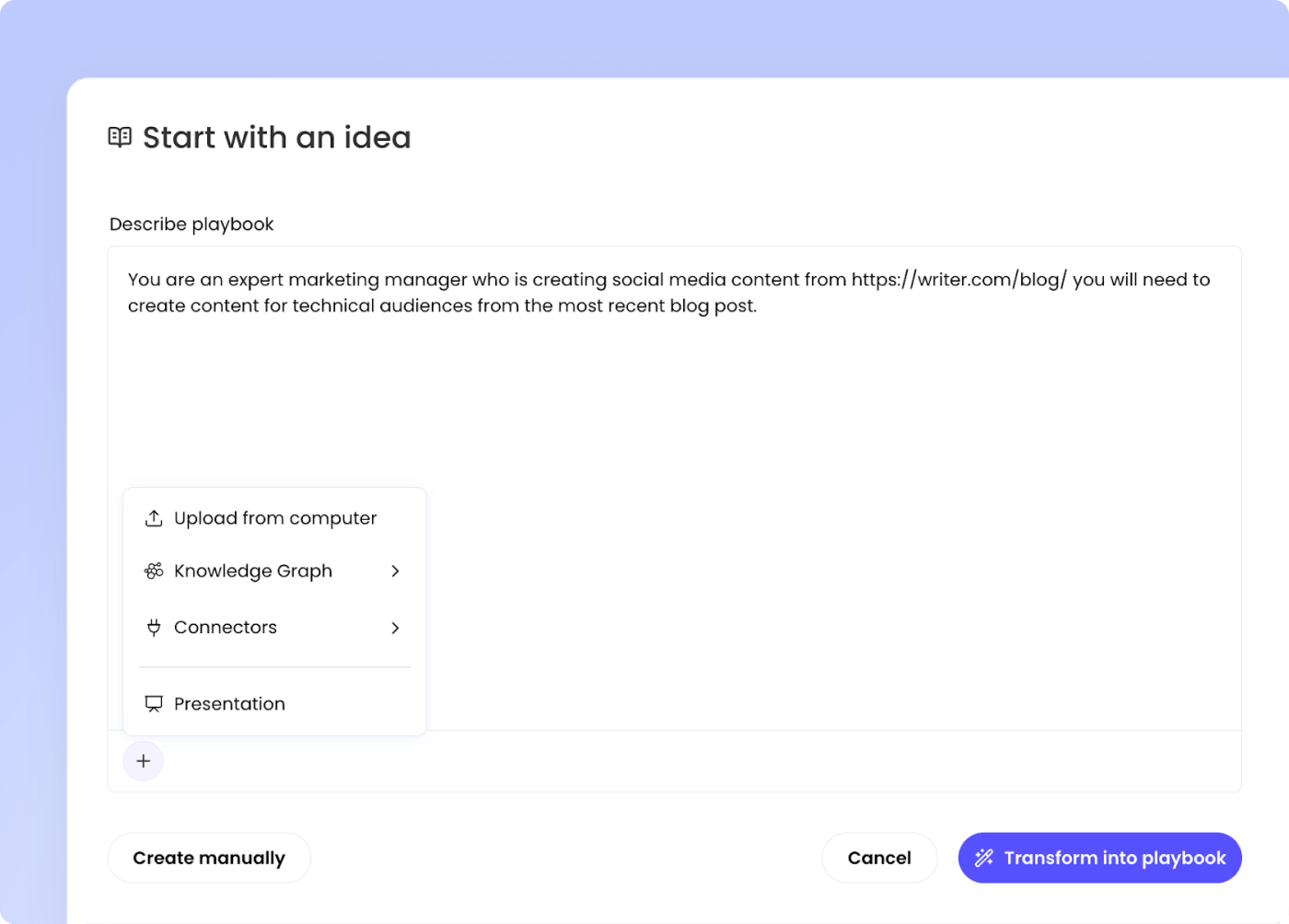
WRITER’s approach: WRITER Agent doesn’t require prompting or coding expertise. Marketers simply start with an outcome in natural language—”create personalized ABM email sequence for enterprise prospects”—and WRITER works backwards, building a multi-step plan that executes across your data and tools. You can inspect each step, understand the reasoning, guide the process, and course-correct as it runs.
4. Enterprise governance and oversight (Not “trust and pray”)
When marketers can build their own agents and workflows, you need governance to ensure quality and compliance at scale.
What this means:
You need the ability to enforce brand consistency, legal compliance, and approval workflows at scale—without creating bottlenecks that kill velocity.
Why this matters for enterprise marketing:
Your CMO approves AI content creation. Your Legal team approves it only if there’s proper governance. Your brand team approves it only if outputs maintain quality standards.
Without built-in governance, you get stuck in endless review loops or worse—inconsistent voice, compliance violations, or content that requires as much editing as writing from scratch.
What this looks like at scale: Qualcomm’s brand compliance
Qualcomm has 1,200+ trademark terms that must be used correctly across all Snapdragon marketing materials. Before agent-based workflows, every piece of content required manual legal and brand review—a bottleneck crushing velocity.
Using WRITER’s governance capabilities, they automated compliance checking:
- Brand terms database integrated into agent workflows
- Automatic compliance verification before content surfaces
- Human approval gates for high-stakes materials
- Audit trail showing what was checked and approved
Result: 30-40% workload reduction for the legal/brand team. Content velocity increased while compliance improved.
The platform requirement: Governance, approval workflows, audit trails, and quality controls built into the platform—not bolted on after the fact.

WRITER’s approach: WRITER provides real-time oversight of agent outputs with configurable approval workflows, brand compliance checking, and complete audit trails that satisfy Legal and brand team requirements.

Introducing agent supervision designed for enterprise scale
Learn More
5. Organizational knowledge that compounds (The emerging requirement)
With the right governance in place, the final frontier is making your system smarter over time.
The four capabilities above are necessary infrastructure. But there’s an emerging fifth requirement that separates AI tools from AI-native platforms:
Does your system get smarter as your team uses it? Or does every interaction start from zero?
The problem with AI that has no memory:
Most AI tools treat every interaction independently. You make a decision, the AI helps, you move on. A week later, someone else faces a similar decision—and the AI has no memory of what you did or why.
Organizational knowledge disappears into Slack threads, email archives, and the heads of people who might leave next quarter.
What’s missing: Context graphs, not just knowledge graphs
This is where the industry is heading, and WRITER’s engineering team has been exploring this frontier since early in our company’s history. In a recent piece on context graphs, we explored a critical question: Why do enterprise systems store what happened but not why it happened?
Your CRM shows that a customer deal closed. But it doesn’t capture why Legal approved that unusual contract term, what precedent was referenced, or what reasoning connected the decision to the outcome.
That context—the decision logic your organization uses daily—is organizational dark matter. Critical to how work gets done, but never captured as structured data.
The concept:
- A knowledge graph stores facts and relationships (Customer A bought Product B)
- A context graph stores decision traces: why decisions were made, what reasoning applied, what constraints shaped them, what precedent was referenced, what outcomes resulted
This transforms passive systems of record into active systems of reasoning.
What this looks like in practice:
When your demand gen team builds an ABM campaign using AI agents:
- The agent captures not just the final campaign, but the reasoning behind messaging choices
- It records what audience segmentation logic worked and why
- It connects campaign performance back to the strategic decisions that shaped it
- When the next ABM campaign launches, the agent already knows what worked for similar audiences
The system doesn’t just execute workflows—it learns from execution and gets smarter over time.
Where WRITER is heading:
At WRITER, we’re building toward this vision: Agents that execute workflows today, with the infrastructure for capturing organizational context as we develop it. Our engineering team has been exploring context graph technology—how to capture decision traces across agent interactions and make organizational knowledge compound over time instead of disappearing.
This is what will ultimately separate platforms from point solutions: not just faster content generation, but infrastructure that makes your organization’s collective knowledge accessible, queryable, and continuously improving.
For now, WRITER Agents provide the necessary infrastructure: execution, replication, and governance. The memory layer — what we’re calling Enterprise Brain—is where we’re pushing the industry forward.

Context graphs: Marketing as the tip of the spear in the enterprise
Read More
Why platform architecture matters to AI-native marketing
You could try to build AI-native marketing with a collection of point solutions:
- Use ChatGPT for content drafting
- Use Zapier for workflow automation
- Use your existing CMS for publishing
- Figure out governance manually
Some teams try this. Here’s what happens:
The fragmentation trap:
- Agents that don’t talk to each other
- Data siloed across tools
- Manual handoffs that slow everything down
- No unified governance or oversight
- Organizational knowledge scattered and inaccessible
You end up with 10 AI tools creating chaos instead of one AI platform creating transformation.
The platform advantage:
When agents, workflows, governance, and organizational memory exist in one unified platform:
- Agents can access all organizational knowledge
- Workflows can orchestrate across systems seamlessly
- Governance is consistent and enforceable
- Intelligence compounds as the system learns from every interaction
- IT approves once instead of reviewing every new tool
American Eagle, KPMG, and Qualcomm aren’t using 15 disconnected AI tools. They’re using an integrated platform that handles the complete stack.
The “build vs. buy” decision
Some enterprise marketing teams consider building custom AI infrastructure in-house. Here’s the honest math:
To build what WRITER provides, you’d need:
- Engineering team to build and maintain agent infrastructure
- Integration engineers to connect to your martech stack
- ML engineers to fine-tune models for your domain
- Security and compliance team to build governance layer
- Ongoing maintenance as AI models and APIs evolve
Estimated cost: $2-5M in year one, $1-2M annually ongoing.
Timeline to production: Months to years.
Or: Use a platform built specifically for enterprise business teams.
Timeline to production: Days to weeks for your first workflows.
The choice isn’t “build or buy.” It’s “build from scratch or extend what you already have.”
It’s about extension, not replacement
WRITER doesn’t replace your existing infrastructure—it extends it. The platform is designed to be fully interoperable and configurable with your current tech stack, giving you flexibility without forcing wholesale replacement.
What this means in practice:
Models: Use WRITER’s state-of-the-art enterprise-ready models, or bring your own (BYOM). The platform supports both— whatever aligns with your organization’s model strategy and governance requirements.
Knowledge retrieval: Leverage WRITER’s built-in knowledge retrieval engine instead of building and maintaining your own RAG (Retrieval-Augmented Generation) system. Or integrate your existing knowledge infrastructure if that’s where your organizational context lives.
Integrations: Use WRITER’s 50+ out-of-the-box Connectors to your existing martech stack (Salesforce, HubSpot, Marketo, Google Workspace, etc.), or configure custom integrations using our API framework. The platform works with your systems, not against them.
Governance: WRITER’s governance layer integrates with your existing approval workflows, brand guidelines, and compliance requirements. You’re not replacing what already works—you’re automating and scaling it.
Enabling IT to do more without more work
Here’s the shift that matters: When marketers can build their own agents and workflows using no-code tools, IT becomes an enabler of innovation instead of a bottleneck.
The old model: Marketing requests → Engineering backlog → 3-6 month wait → Manual build → More requests pile up → IT overwhelmed
The new model: IT integrates WRITER once (a few weeks) → Sets governance guardrails → Marketers build workflows themselves within those guardrails → IT focuses on strategic infrastructure and complex edge cases
What this enables for IT:
Instead of building every marketing automation request, IT builds infrastructure for safe innovation:
- Define approved pathways for AI adoption
- Set governance rules and security boundaries
- Maintain integrations with core systems
- Monitor usage and ensure compliance
- Focus engineering resources on truly complex problems that require custom solutions
Marketing velocity increases. IT workload decreases. Innovation accelerates without compromising security or governance.
This isn’t a threat to technical teams—it’s an opportunity to multiply their impact. By providing the platform and guardrails once, IT enables hundreds of business-driven workflows without becoming the constraint.
The IT governance question
Beyond platform capabilities, there’s the IT Security approval timeline.
48% of high-maturity organizations identify security threats as a top-three barrier to AI adoption. IT Security requires comprehensive vendor assessment, data classification, and risk analysis.
The timeline trap:
Most marketing teams treat security as an afterthought. Build something that works, prove value in pilot, then submit for IT Security review—only to discover a six-to-twelve-month approval queue.
By the time approvals clear, the business case has evaporated, the team champion has moved to another role, or the competitive moment has passed.
What actually works: Early IT partnership
Paul Dyrwal at Marriott International nails the dynamic: “Business teams own the use cases and outcomes. IT owns the infrastructure and governance. Neither can succeed without the other, but the business must lead.”
This isn’t about marketing going around IT or IT blocking marketing. It’s about partnership from Day 1, not Month 6.
The pattern that succeeds:
- Marketing and IT jointly define “approved pathways” for AI adoption upfront
- Platform gets vetted once with proper security assessment
- Marketing builds within those pathways without case-by-case reviews
- IT maintains governance and oversight without becoming a bottleneck
Why platform choice matters for IT governance:
Choose a platform that’s:
- Already cleared by IT teams at similar enterprises
- Interoperable with your existing tech stack (extending, not replacing)
- Built with enterprise security and compliance from day one
- Designed to scale within IT’s governance framework
- Flexible enough to work with your model strategy (WRITER models or BYOM)
This is why “build vs. buy” is really “build custom infrastructure from scratch” vs. “extend your existing infrastructure with an enterprise-ready platform.”
From platform requirements to production deployment
You’ve been researching AI marketing platforms. You’ve seen the demos. You understand the use cases.
Now you know what platform capabilities you actually need to move from pilots to production:
1. Multi-step orchestration—Agents that execute workflows end-to-end, not just assist with individual tasks
2. Workflow standardization—Reusable playbooks that scale best practices across teams, not one-off prompts that create inconsistency
3. Natural language creation—Tools that let marketers build agents themselves, without engineering resources or prompting expertise
4. Enterprise governance—Brand and legal compliance built in, not bolted on as an afterthought
5. Organizational knowledge that compounds—Systems that get smarter over time, not tools that start from zero with every interaction
Without these capabilities, you’re stuck running disconnected pilots with consumer AI tools that can’t scale to enterprise requirements.
With them, you’re building the system that American Eagle, KPMG, Qualcomm, and hundreds of other enterprises are using to achieve 10–20x content multiplication, 80% time reduction, and 30–40% workload decrease—while improving quality and maintaining brand consistency.
The gap between understanding what you need and implementing it at enterprise scale isn’t about budget or access to better AI models.
It’s about choosing infrastructure built specifically for how enterprise marketing teams actually work—with the right integrations, governance, flexibility, and support for marketers to build autonomously.
Ready to see how these capabilities work together?
We’ve built a complete implementation guide and toolkit that shows you how to operationalize AI-native marketing at scale:
Download The AI Marketing Prioritization Toolkit
Register for our next webinar to learn how to build the AI-native marketing operations strategy that delivers measurable business impact.
You understand what platform capabilities you need. Now learn how to put them into production—with the prioritization framework and change management strategies that move teams from experimentation to transformation.
Next step: See the platform in action
Reach out to our team to see exactly how these capabilities work together—using real marketing workflows, not generic examples.
You’ve got the vision for AI-native marketing. Now see the platform that makes it possible.
From pilots to performance
How enterprise marketers scale AI and prove ROI
AI FOR MARKETERS
Download nowMore resources

AI agents at work
– 22 min read
Agentic AI for marketing teams: Use cases from content generation to campaign orchestration
Diego Lomanto, CMO

AI agents at work
– 13 min read
Right-to-left thinking: A new framework for marketing AI transformation

Bridget Heaton

Innovation
– 13 min read
Context graphs: Marketing as the tip of the spear in the enterprise
Diego Lomanto, CMO