
AI agents at work
– 9 min read
Bankers mostly skipped SaaS. They’re all in on AI now.

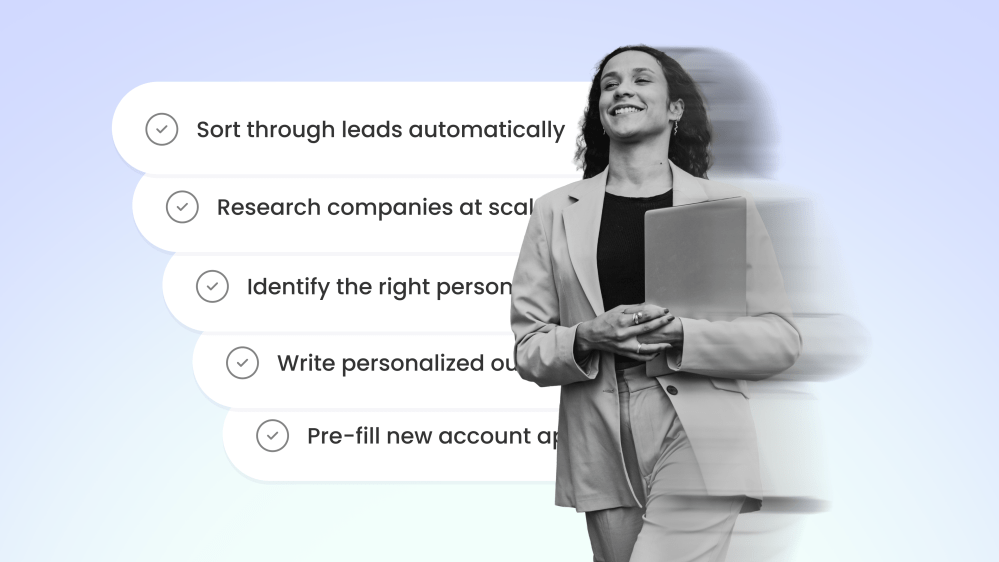
- Prospecting and outreach consume the majority of working hours for the relationship managers at commercial banks, especially junior staff. Finding qualified leads, researching companies and points of contact, then crafting personalized outreach, claims far more hours than actual conversations.
- According to a McKinsey survey of 400 commercial bankers from the US and Canada, relationship managers spend just 25% to 30% of their time in client dialogue. The rest is spent on prospecting, research, and data entry. The survey found this often led to frustration and burnout, resulting in high churn rates for new employees in the role.
- AI agents are a powerful new tool for this workflow. Agents can clean up bulk lead lists, excluding the dead ends that waste hours. A research agent can produce an in-depth brief on a company and identify the best points of contact. An outreach agent can craft personalized messages and be trained on the banker’s voice and tone. The banker can focus on human interactions.
- A banking client recently ran a blind test, comparing a group of relationship managers using these AI agents to those using traditional methods. The AI-powered group booked more than five times the meetings. Since being deployed, the system has allowed the bank to win millions in new business.

Let’s imagine the day in the life of a commercial banker. Your sales effectiveness and analytics team has a fresh dataset of companies in your geography, a basket of 1000 names to sort through.
First step — sort the signal from the noise. Out of the hundreds of new contacts in your pipeline, which are worth pursuing? Who is most likely to convert and has the potential to become a primary client?
Doing this manually was a slog — limited or no internal data, hours of prep, followed by manually creating an account plan through clicks and dropdowns.
Once you identify the qualified leads, the question becomes where to focus first.
In the past, a banker would get a spreadsheet and manually sift through it with the ambition of logging their activities in a CRM — if one was available — but more often just adding comments in the spreadsheet.
SaaS never offered a ton of utility over web research and a basic spreadsheet here. In fact, a sea of dropdowns and tables often created more context for a busy RM to sort through.
Now, let’s look at this same process completed with the help of three AI agents.
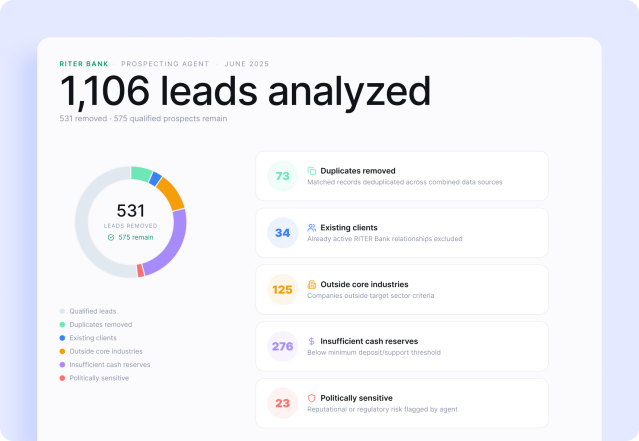
An RM wakes up and puts on a pot of coffee. She opens her email and sees the regional branch has released a new batch of over 1,000 leads. In the past, she would spend the day sorting through the spreadsheet, using a homegrown approach to scoring and ranking the prospects. Today, she finds an email from the prospecting agent, which has deduped the leads, removed existing customers, deprioritized companies outside their region and key industries, and flagged a few prospects with serious political or reputational risk. The overall list of leads is now 531 companies.
After coffee, toast, and a bike ride to work, the banker sits down and hops into Slack. A message is waiting from the account intelligence agent. It took the 531 leads from the prospecting agent and conducted research on each using a mix of internal data, proprietary data from third party vendors, and open web research. It disqualified a few based on the latest press releases and M&A announcements, then put the top 10 in an HTML dashboard for review, explaining why they scored so highly.
The top prospect has a lot going for it. It recently expanded from a messaging app to a fintech provider offering a mobile app where users can exchange payments and trade stocks. This has always been a sweet spot for her bank. It announced a Series B fundraise that implies it has a good amount of cash on hand and opened two regional offices to help sustain its growth.
Identifying which companies to pursue is a big help, but you still need the right person to open your email or answer the phone. The agent also provides a detailed brief on the best candidates for cold outreach. It looks at public web data and LinkedIn to gather details that can open up the conversation or get a foot in the door with a great email subject line.
This AI-powered process is happening today with banking clients using WRITER. Let’s take a deeper dive into each of the agents and explore what the output from them might look like.
Agent 1: Signal from noise – Identifying the right prospects
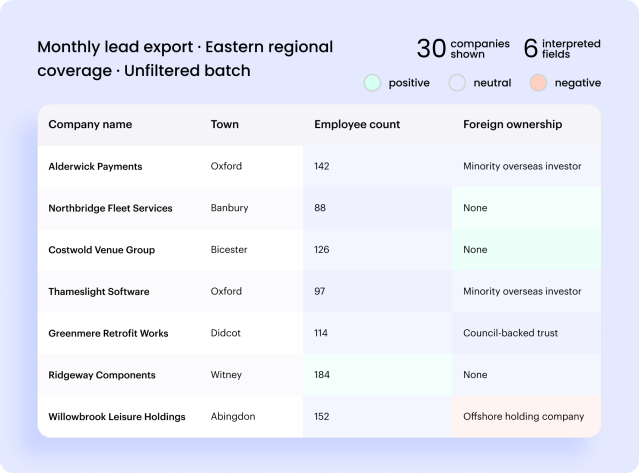
With an AI-driven approach, when new leads arrive, they are routed to a prospecting agent. This AI worker builds a clean, deduplicated list of high‑quality prospects from multiple data sources. It excludes existing customers, connections, and overlaps, then removes leads from industry verticals that don’t fit the bank’s risk or compliance appetite.
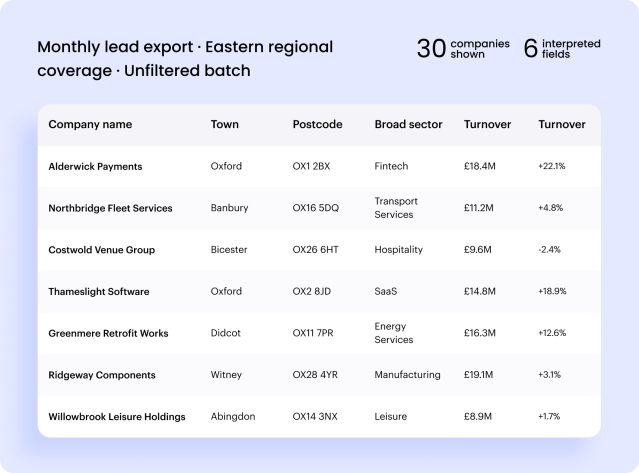
Once it’s cleaned and organized the leads, the agent routes the prospects to the right Relationship Manager or Business Development team (RM/BD) based on postcode, segment and team structure. This agent can run weekly or even daily, providing a regularly refreshed, centrally managed prospect list that forms the starting point for account intelligence and outreach.
Agent 2: Prioritize and prosper – Identifying the top prospects
The prospecting agent gave us a list of eligible leads and passed the target list to the right RM/BD. The question now is where to focus first.
In the past, a banker would get a spreadsheet and manually sift through it with the ambition of logging their activities in a CRM — if one was available — but more often just adding comments in the spreadsheet. They would then painstakingly create an account plan and fill out a digital form or create a manual PowerPoint or Word document that they could then socialize with management.”
In our example, the client sends the data to a research agent, which pairs the raw list with internal data from your CRM, Loan Origination System, Core Banking Platform, and Enterprise Data Layer. Then it brings in information from public government portals, LinkedIn, company websites, recent news reports, and verified and trusted sources from the open web.
Using this combination of sources, the agent builds a 360° company profile: a concise view of size, financial signals, sector context, recent events, key contacts and fits with the bank’s products and services that meet the client’s needs. The result is a practical briefing pack that equips RMs/BDs to have informed, relevant conversations with each target account.
The agent then applies a custom skill to score the leads it researched. To create this, we work with the top performers in a given region, encoding their best practices into a programmatic skill that the agent can use to score the lead data. That means everyone, even the newest hire, has access to deep expertise through the use of a collaborative AI platform.
The agent might subtract points for a company with political or media risk, and add points for a company that just announced revenue growth and a new regional office. Everything from cash on hand to industry vertical to leadership change is considered.
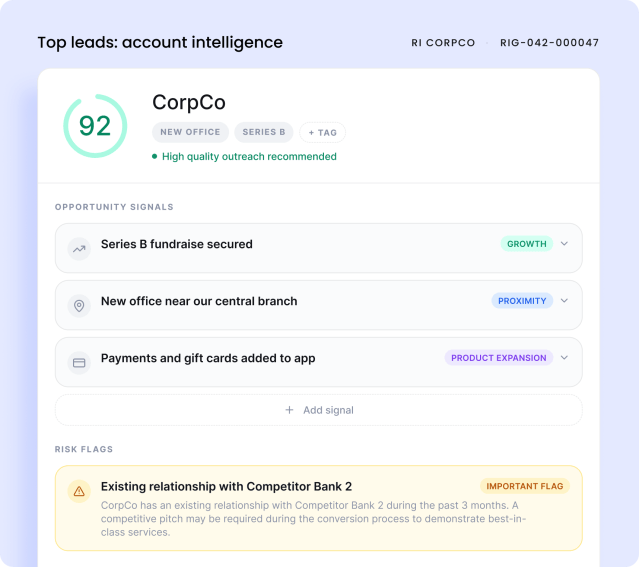
When it’s done, the banker has reduced over 1,000 leads to a tightly scoped top ten opportunities they can go after first.
Agent 3: Get in touch – A personalized approach
With their selected accounts in hand, the banker moves on to outreach. In the past, that meant drafting emails. Today, a communications assistant agent generates personalised, compliant outreach for each target account.
In this third step, an outreach agent helps to generate personalized email copy for contacts at the target account, provides a talk track that calls out specific details about the company’s recent business and news to show a real understanding of the prospect, and even delivers objection handlers for common questions and roadblocks.
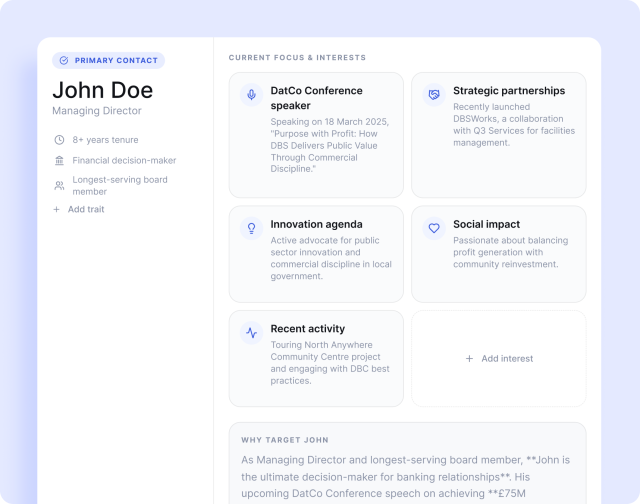
Generic copy from a consumer-grade chatbot won’t pass the smell test. Luckily, the research report from our second agent includes information not just on the business, but on key individuals who are appealing targets for outreach.
In crafting its messaging, the outreach agent uses context from the prospecting and account intelligence agents, plus the bank’s best‑practice examples, tone of voice, and brand/compliance guidelines.
The agent applies these across talk tracks, emails, LinkedIn messages, and letters aligned to the specific prospect and trigger events. The result is faster, higher‑quality outbound communications that feel bespoke rather than generic. Each RM can even train the agent on their own personal voice.
In recent months, we have seen clients use this multi-agent approach to increase the volume of sales calls booked by more than fivefold, leading directly to millions in new business won from competitors, a pace of ROI that would recover the cost of the AI deployment in the span of a few short months.
From personal productivity to organizational change
Where do things go from here? With the bank booking far more meetings and winning new business, it has the enviable problem of needing to open new accounts. In the past, a client would be mailed a 20+-page PDF they needed to print out and complete manually. The result was a lot of user error, with applications abandoned or incomplete. The bank would spend hours working to correct and complete these forms, as erroneous data led to issues with both clients and regulators down the road.
Using WRITER, banks can build an agent that takes the data utilized by the agents we discussed earlier and pre-populates a large portion of the application. Quality control agents can review user input, bringing down error and abandon rates. Saving four to five hours per application across tens of thousands of new applicants per year equates to an entire team’s worth of work saved.
From content factory to brand engine
Webinar | June 30, 12PM ET
More resources

AI agents at work
– 22 min read
Agentic AI for marketing teams: Use cases from content generation to campaign orchestration

Diego Lomanto, CMO
Enterprise transformation
– 15 min read
Stop selling AI efficiency to your CFO. Here’s what finance actually wants to hear
Diego Lomanto, CMO

AI agents at work
– 10 min read
Stop wrestling with Snowflake data: How to automate customer segmentation
Ben Popper