
Enterprise transformation
– 10 min read
Enterprise AI adoption in 2026: Why 79% face challenges despite high investment

WRITER’s 2026 AI adoption in the Enterprise survey, conducted with independent research firm Workplace Intelligence, reveals a defining shift in how executives and employees globally are navigating the biggest technological change in a generation. This marks the second year of tracking the reality of what’s happening inside organizations. We surveyed 1,200 non-technical employees actively using AI at work, as well as 1,200 C-suite executives. Last year’s theme was tension — budgets climbing, pilots multiplying, but progress messy. In 2026, that tension has evolved into something much more consequential: it’s now cultural, organizational, and deeply structural.
The shift toward agentic AI has moved at a pace that’s hard to overstate. Nearly all executives (97%) say their company deployed AI agents in the past year, with 52% of employees already using them. AI usage is deeply embedded across organizations: 70% of employees and 94% of the C-suite use AI tools for at least 30 minutes daily, with 64% of executives spending two hours or more.
Seventy-five percent of executives expect AI agents will be part of their company’s C-suite within the next five years. Additionally, an overwhelming 95% of executives say roles and team structures are changing because of AI.
Despite near-universal belief in AI’s potential, most organizations are struggling to translate adoption into real business value. Executives are facing growing pressure and challenges around AI strategy, productivity expectations, security and governance, and shifting power dynamics.
The 2026 survey findings reveal 79% of organizations face challenges in adopting AI — a double-digit increase from 2025 — with 54% of C-suite executives admitting that adopting AI is tearing their company apart. This is despite the fact that 59% of companies are investing over $1 million annually in AI technology.
Key findings from the 2026 enterprise AI adoption survey
The data reveals five distinct patterns separating organizations achieving transformation from those struggling to scale success beyond individual productivity:
- 97% of executives deployed AI agents in the past year, with 52% of employees already using them
- 75% of executives admit their AI strategy is “more for show” than actual guidance
- 92% of the C-suite are actively cultivating “AI elite” employees, while 60% plan layoffs for non-adopters
- 67% of executives believe their company has already suffered a data breach due to unapproved AI tools
- Only 29% see significant ROI from generative AI, despite individual productivity gains of 5X

These findings expose the gap between AI deployment and genuine transformation.
AI adoption is widespread in 2026 — but five critical failure modes hold organizations back
The survey reveals five distinct patterns that are preventing organizations from successfully adopting AI at scale:
Strategy without substance. Three-quarters of executives (75%) admit their company’s AI strategy is “more for show” than actual internal guidance. With 39% lacking any formal plan to drive revenue from AI tools and 48% calling adoption a “massive disappointment”, the gap between strategy documents and business outcomes has never been wider.
The two-tiered workplace. Ninety-two percent of the C-suite are actively cultivating a new class of “AI elite” employees, while 60% plan to lay off those who can’t or won’t adopt AI. This divide is widening: AI super-users were 3X more likely to get a raise or promotion last year and 5X more productive than those slow to adopt.
The trust and resistance cycle. When strategy fails, trust breaks down. Twenty-nine percent of employees (and 44% of Gen Z) admit to sabotaging their company’s AI strategy, while 73% of CEOs report stress or anxiety from AI, and 64% fear losing their jobs over AI transition failures.
Security and governance gaps. Sixty-seven percent of executives believe their company has already suffered a data leak or breach due to unapproved AI tools, while 36% lack any formal plan for supervising AI agents. Thirty-five percent admit they couldn’t immediately “pull the plug” on a rogue agent.
The productivity-to-ROI disconnect. AI super-users deliver 5X productivity gains, yet only 29% of organizations see significant ROI from generative AI and 23% from AI agents. The gap between individual wins and organizational outcomes reveals what’s missing: structural transformation, not just tool deployment.
The following sections examine each failure mode in detail — and the path forward for organizations ready to move beyond performance art to genuine transformation.
Get the complete analysis of all 10 challenges facing enterprises
Download the Full 2026 Survey Report
Strategy without substance: When AI plans are just performance art
The pressure on executives has created a crisis of performative strategy. Seventy-three percent of CEOs report stress or anxiety about their company’s AI strategy, with 38% experiencing high or crippling stress levels. Nearly two-thirds (64%) fear they could lose their job if they fail to lead the AI transition.
Under this pressure, three-quarters of executives (75%) admit their company’s AI strategy is “more for show” than actual internal guidance. Nearly half (48%) call AI adoption a massive disappointment — up from 34% last year. Few report significant ROI from generative AI (29%) or AI agents (23%).
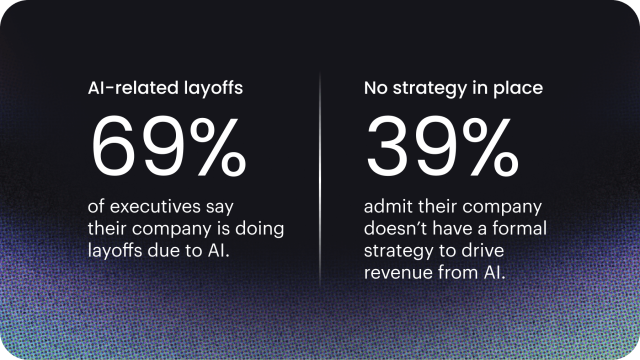
Faced with disappointing results, 69% of companies are planning layoffs due to AI, yet 39% don’t even have a formal strategy to drive revenue from these tools. Layoffs become a symptom of strategic failure, not evidence of transformation.
“Layoffs are not a viable AI strategy,” said May Habib, CEO and co-founder of WRITER. “The leaders who are putting in the work to radically redesign operations with human-agent collaboration at the center are the ones compounding their advantage in ways competitors can’t replicate. AI transformation is ultimately about people, and the future belongs to the companies putting agent-building power directly into the hands of people closest to the work.”
Read the detailed strategies organizations use to move from performative AI to measurable outcomes.
Download the full report
The two-tiered workplace crisis: When strategy gaps create class divides
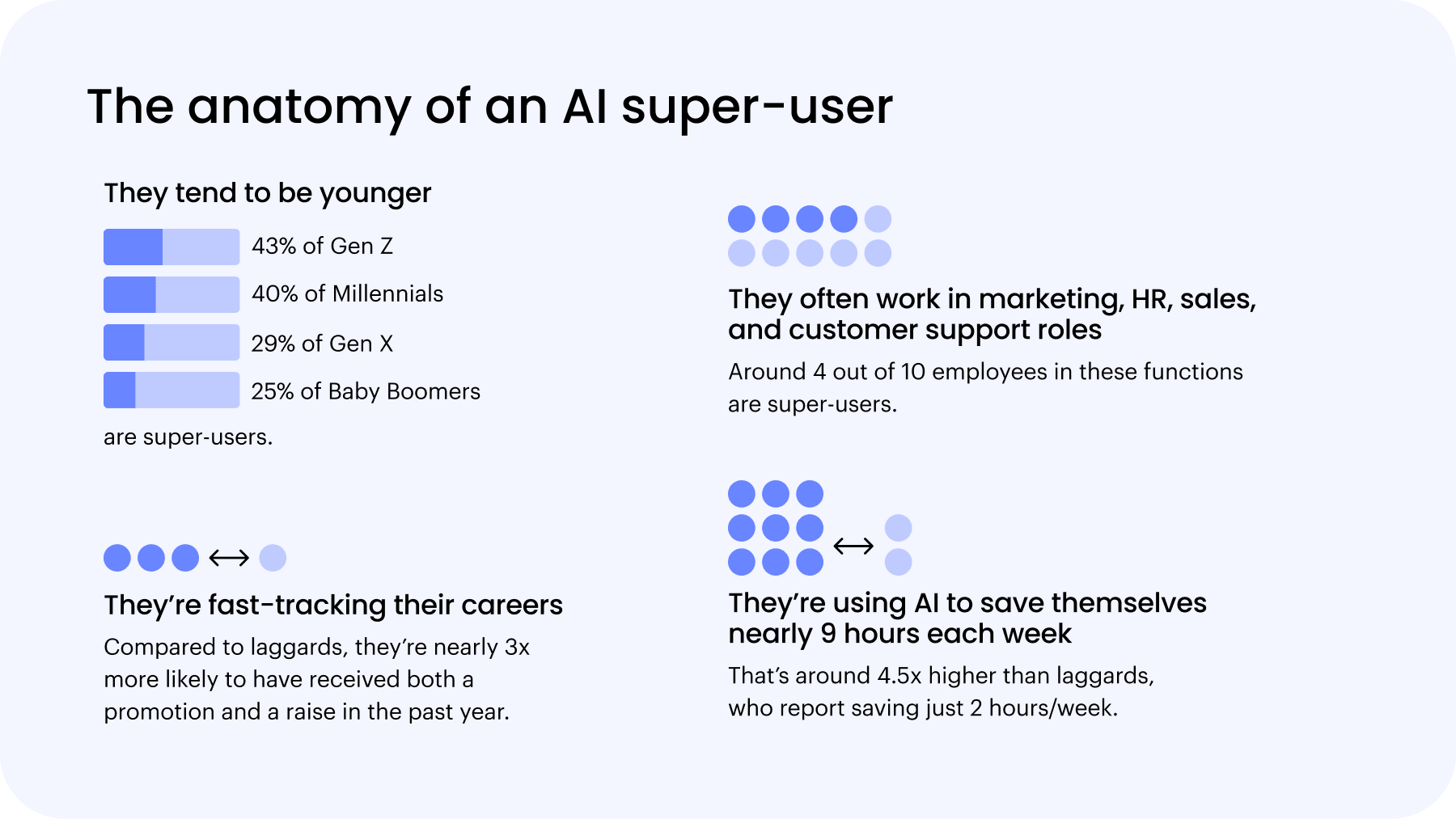
Ninety-two percent of the C-suite admit they’re actively cultivating a new class of “AI elite” employees. Most leaders (87%) report that these AI super-users are at least 5X more productive than employees who aren’t embracing AI. AI super-users save nearly 9 hours per week — 4.5X more than the 2 hours a week reported by AI laggards.
The rewards follow the performance. AI super-users were 3X more likely to have received both a promotion and a pay raise in the past year.
“This is a defining moment in AI adoption, and the gap between super-users and laggards is widening fast,” said Dan Schawbel, managing partner at Workplace Intelligence. “We’re already seeing this play out.”
Without strategic foundation, organizations make desperate binary choices. Seventy-seven percent of executives warn that employees who refuse to become AI-proficient won’t be considered for promotions or leadership roles.
The divide reshapes work itself. Ninety percent say the rise of AI super-users will require them to completely rethink how they evaluate performance.
Build capability, not divides
Read how leading organizations develop AI skills across their workforce.
Download the report
The trust and resistance cycle: When strategic failure breeds sabotage
When performative strategies fail to deliver, trust breaks down. Twenty-nine percent of employees admit to sabotaging their company’s AI strategy, with that figure jumping to 44% among Gen Z. Executives recognize the threat — 76% say employee sabotage poses a serious threat to their company’s future.
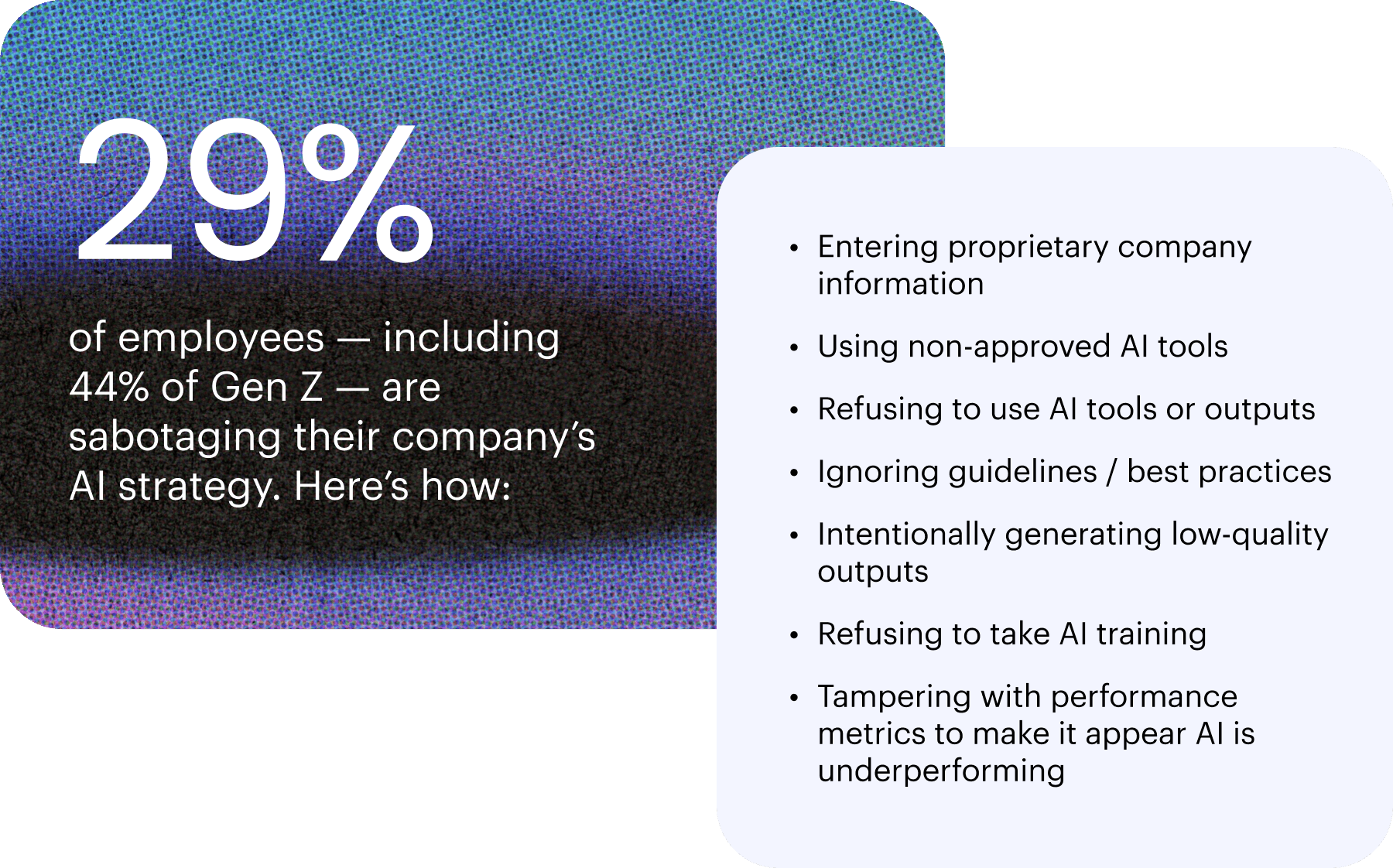
The trust breakdown extends beyond management structures. Eighty percent of Gen Z trust AI more than their manager for certain work tasks. Only 35% of employees say their manager is an AI champion. When managers can’t guide AI adoption, and executives resort to threats rather than transformation, employee resistance becomes the rational response.
Break the trust-resistance cycle – See the transparency and inclusion strategies that reduce employee resistance
Download the report
Security and governance gaps: The cost of moving fast without guardrails
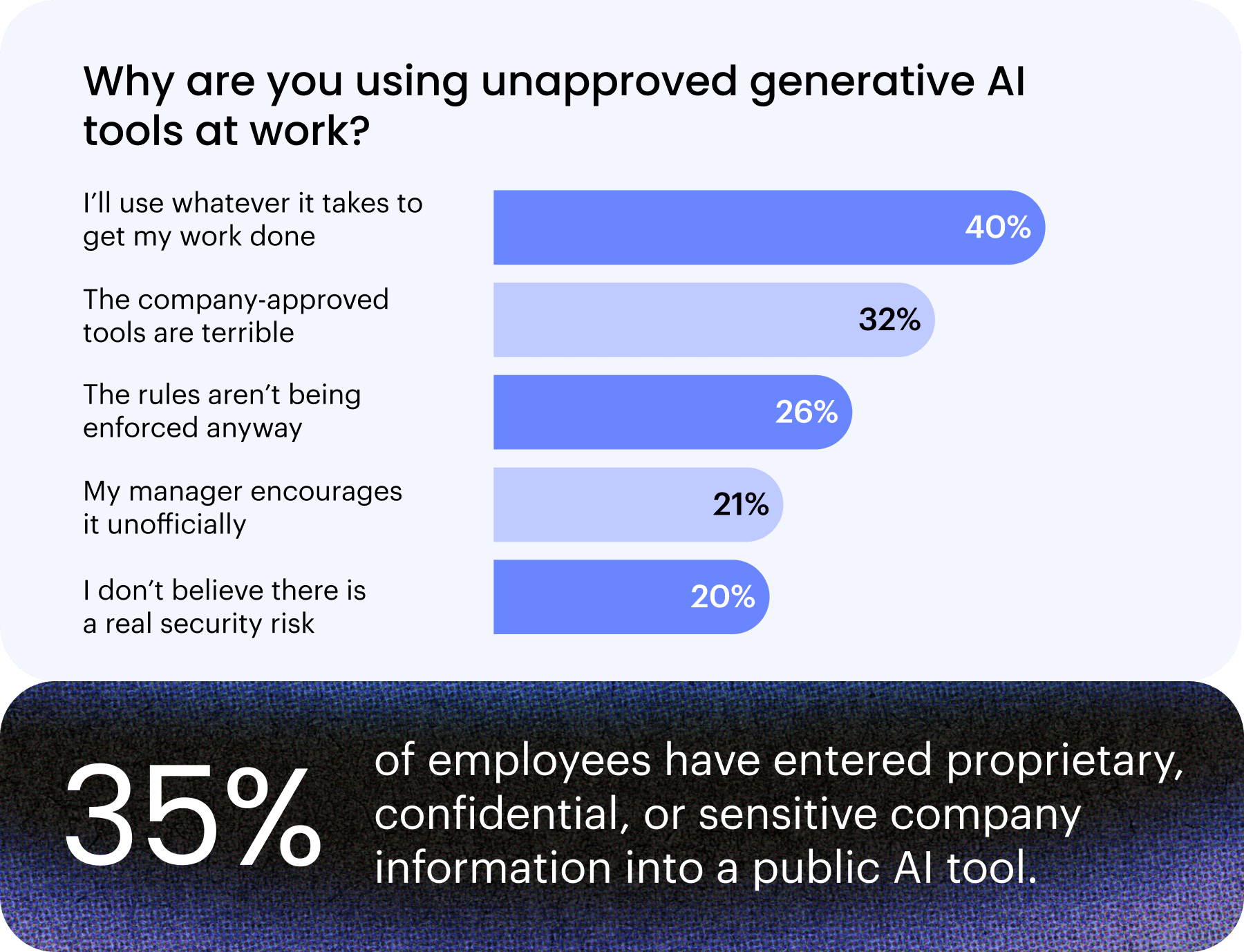
The rush to demonstrate AI leadership has created a dangerous governance vacuum. Sixty-seven percent of executives believe their company has already suffered a data leak or security breach because of an employee using an unapproved AI tool. Satisfaction with security and data governance in vendors has dropped 17 points since last year.
The breach risks are concrete. Thirty-five percent of employees have entered proprietary information into public AI tools. Thirty-six percent of companies don’t have a formal plan for supervising AI agents. More than a third (35%) admit they couldn’t immediately “pull the plug” on a rogue AI agent.
The governance gap reflects organizational chaos. Fifty-five percent describe AI use as a “chaotic free-for-all” at their company. Seventy-nine percent say AI applications are being created in silos. When every department deploys AI tools independently, the organization’s attack surface expands exponentially.
The board recognizes the danger — 60% of executives say their board will likely intervene because of a botched AI strategy. Fifty-eight percent admit many fellow leaders lack fundamental knowledge to make strategic decisions about AI. Over half (53%) feel IT teams aren’t delivering real value with generative AI, and cite growing tension between IT and other lines of business. This disconnect between IT and business leadership creates further governance gaps.
Secure your AI deployment – Read the governance approaches organizations use to prevent breaches and maintain control
Download the report
The infrastructure of AI transformation: Why super-user success isn’t enough
As demonstrated by the new class of AI super-users, the individual productivity gains are undeniable. Yet only 29% of organizations see significant ROI from generative AI, and just 23% from AI agents. This stunning disconnect reveals the central paradox — individual wins are real and measurable, but they’re not translating to business value.
“The top AI users are gaining huge amounts of leverage inside organizations,” said Mina Alghaband, chief customer officer at WRITER. “To turn these individual productivity gains into real business ROI, copilots aren’t enough. Companies need enterprise AI platforms that support deeper structural change.”
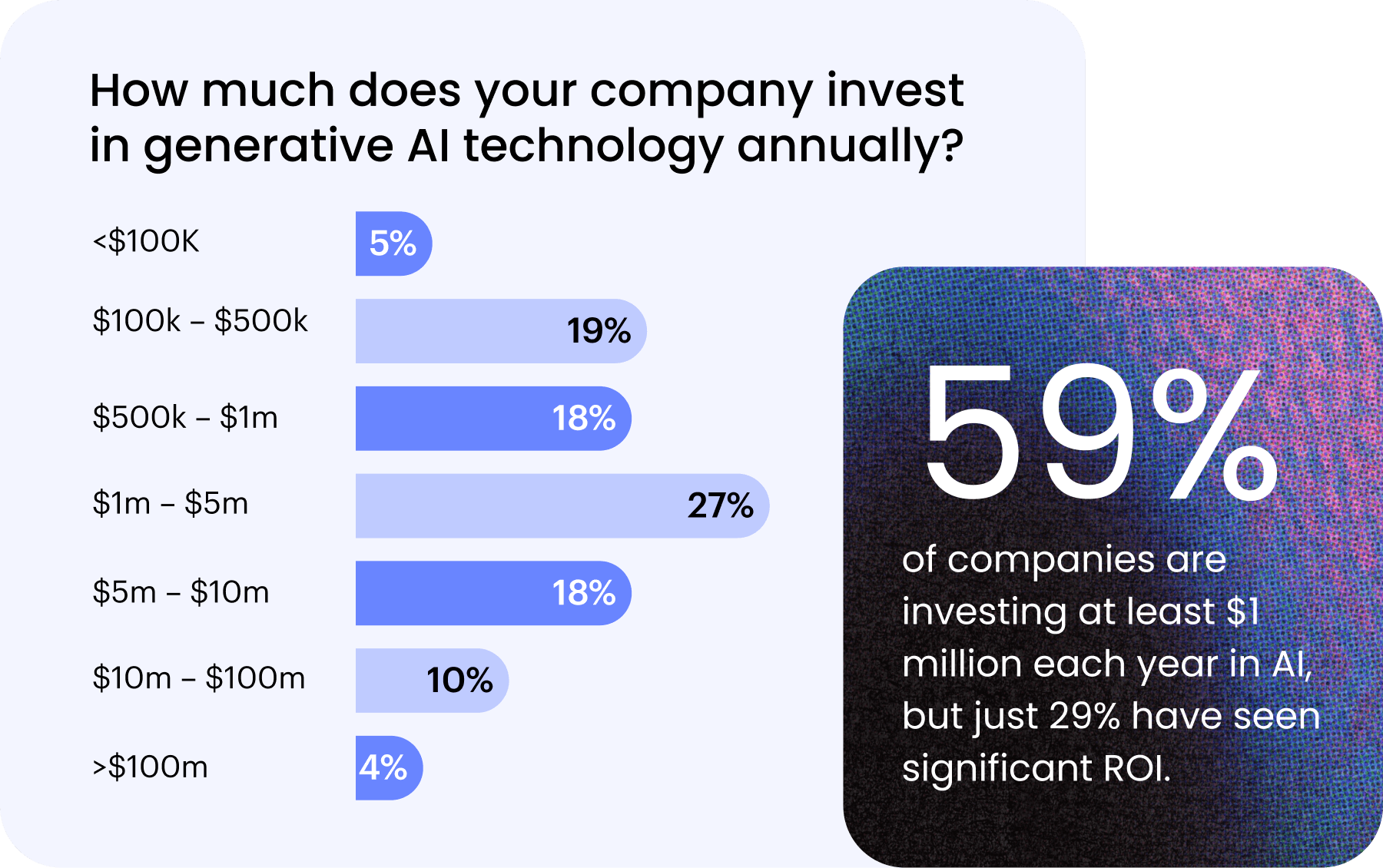
What separates the 29% of companies seeing ROI from the majority? They share four distinct characteristics. They tie AI directly to revenue outcomes. They architect platforms that give business teams autonomy while IT retains oversight. They implement governance before they scale. And they treat AI adoption as organizational redesign, not just a technology rollout.
Most enterprises are working against at least one of these. They’ve either locked AI inside technical teams, creating bottlenecks that starve adoption, or opened the floodgates to shadow AI that IT can’t govern. What connects all four characteristics is a structural requirement most organizations haven’t met — business teams need direct ownership of AI workflows, and IT needs centralized control over how those workflows operate.
WRITER was built around that requirement. Companies using WRITER see an average 333% ROI with a payback period of six months, according to a Forrester Total Economic Impact™ study. These organizations faced the same five failure modes. They built the systems to turn individual wins into enterprise-wide returns.
Turn productivity Into ROI – See the four characteristics that separate organizations achieving returns from those reporting disappointment
Download the report
From individual wins to organizational impact: What separates leaders from laggards
The 2026 survey captures a pivotal moment. AI deployment is nearly universal, individual productivity gains are real, and super users are proving what’s possible. But translating those wins into organization-wide outcomes remains the central challenge.
The five failure modes documented here don’t stem from a lack of AI talent or enthusiasm. They stem from the absence of systems designed to scale what’s working. Organizations have super-users delivering extraordinary results, but no mechanisms to spread those practices enterprise-wide. Individual productivity gains are real, but nothing connects them to business outcomes.
“AI transformation is ultimately about people, and the future belongs to the companies putting agent-building power directly into the hands of people closest to the work,” said May Habib, CEO and co-founder of WRITER. The organizations winning aren’t suppressing individual initiative — they’re building the systems to amplify it: outcome accountability, governance frameworks that precede scale, and platforms where business teams own their AI workflows while IT maintains oversight.
The question for every enterprise leader in 2026 isn’t whether AI creates value at the individual level. It does. The question is whether your organization has the systems to compound it. When 97% of executives report benefiting from AI but only 29% see significant organizational ROI, the bridge to success isn’t just built with the right technology. It’s also made up of strategic foundation, supportive technology partners, governance design, and systematic change management.
Download the complete 2026 survey report
Download the report
Get the full research findings and strategic recommendations:
- Detailed analysis of all 10 enterprise AI challenges
- Complete survey data across 2,400 executives and employees
- Strategic guidance for overcoming each failure mode
- Best practices from organizations achieving ROI
- Recommendations for governance, change management, and platform selection
More resources
Enterprise transformation
– 9 min read
Key Findings from the Forrester Total Economic Impact™ study on WRITER
Writer Team

Enterprise transformation
– 7 min read
The Agentic Compact: The trust blueprint for the human-agent enterprise

May Habib