
AI agents at work
– 17 min read
The five pillars of AI-native marketing: Why focusing on productivity alone isn’t enough


The AI industry is exploding from $45 billion toward $1.1 trillion by 2028. Every enterprise marketing team is being told to “adopt AI” and “transform digitally.” Most are responding the same way: using AI chatbots to try and work faster.
They’re generating more content. Flooding more channels. Optimizing for more keywords. Moving from insight to execution in days instead of weeks.
Here’s the problem: when everyone has access to the same AI tools, productivity gains alone don’t create competitive advantage. They create a race to the bottom.
When everyone can produce infinite content, volume becomes worthless. Quality without differentiation becomes noise. Speed without strategy becomes expensive mediocrity at scale.
The teams that win in the AI era understand something different: productivity can scale with AI tools, but without quality, the impact can be negligible to harmful.
- Most marketing teams are stuck in the productivity trap, using AI to work faster on the same tasks while competitors use it to fundamentally redesign how marketing gets done. The shift from traditional AI adoption to AI-native operations separates efficiency gains from strategic differentiation.
- The five-pillar framework organizes into two categories: productivity pillars (speed and scale) create the foundation, while differentiation pillars (humanity, high-touch relationships, and consistency) build the competitive moat. Without both, teams become faster commodity producers rather than strategic partners.
- Speed isn’t just velocity — it closes the gap between insight and action. Scale multiplies impact by reaching new markets and creating impossible levels of personalization. Together, they free 80% of tactical work so teams can focus on the 20% that’s strategic and inspired.
- Humanity keeps creativity at the center by empowering AI agents to handle repetitive work while humans drive strategy. High-touch doesn’t mean high volume—it means every interaction is rich with insights and genuine connection. Consistency delivers on-brand, contextually relevant experiences across all touchpoints.
- The framework shows why productivity alone won’t save you and what the alternative looks like. Pair it with the companion implementation guide to move from AI experimentation to AI-native operations, where productivity compounds into differentiation instead of just making you a faster commodity producer.

What is AI-native marketing?
AI-native marketing means rewiring your entire operating model, not just adding tools to your stack. It’s the difference between using AI to do your current job faster and redesigning how marketing work fundamentally gets done.
The distinction matters:
Traditional AI adoption looks like this: You add ChatGPT to your workflow. You use it to draft emails faster, outline blog posts quicker, generate social captions more efficiently. Your process stays the same—you just have a productivity helper.
AI-native marketing looks like this: You use AI agents to handle complete workflows end-to-end. The agent researches, drafts, generates channel variants, and queues everything for review. Your role shifts from executor to orchestrator. You’re not doing tasks faster—you’re directing an AI-powered system that does the tasks while you focus on strategy.
Traditional vs. AI-native:
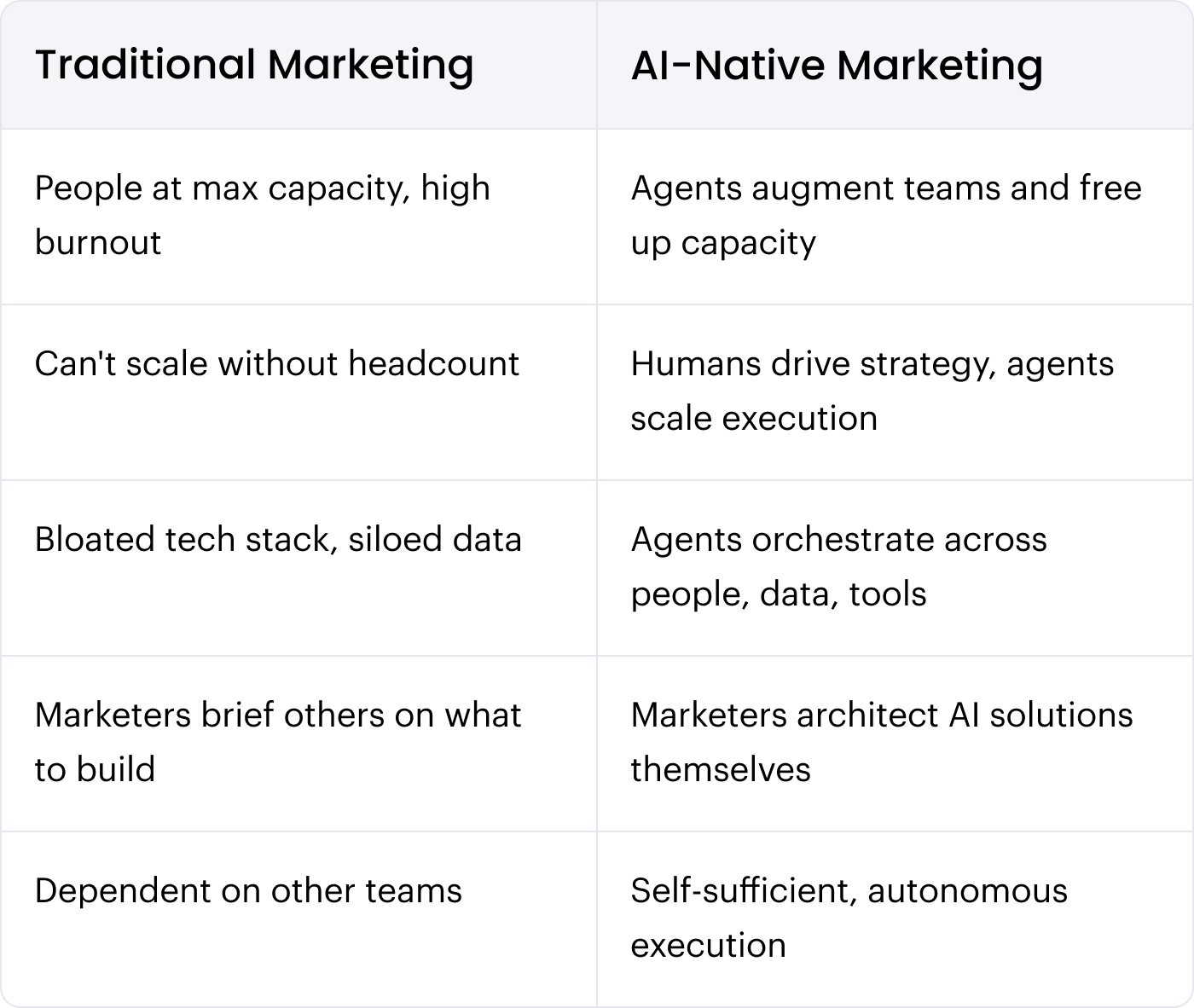
At the heart is a simple equation: Productivity → Differentiation. Use AI to reclaim time, then reinvest in creativity and strategy. Use your resources to build deeper customer relationships through high-touch engagement. Free people up to invent the spark that is your brand and maintain a consistent brand voice while achieving massive scale. Focus on trust and authenticity, not just volume.
This is what the five-pillar framework operationalizes.
The framework: Five pillars in two categories
The five pillars organize into two categories that create a virtuous cycle:
Productivity pillars (The foundation)
- Speed — Remove friction from every workflow
- Scale — Multiply impact without adding headcount
Differentiation pillars (the competitive moat)
- Humanity — Keep creativity at the center
- High-Touch — Build relationships that compound
- Consistency — Deliver on-brand, relevant, contextual experiences
The core insight: Productivity gains from speed and scale create capacity. That capacity gets deliberately reinvested into the differentiation pillars — humanity, high-touch engagement, and consistency.
Your competitors can copy your AI tools. They can’t copy 18 months of compounding effects from your integrated system.
Let’s break down how each pillar works.
Pillar 1: Speed — Remove drag from every part of the engine
Speed isn’t just about working faster. It’s about closing the gap between insight and action, between inspiration and execution, between opportunity and response.
When teams move faster, they’re not just more efficient. They’re more relevant, more agile, and better positioned to lead conversations in their market instead of reacting to them.
How Speed Works:
- Eliminates handoffs and bottlenecks across teams and tools
- Coordinates workflows end-to-end with no waiting
- Compresses production timelines from weeks to hours or days
- Helps marketers write first drafts faster
Real example: KPMG research assistant
A KPMG stakeholder needed to write an article for a major publication on Wednesday morning. He asked his team member to pull KPMG studies and synthesize the findings.
Traditional process: Eight hours of manual research across databases, reading materials, extracting insights, organizing findings, fact-checking. Full working day consumed. Limited time for strategic client advisory work.
AI-powered process: one hour. The AI agent searches all knowledge bases simultaneously, analyzes data, identifies patterns, creates an initial summary with sources. The consultant reviews, adds strategic context and client insights, and prepares the talking points, completing the research in 60 minutes. Seven hours freed for high-value client advisory work.
Once researched, AI can help you write that first draft in minutes instead of hours.
The stakeholder had cleared his calendar expecting an all-day project. Instead, he had a complete, sourced draft within sixty minutes.
The strategic value: The time AI saves are hours your team can reinvest in creative work that sets your brand apart. When a research project collapses from 8 hours to 1 hour, that’s 7 hours returned to strategic thinking, relationship building, or crafting the kind of story that no AI can replicate.
Speed also means relevance. Markets move quickly. When you can move from insight to execution in hours instead of days, you stay ahead of the conversation instead of reacting to it.

How KPMG accelerates time to market and empowers people with AI and WRITER
watch now
Pillar 2: Scale — Reach more markets and channels without more headcount
Speed gets you there faster. Scale multiplies your impact. This isn’t just about doing more—it’s about reaching new markets, creating levels of personalization that were impossible before, and replicating excellence across your entire operation.
How Scale Works:
- Replicates workflows across audiences and channels systematically
- Orchestrates more activity without adding headcount or agency spend
- Preserves quality through consistent logic and feedback loops
Real example: American Eagle’s content multiplication
Craig Brommers, CMO of American Eagle, puts the scale challenge in stark terms. Twenty years ago at Calvin Klein, a campaign meant six beautiful pictures, a Soho billboard, a double-page spread in Vogue, and you were done.
Today at American Eagle? They produce at least 500 pieces of content per week and a major social platform just told them that will need to increase by 500% in the coming months if they want to stay at the top of your feed.
They also have 34,000 SKUs live on their website at any given time. For years, human beings manually wrote product descriptions for every single one.
Traditional Model:
- High-production photoshoot creates 6 beautiful hero images.
- Creative team manually adapts for a few key channels.
- Most markets get generic or outdated content.
- The creative team becomes the bottleneck.
AI-Powered Model: Same photoshoot, but AI agents automatically generate variants optimized for every channel—Instagram stories, TikTok, Pinterest, email campaigns, website banners, paid ads, retail displays. AI adapts content for regional markets, local campaigns, seasonal promotions, all maintaining brand consistency. Creative team reviews and approves variants, focuses on strategic campaigns and breakthrough creative work.
The result: 83x content multiplication, growing from six photoshoot images to 500+ weekly content pieces reaching every channel, every market, every campaign.
The Jorts campaign: Scale enables creativity
When American Eagle launched their Jorts campaign — digitally putting jean shorts on the Statue of Liberty and other famous landmarks, targeting key markets worldwide — the campaign was so obviously tech-enabled and pushed such creative boundaries that it cut through all the noise.

Search for “AE Jorts” on their site was up 250% in the week after launch.
This campaign worked because AI handled the routine 500 pieces of weekly content. That freed the creative team to conceive, design, and execute a campaign that no competitor could match.
The genius of replication: Once you build a successful process—like localizing a campaign for a new market—an agent can run that exact playbook again and again for any market, any product, any audience. The hundredth execution is as precise as the first. The process stays consistent. The brand remains intact.

From denim to data: American Eagle’s seamless transition into
AI-powered retail
watch now
Pillar 3: Humanity — Keep creativity and connection at the center
Now we move from productivity pillars to differentiation pillars. And the first might surprise you: in an AI world, we need more human creativity, not less.
The 80/20 Principle: By empowering AI agents to take on the 80% of work that’s repetitive and tactical, we free up our team’s creative energy to focus on the 20% that is strategic and inspired. This is where transformative business impact happens: breakthrough campaigns that drive brand differentiation, strategic insights that shape market positioning, deep customer relationships that compound over time.
How Humanity Works:
- AI handles creative assistance, drudge work, prep, formatting, QA
- Humans focus on high-value creative tasks, strategic thinking, breakthrough campaigns
Real example: New American Funding’s mission-driven marketing
New American Funding’s mission is to define a path to homeownership for everyone, including previously underrepresented and diverse communities. That mission requires deep human connection, cultural understanding, and creative problem solving, not just operational efficiency.
When NAF adopted WRITER AI agents, they didn’t just speed up content production. They eliminated hours of manual compliance work that had been crushing their team’s creative capacity.
But here’s what matters: what did they do with those reclaimed hours?
“We’re able to focus more on our mission,” says CMO Andrew Strickman. “AI handles the mechanical work—the compliance checks, the template population, the routine updates. That frees our team to spend more time understanding our customers’ dreams of homeownership, crafting messages that resonate with diverse communities, and building relationships that help first-time buyers navigate one of the biggest decisions of their lives.”
The creative breakthrough: “Hell Yeah You’re Buying A Home”
With capacity for strategic creative work, NAF launched “Hell Yeah You’re Buying A Home”—a bold, emotionally resonant campaign that captured the joy and affirmation of homeownership in a way that cut through the typically staid mortgage industry messaging.

This wasn’t safe, corporate marketing. It was authentic, energetic, and deeply aligned with NAF’s mission to make homeownership accessible and celebratory for diverse communities.
The AI multiplier effect: Once the creative team developed this breakthrough concept, they used WRITER to adapt the campaign voice for different channels, maintain the energetic tone while ensuring compliance, and scale the campaign theme across diverse customer touchpoints — keeping the message consistent whether someone encountered it on Instagram or in a mortgage application email.
This is the 80/20 principle in full expression: AI handles compliance and coordination so humans can create campaigns that move the business. Then AI amplifies that creative breakthrough at scale.

How New American Funding supports its mission to democratize
home ownership with generative AI
Check out the full story
Pillar 4: High-Touch — Build relationships that compound over time
High-touch doesn’t mean high volume. It means high value. Every interaction should be rich with insights, opportunities to learn, and genuine connection.
How High-Touch Works:
- Personal relationships are your moat
- AI handles research, preparation, personalization at scale, follow-up coordination
- Humans focus on strategic conversations, relationship building, trust development
Real example: WRITER’s field marketing events
At WRITER, our events team faced a familiar challenge: burning out while trying to keep pace with growth and demand. We could only focus on one event at a time. Strategic planning suffered. Personalization was impossible at scale.
Our team now works alongside AI agents to fast-track project management, develop campaigns, brainstorm activations, synthesize data, and handle follow-up communications. We even have agents to track swag deliveries en route and coordinate schedules to keep our booths staffed.
The AI handles the coordination. Our humans focus on what they do best.


The bilateral meeting advantage
Our events include dozens of bilateral meetings — one-on-one executive conversations happening between sessions or in dedicated suites.
At Cannes, we might have 30+ meetings scheduled over three days. At AI Leaders Forum, executives are squeezing in meetings with sales reps between keynotes.
Here’s where AI-human collaboration creates real value: The event marketing team uses AI agents to generate personalized “Look Books” for every bilateral meeting. Before a sales rep sits down with a prospect, they have a brief ready:
- The prospect’s recent company news
- Their business priorities
- Pain points from previous interactions
- Relevant case studies
- Suggested talking points
The sales rep walks into that meeting armed with context and insights — not generic pitches. They spend precious face time building relationships and solving problems, not asking basic discovery questions they could have researched.
The conversation is genuinely valuable from minute one.
The business impact: Field marketing events now generate 150% increase in deal size and influence 80% of pipeline. Every touchpoint is deeply personalized and genuinely valuable.
The AI does the coordination. The humans do the connection.
Pillar 5: Consistency — Deliver context-appropriate content while maintaining brand DNA
Brand consistency isn’t about rigidity. It’s about strategic adaptation: showing up with the same essence while speaking the language of each audience and context.
Your executive briefing for the CFO should feel more strategic than your product tutorial for practitioners. Your LinkedIn thought leadership should sound more authoritative than your Instagram content. Your pitch to automotive partners should emphasize different value propositions than your pitch to healthcare partners.
But all of it should be unmistakably you.
Real Example: Qualcomm’s Snapdragon voice
Qualcomm faces an amplified version of this challenge with Snapdragon — building it into a distinct consumer brand in the competitive chip market, separate from parent company Qualcomm, with its own personality and positioning.
The Complexity: Snapdragon appears in smartphones, gaming devices, laptops, automotive systems, and XR headsets. The brand sponsors Formula 1 and Coachella. Content targets gamers, car enthusiasts, mobile users, and developers—each expecting the brand to speak their language.
The brand consistency challenge: The brand essence is consistent: “driven” and “joyful.” But how that shows up must adapt radically:
- Formula 1 activations speak differently than gaming content
- Automotive partner materials emphasize different capabilities than XR developer docs
- A Coachella social post sounds different than a smartphone manufacturer spec sheet
Before AI agents, this required massive manual effort. Every variant needed brand-level review. The team couldn’t keep up.
The solution: The marketing team built an AI agent that understands the Snapdragon voice.
The copy leader describes the transformation: “We have an AI agent that allows users to rewrite standard copy with the Snapdragon voice in seconds. We have such a large volume of marketing assets that require brand-level review, and it’s become almost a pressure relief valve in that I’m able to get to the ideation quicker, get through more content faster and more efficiently.”
How it works:
- For gaming content, the AI emphasizes performance and immersive experiences
- For automotive, innovation and reliability
- For consumer smartphones, it balances technical capability with emotional aspiration
Each version sounds distinctly Snapdragon while speaking its audience’s language.
The result isn’t just efficiency — it’s better brand building. Snapdragon shows up consistently across hundreds of touchpoints, each contextually right, each building recognition and differentiation.

How Qualcomm increases employee productivity and satisfaction with WRITER
Get more of the story
How the five pillars interconnect
These five pillars aren’t isolated tactics. They’re an interconnected system where each pillar reinforces and amplifies the others.
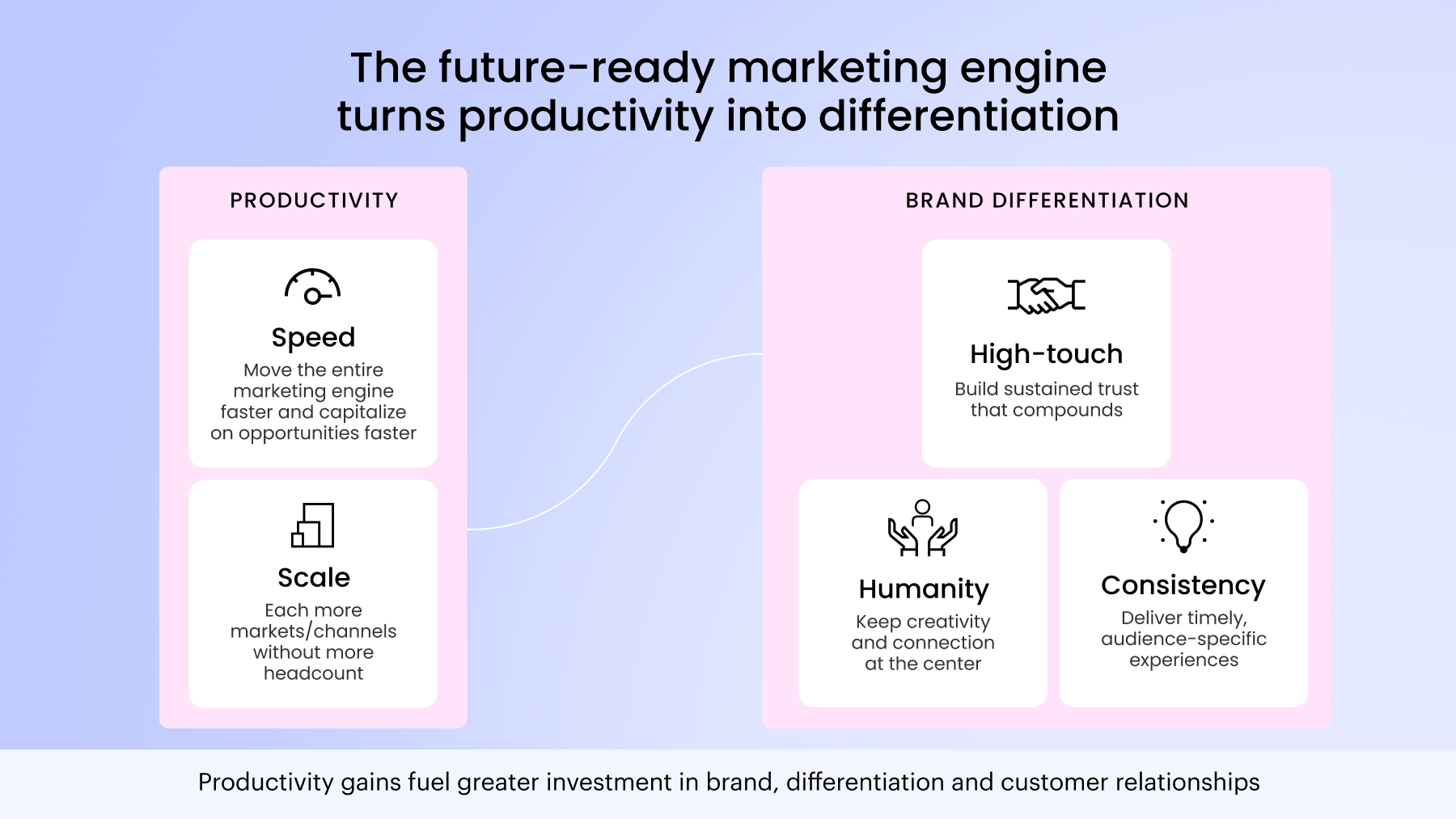
The reinforcement cycle:
Speed enables Scale: When you can move from insight to execution in hours instead of days, you can replicate successful workflows across markets, products, and audiences much faster.
Scale creates space for Humanity: When AI agents can handle 500+ pieces of routine content weekly, your creative team has bandwidth to focus on breakthrough campaigns like American Eagle’s Jorts.
Humanity drives High-Touch: When your team is freed from tactical work, they can invest in the relationship-building activities that create lasting customer connections.
High-Touch informs Consistency: Deep customer relationships give you insights into what truly matters to your audience, which feeds back into more relevant AI-powered content.
Consistency multiplies Speed and Scale: When your AI agents are trained on your unique brand and customer insights, they can produce relevant content at significant speed and scale.
This creates powerful feedback loops. As you get better at each pillar, the entire system becomes stronger. A team achieving 2x productivity in month one might be at 5x by month six — not through working harder, but through the compounding returns of the integrated system.
The value equation
Here’s what makes this framework different from “AI best practices” or “productivity hacks”:
Productivity gains from speed and scale create capacity. That capacity gets deliberately reinvested into what creates lasting competitive advantage: humanity, high-touch relationships, and relevance.
This is how you avoid the race to the bottom. Your competitors can copy your AI tools. They can adopt the same models, use similar prompts, automate comparable workflows.
What they can’t copy:
- The creative breakthrough campaigns your team conceived because they had capacity
- The deep customer relationships your team built because they had time
- The brand consistency you’ve encoded into organizational intelligence over 18 months
- The compounding effects of productivity feeding differentiation in a continuous cycle
This creates a moat that deepens over time. The longer you operate with this integrated system, the harder it becomes for competitors to catch up—not because they lack access to AI, but because they lack the accumulated intelligence, the relationship depth, and the creative differentiation your system has been compounding.
What’s required to make this work
The five-pillar framework isn’t plug-and-play. It requires:
Strategic clarity: You must decide what differentiates your brand and deliberately invest productivity gains there. This is a strategic choice, not an automatic outcome of using AI tools.
Organizational commitment: The productivity → differentiation equation only works if you actually reinvest the gains. That requires leadership commitment to protect creative capacity, invest in relationship building, and maintain brand integrity even when volume is possible.
The right infrastructure: You need AI agents that can execute workflows end-to-end (not just assist), integrated with your systems (not siloed tools), and governed appropriately (so autonomy can safely expand). This is where platform choice becomes strategic.
Measurement discipline: Track both productivity metrics (time saved, output velocity) AND differentiation metrics (creative campaign velocity, engagement lift, brand consistency). The system only works when you measure the complete cycle.

A correction is coming to the AI market. Are you ready?
Learn More
From framework to execution
The five-pillar framework provides the strategic vision for AI-native marketing. It shows you WHY productivity alone won’t save you and WHAT the alternative looks like.
But vision without execution is just theory.
That’s why we created a companion guide: “From pilots to performance: How enterprise marketers scale AI and prove ROI“. It takes this framework and shows you exactly HOW to implement it:
- The Impact × Frequency Matrix for choosing which workflows to build first
- The six mistakes keeping marketing teams stuck in pilot purgatory
- The 12 agent systems (The Dirty Dozen) working in production at enterprises right now
- The rollout playbook for scaling from 5 to 50+ users in 8-12 weeks
- The measurement approach that tracks both productivity and differentiation
- The platform evaluation criteria that separate capability claims from reality
The framework is your strategic vision. The guide is your implementation playbook.

From pilots to performance: The AI native marketing guide for marketing leaders
Download the complete guide
If you’re ready to move from AI experimentation to AI-native operations — where productivity compounds into differentiation instead of just making you a faster commodity producer — the framework and the playbook together will show you the path.
Your competitors are using AI in a race to the bottom. Now you know how to race to the top.
From pilots to performance
How enterprise marketers scale AI and prove ROI
The 12 marketing agent systems driving real ROI at leading enterprises
See moreMore resources

AI agents at work
– 17 min read
How to build an AI-native marketing engine: The platform capabilities that make it possible
Diego Lomanto, CMO
AI agents at work
– 9 min read
Webinar recap: The agentic marketer playbook — a new playbook for the AI-powered team

Writer Team

AI agents at work
– 6 min read
As AI content creation explodes, invest in trust and differentiation
Diego Lomanto, CMO