
Humans in the loop
– 6 min read
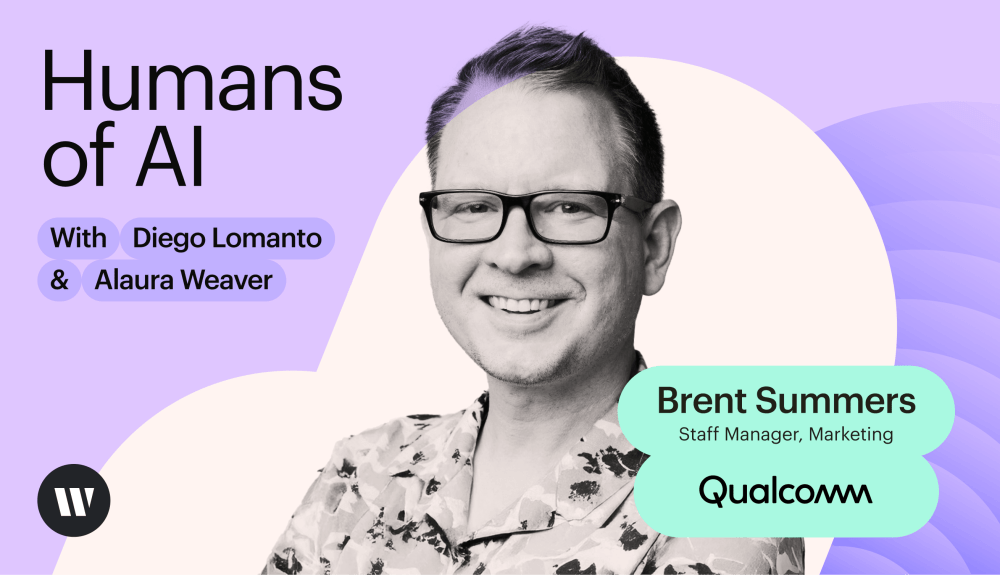
Brent Summers of Qualcomm Technologies, Inc. on moving AI from magic to muscle — and what gets lost in between

Most enterprise AI transformations follow the same arc. There’s a magical moment — the first time the agent actually works, the first account research report that would have taken three hours and now takes three minutes, the first draft that’s actually good. Leadership gets excited. Champions get nominated. Pilots get greenlit. And then, somewhere between that first magical moment and actual organizational change, things stall.
Brent is the head of AI platforms and GTM innovation at Qualcomm Technologies — a company that has invested $110 billion in R&D and holds 200,000 patents. He joined us on Humans of AI to talk about what it actually takes to move a marketing organization from AI curiosity to AI capability.
Why the magic moment is a trap
When AI feels like magic, it implies that it just works — that no further investment is required. No behavior change, no new habits, no organizational redesign. Just prompt and receive. That framing, Brent argues, is exactly why so many AI deployments plateau.
“For AI to really deliver productivity gains, or to help transform an organization, there are reps and sets required,” he told us. “You have to teach people prompting techniques — when is it appropriate to delegate to AI versus collaborate with AI. And that looks like muscle — trying and practicing and honing and going back to the gym. The digital gym.”
At Qualcomm, the shift from magic to muscle has meant redesigning workflows from the inside out, not bolting AI on top of existing processes. Brent’s team runs a people-led, AI-powered ABM program where account research — previously two to three hours of manual Google and LinkedIn searching — now flows through a deep research agent that delivers a complete competitive brief in minutes. A territory sales manager kicks off the request and owns the relationship. The agent does the three hours of research in between.
But the workflow is only part of it. The harder work is the change management. “There are still a few skeptics,” Brent said. “People who had a negative early interaction, bounced out of a platform, and now have renewed skepticism. Managing that — that’s the play for a while longer.”
His single most important structural advice for leaders still stuck in experimentation mode: stop managing AI transformation by committee.
“Nominate someone to own the business case and the outcome. If you don’t assign a responsible individual, that initiative is not likely to be propelled forward.” And if you’ve been running pilots for three years without meaningful results? “Maybe you need to examine your assumptions about the way work has to get done — because AI has more value when it’s designed into a workflow, not simply bolted on top.”
Starting with human need, not capability
Before Qualcomm, Brent spent more than a decade at some of the world’s best design agencies as a UX strategist. His entire problem-solving orientation starts with human need — what’s causing people to hesitate, what are they trying to avoid, where are the friction points in the handoff between human and technology.
His job, in his own words, is to be the person in the room asking, “Why do we need that?” “We’re often trying to bend physics to our will,” he told us, “and I’m going — why do we need that?” He said it like it still surprises him that the question is his job.
“A designer has different needs than a writer,” he told us. “The application layer is where all the real questions live — what someone is interested in, willing to adopt. And that is wholly separate from just pushing the frontier forward.”
That gap — between what AI can do and what organizations are ready to do with it — is where Brent has been living for years.
The excuse hiding inside your AI strategy
We put the question we ask almost every guest to Brent — how do we stay human while growing a business in the age of AI?
“There’s an assumption worth examining,” he said. “That we need to stay human — that implies our default trajectory with AI is going to pull us away from humanity. But the opposite risk is just as common, and maybe more dangerous. It’s not that AI makes us less human. It’s that we use AI as an excuse to not do the hard and human work in the first place.”
We see it everywhere — difficult customer conversations that never happen because an agent can handle the touchpoint. Ambiguous strategic decisions get delegated to a model because the model gives an answer fast. Relationships that stay shallow because the friction of building them feels inefficient.
But friction, Brent reminded us, can be healthy. “We have to talk to our customers — to understand what their pains are, to understand why they did or didn’t adopt a feature. People need to stay curious and leaned in to other people.”
And that extends to the relationships and meetings we’re most tempted to hand off. “We’re not in show business. My agent shouldn’t call your agent in every situation. Sometimes the humans should talk to each other.”
Three moves that actually change organizations
1. Nominate someone, don’t convene a committee. When Brent joined Qualcomm in 2022, he received a specific charter — build a lead generation practice. Not a working group. Not a cross-functional alignment team. One person, one outcome. He’s seen what happens when that accountability is diffuse. “If you don’t assign a responsible individual, that initiative is not likely to be propelled forward.”
2. Find the workflow that’s already broken and redesign it around AI. The Qualcomm ABM team didn’t add AI to their existing account research process. They replaced it. Two to three hours of manual searching became a deep research agent brief. The workflow changed — the human judgment at the start and end of it didn’t. That’s the model.
3. Protect the hard conversations. Identify the customer interactions, creative decisions, and relationship moments that are worth doing the human way — not because it’s efficient, but because that’s where understanding actually forms.
There’s one more thing worth noting about Brent — something that doesn’t fit neatly into a framework. When we asked him where his anxiety lives right now, he didn’t talk about technology risk or competitive pressure. He talked about the people he works with. About keeping them employed. About keeping them fulfilled. “I get a lot of personal satisfaction from working,” he told us. “Life without work would be a bit drab and dull.” He said it like a man who has spent real time sitting with that question — and hasn’t fully resolved it. That conversation is in the episode. It’s worth hearing directly.
More resources

AI agents at work
– 13 min read
The four AI failure modes keeping marketing teams stuck

Diego Lomanto, CMO

AI agents at work
– 18 min read
The conversation that actually drives AI adoption: Three fears every CMO must address
Diego Lomanto, CMO
Humans in the loop
– 10 min read
The hybrid AI-human workforce: When everyone becomes a manager
Alaura Weaver