
Humans in the loop
– 7 min read
From dashboards to action: Bruno Aziza on building AI that works

A few years ago, before generative AI dominated every strategy meeting, Bruno Aziza sat across from a customer who made a startling confession. Their company had built 20,000 dashboards over the previous year. Bruno asked the obvious question: how many people actually use them?
The answer: 18,000 of those dashboards were accessed by fewer than eight users.
This moment crystallized something Bruno had been observing throughout his career in data and analytics. We were building systems optimized for information — dashboards, reports, visualizations — when what businesses actually needed were systems optimized for action.
“The reason you had this dashboard in the first place is to understand what you should do, not what you should know,” Bruno explains.
Now, as enterprises rush to deploy AI agents, Bruno sees the same pattern emerging. We’re building AI that thinks when what we need is AI that acts.
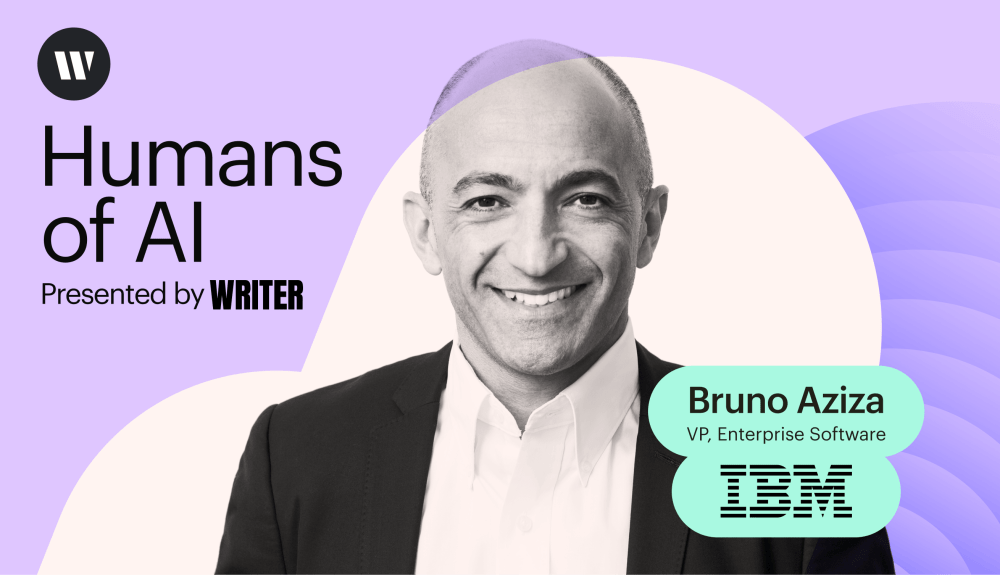
In this episode of Humans of AI, Bruno Aziza — Group Vice President of Data, BI, and AI Strategy at IBM — shares the frameworks that separate successful AI deployments from expensive experiments, and why the future of work looks radically different than most people expect.
The new reality: 50 humans and 150 agents
When Bruno asks customers about their team size, he gets different kinds of answers. One customer recently told him: “I have 200 employees. 50 are humans. 150 are agents”.
This isn’t a vision of the future. It’s happening now.
But here’s the uncomfortable truth: according to Gartner, 40% of agentic AI projects will fail by 2027. The gap between hype and execution remains vast, and most organizations are navigating this transition without a clear framework.
That’s where Bruno’s insights become invaluable. After years of watching companies struggle with data strategy, he’s developed mental models that help organizations avoid the most common pitfalls in AI adoption.
The twin traps: FOMO and FOMU
Bruno identifies two psychological forces that paralyze AI initiatives before they even begin:
FOMO (Fear of Missing Out): Organizations feel pressure to adopt AI because their competitors are. They chase what’s “cool” rather than what’s useful. “We’re trying to be efficient, useful, and then if we can be cool, that’s a benefit,” Bruno says.
FOMU (Fear of Messing Up): The opposite trap. Companies become so risk-averse that they can’t move forward at all. Every pilot requires endless approval cycles. Every use case gets debated into paralysis.
The solution isn’t choosing between speed and caution. It’s building with agility.
“The principle that would’ve helped you at the beginning is, how do I build with agility if I don’t know what the best model is tomorrow? What size, which provider? How do I work in a way where I can mix and match, change quickly and adapt?”
This principle of agility over permanence becomes especially critical when you understand Bruno’s framework for what makes agents actually work.
“Agent Minus”: The infrastructure nobody talks about
Before you can build effective AI agents, you need Agent Minus — and most organizations skip this step entirely.
“This idea of mix and match. It’s kind of what I call Agent Minus. It’s the agent. But there’s also a whole set of technologies before the agent, like rules, tools, workflows that need to marry with it”.
Think of Agent Minus as the foundation layer. It’s not sexy. It’s not what makes headlines. But it’s what determines whether your agents will actually work.
Bruno offers a powerful example: Heineken. When they began their AI journey, they didn’t start by deploying agents. They started by harmonizing 100,000 data elements across their systems . Only after that foundation was solid did they layer agents on top.
This reveals a crucial principle that Bruno emphasizes throughout the conversation: “If the process is useful, automate. If the process is not useful, eliminate”.
Most organizations do the opposite. They automate bad processes, assuming AI will somehow make them better. It doesn’t. It just makes them faster and more expensive.
Every new technology becomes “an excuse to try something new,” Bruno observes. But the first question should always be: what are we trying to accomplish? If the underlying process isn’t useful, no amount of AI sophistication will fix it.
“Agent Plus”: Orchestrating at scale
Once you have Agent Minus in place — the rules, tools, and workflows — you encounter a new challenge: Agent Plus.
“Agent Plus is this idea that if you live in a world that has hundreds of agents, that might be built by multiple vendors, some hyper-scalers, maybe an application vendor, maybe your developers are hard coding agents, then the difficulty is going to be on top of that, which is going to be orchestration of these agents”.
This is where most organizations are heading whether they realize it or not. We’re moving from a world of a few carefully managed agents to an ecosystem of hundreds or thousands of specialized agents, built by different teams, using different platforms, serving different functions.
The challenge isn’t building one great agent. It’s orchestrating many agents into coherent workflows.
Bruno frames this as requiring three core capabilities:
- Autonomy: Do these agents have the right permissions to operate? What are the feedback loops and risk profiles?
- Integration: How do agents access the systems and data they need?
- Orchestration: How do agents work together without constant human intervention?
This level of sophistication requires rethinking not just technology, but organizational structure and governance.
Leadership in the agentic era
If 75% of your workforce might soon be AI agents, what does leadership even mean?
Bruno’s answer is surprisingly grounded: “The science of leadership does not change, right? It’s still the superpower, the environment, and the inspiration. The art of it might evolve a bit”.
He’s put this philosophy into practice in unconventional ways. He writes a blog called “Nobody Cares,” where he scales his leadership lessons. He’s even created a user manual for himself called “How to Bruno”—treating himself as a product that his team should know how to use effectively.
These aren’t gimmicks. They’re recognition that in a world where agents can execute work at scale, human leadership becomes about codifying judgment, values, and strategic thinking in ways that can be operationalized.
The goal isn’t to make leaders obsolete. It’s to elevate what leaders do—from coordinating tasks to defining direction and building culture.
What this means for your organization
Bruno’s frameworks offer a practical roadmap for any organization navigating AI adoption:
Start with Agent Minus. Before deploying agents, audit your processes. Which ones are useful? Which ones should be eliminated entirely? Build the infrastructure—rules, tools, workflows—that agents need to operate effectively.
Escape FOMO and FOMU. Build with agility rather than permanence. Design systems that let you swap models, adjust approaches, and evolve as the technology landscape changes.
Prepare for Agent Plus. Even if you’re just starting with one or two agents, think ahead to orchestration. How will you manage permissions, integrate systems, and coordinate multiple agents?
Rethink leadership. In an agentic era, leadership is about codifying judgment and strategic thinking in ways that can guide both human and AI collaborators.
The companies that get this right won’t be the ones with the most advanced AI. They’ll be the ones who understand that AI is only valuable when it enables action—not just intelligence.
As Bruno’s customer with 50 humans and 150 agents demonstrates, that future is already here. The question is whether your organization is ready for it.
Listen to the full conversation with Bruno Aziza on Humans of AI, available on Apple Podcasts, Spotify, and YouTube.
More resources


Innovation
– 7 min read
Introducing agent supervision designed for enterprise scale

Matan-Paul Shetrit

AI agents at work
– 18 min read
The conversation that actually drives AI adoption: Three fears every CMO must address

Diego Lomanto, CMO