
Humans in the loop
– 11 min read
Marketing AI Institute’s Cathy McPhillips on the new productivity and the value of productive struggle

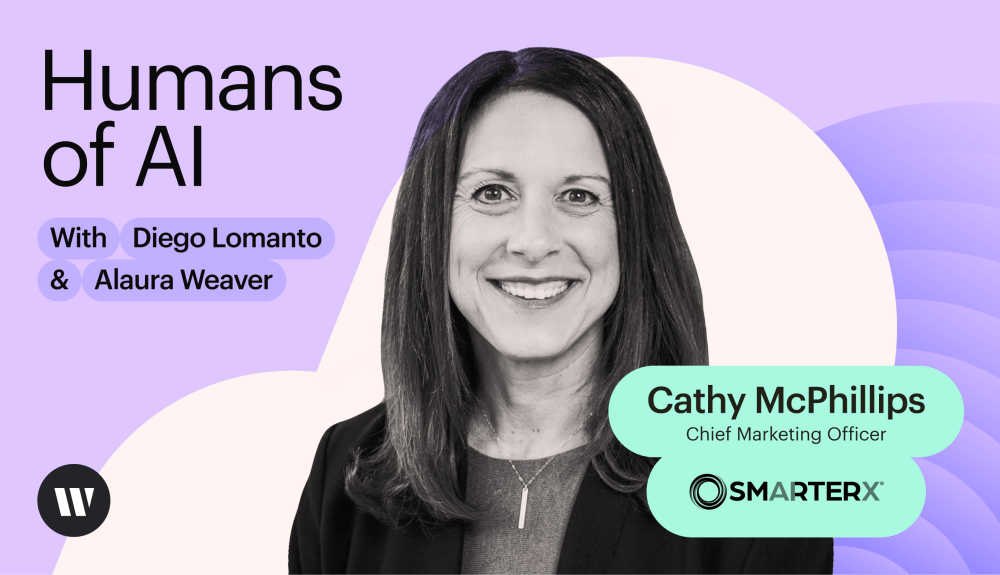
Cathy McPhillips spent nine years at the Content Marketing Institute helping brand the concept of content marketing to a world that wasn’t quite ready for it yet. She watched budgets get denied. She watched executives ask where “content” even fit inside a marketing org. And she watched, slowly, as the entire industry caught up to what the folks at CMI already knew.
Now she’s doing it again — this time with AI.
“I came to MAICON (Marketing AI Institute’s annual conference) in 2019 in its first year,” she tells hosts Alaura Weaver and Diego Lomanto on this episode of Humans of AI. “Joe [Pulizzi, co-founder of CMI] and I left like, ‘Oh, that was cool,’ and we went back to our jobs.” Neither of them knew quite what to do with what they’d seen. The technology was abstract. The vocabulary wasn’t settled. The use cases weren’t obvious yet.
A few years later, when Paul Roetzer — the founder of the Marketing AI Institute — called Cathy to join his team, she made the same kind of bet she’d made with Joe. That was a bet on a person whose conviction she trusted, not a technology she fully understood. “I don’t even know what this means,” she remembers thinking. “I’d love to be part of the team that figures it out.”
That phrase — the team that figures it out — turns out to be a pretty accurate description of where most marketing organizations are right now.
From content marketing to AI: the same bet, twice
There is something clarifying about the parallel Cathy draws between the early days of content marketing and the early days of AI in marketing. Both arrived before the infrastructure existed to support them — new ideas in fields that didn’t yet have budgets, vocabulary, or leadership buy-in. Both required marketers to learn while doing, to justify investment before anyone had proof, and to convince leadership that something abstract was worth real commitment.
Speed is the difference now. And noise.
“It was hard,” Cathy says of those first months at the Marketing AI Institute, “because it was still kind of abstract. There wasn’t ChatGPT. It was like, I don’t know what this even means, and I gotta learn. I gotta do my job, and I have to learn in parallel.”
That tension — doing the job while also transforming how the job gets done — is what separates her from the conference-circuit AI optimists. She doesn’t have the luxury of theorizing. “I’m the one using AI in my job day to day,” she says. “So I’m kind of living through it with our customers.”
The AI moment that changed how she thinks about time
Ask Cathy about her first real AI turning point, and she doesn’t cite a keynote or a strategy session. She cites an early AI writing tool — before most people had heard of it, before ChatGPT had made generative AI a household term.
She was writing marketing copy for MAICON and decided to try the tool. The output wasn’t good. She went back and edited the posts heavily. But it gave her a starting point, and that starting point saved her four hours on a process she’d been doing manually.
Four hours sounds like a footnote. The decision Cathy made with those four hours is the whole point.
“I said to myself, ‘I’m going to consciously take those four hours, and I’m going to talk to humans. I’m going to schedule meetings with customers.’ You can’t replace that.”
She didn’t use the time to generate more content. She used it to do the work that doesn’t scale and can’t be automated — building real relationships with real people. And that moment gave her a frame for every AI decision she makes now. “Where else can I grab some time back so I can really do the things I like doing and that matter to the business?”
Cathy’s frame for every AI decision she makes going forward became: what high-value human work can I now protect time for?
The content quality vs. quantity debate is back — and AI is why
Cathy spent nine years at CMI watching the industry wrestle with a fundamental question — does publishing more content make you more effective? The answer, hard-won over a decade of data, was no. Connection comes from value, reliability, and consistency — not volume.
She believes that debate is happening again right now, and AI is the reason.
“I feel like we’re back to that content quality versus content quantity debate that happened when I was at CMI,” she says. “People don’t connect with volume. They don’t connect with pumping something out every single day, and that’s been going on for decades. They connect to value, they connect to being reliable, consistent, what resonates with me, what’s useful — and that doesn’t change with AI.”
The uncomfortable implication is that many organizations are using AI to solve the wrong problem. They are using it to produce more, faster, when the actual competitive advantage — in a world where any company can now generate unlimited content — is trust.
“In a world of infinite content, trust becomes our best resource and our scarcest resource.”
When the cost of content production drops to near zero for everyone, the content itself becomes undifferentiated. What doesn’t become undifferentiated is the voice, the point of view, the organizational context behind the content. That’s what WRITER has built its enterprise AI platform around — the idea that generic AI creates generic companies, and that the real competitive moat is the organizational intelligence encoded into every output.
Cathy has arrived at the same conclusion from the front lines of a working marketing team. “Use it where you’re going to make the biggest impact on your customers and where your voice remains.”
The “productive struggle” we’re about to lose
The most provocative idea in this conversation doesn’t come from any AI tool. It comes from a question Cathy asks about what we might be trading away without realizing it.
“I don’t think we’ve fully grappled with what happens when AI removes some of the productive struggle that we deal with when we’re trying to learn and grow,” she says. “Are we preserving our growth and not just trying to become more efficient?”
She had, years earlier, even thought about writing a book called Productive Discomfort — a title that captures her intuition that being slightly over your head is often the condition under which real learning actually happens. The risk with AI is that we eliminate the friction before we’ve understood what that friction was doing for us.
There are real stakes here for organizations thinking about how they onboard, develop, and retain talent. If an early-career marketer can ship polished content on day one with AI assistance, what skills are they not building? What judgment are they not developing? These are not rhetorical questions. They are the questions marketing leaders should be asking now, before the answer becomes clear in retrospect.
The conversation that reframed productivity
Sometime before this interview, Cathy was talking with Will Reynolds — a respected figure in the marketing and SEO world — and the two of them were processing a shared exhaustion. AI had taken away the repetitive work they didn’t love. But they weren’t using that recovered time to rest or think. They were just doing more work.
“We’re not getting the downtime we used to have,” she says. She describes a ritual she used to have — blocking a few hours on a Friday afternoon to update spreadsheets, tidy up her to-do list, and do calmly productive administrative work. It wasn’t exciting, but it was restorative in its own way. Now that AI can do much of that, she and Will asked — what is even left to fill that space?
Will asked her a question she couldn’t shake — define productivity.
“Isn’t productive closing your computer and going outside and collecting your thoughts?” she says. “Why does productivity need to be that you’re always doing something and you’re always working? Isn’t that going outside and refreshing and thinking — going for a walk without music and having another thought?”
This matters enormously for marketing leaders right now. As AI absorbs the measurable, trackable, output-generating parts of the job, the remaining human work — the judgment, the taste, the strategic intuition, the relationship-building — is harder to measure and easier to undervalue. If we keep defining productivity the old way, we will systematically deprioritize the very work that AI cannot do.
“I think AI changes the nature of what productivity actually is,” Cathy says. “It used to be about pumping out work. Now it’s about the outcome. It’s partnering with your technology and producing something interesting and useful.”
Judgment is the last competitive advantage
Ask Cathy what is irreplaceable about human marketers, and she doesn’t hesitate — “Judgment. AI can create and can generate a lot of options for us, but humans still decide what matters.”
She is direct about what AI should be clearing off the plate. And that’s “low-value, operational busy work — the kind that keeps us from being strategic, being creative.” The goal isn’t to use AI to become a more prolific content machine. It’s about using AI to become a more strategic one.
She also offers a sharp warning about a failure mode she sees everywhere. If you take a piece of AI-generated copy — a blog post, website content, whatever — and you cannot repeat back what it says without re-reading it, you don’t actually understand it. And if you don’t understand it, you cannot stand behind it. “You need to make sure that you’re using it in tandem with your beliefs, your company’s mission, what your customer needs, what your product does. You have to understand it as well as these machines do.”
The enterprise AI platforms worth using are built on exactly this standard — AI teammates whose outputs are grounded in organizational context, auditable, and worthy of the human’s name attached to them. So the people using them never have to publish something they can’t personally defend.
What she tells her kids — and what it means for you
Cathy has two children in college. When they ask her about careers and the uncertainty that comes with choosing a path in a world where AI is changing every domain, she gives them the same advice she would give any marketer standing at the edge of an AI adoption curve.
“Commit to a thing that sounds like you want that outcome down the road. Don’t think so much about how hard the work is going to be, because when you get to it, you’ll have to work through it because you committed to an outcome.”
And perhaps most simply, “You don’t need to have all the answers to get started. Transformation is very emotional before it becomes operational, and I think we just need to get over that a little bit and just jump in.”
For marketing teams sitting on the fence about AI adoption — still piloting, still experimenting, still waiting for permission — that might be the most actionable sentence in this entire conversation.
The future belongs to marketers who stay human
Cathy McPhillips has made two bets on ideas the rest of the industry wasn’t fully convinced by yet. The first was content marketing. The second is AI. The way she started out using AI was rudimentary compared to today — she laughs looking back at her early AI writing prompts — but she has been right about the direction.
Her operating philosophy is simple and worth writing down — use AI where it makes the biggest impact on your customers, use it ethically and legally, and do not let it replace the parts of your work that make you distinctly you.
“I think the more AI advances, the more valuable genuine human experiences matter,” she says. “The future belongs to marketers who can combine technology with humanity.”
Competitive advantage in a world of infinite AI-generated output does not come from volume. It comes from the people, the judgment, and the organizational DNA behind every word — and from AI teammates built to amplify that DNA, not dilute it.
Listen to the full conversation with Cathy McPhillips on the Humans of AI podcast — available on all major streaming platforms and on the WRITER YouTube channel.
From content factory to brand engine
Webinar | June 30, 12pm ET