Humans in the loop
– 11 min read
From vending machines to champions: Eric Porres, Logitech’s Head of AI
Why the best AI transformation starts by listening, not teaching

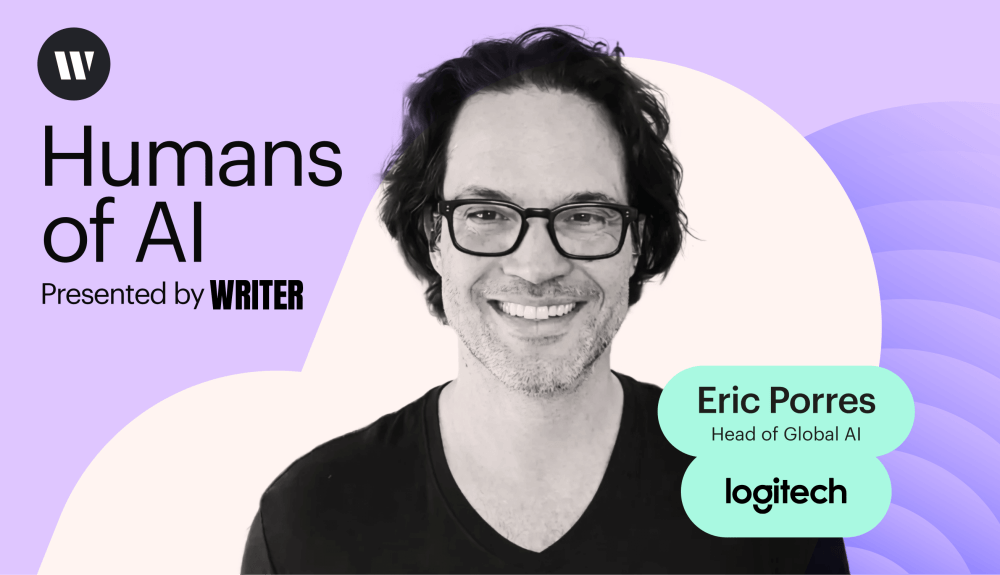
Most people treat AI like Google: ask once, leave disappointed. Eric Porres discovered 112 Logitech employees who were doing something different — and built an enterprise AI transformation framework from their patterns. This is how he turned hidden champions into an adoption movement.
Listen to the latest episode of Humans of AI to learn the 6-element framework that’s changing how 7,000 employees work with AI.
- The Vending Machine Problem: Most people treat AI like Google—ask once and leave—but Eric Porres discovered 112 Logitech employees who understood AI requires iteration and conversation, not transactions.
- The 6-Element DNA of AI: Eric reverse-engineered a framework from AI champions built on six elements (Role, Context, Task, Output, Boundaries, Reasoning) plus the advanced technique of using AI to improve your prompts before executing them.
- Two Barriers Kill Adoption: Organizations fail when AI requires too many clicks to access (friction) and when systems don’t remember context between conversations (institutional amnesia).
- Leadership Modeling Beats Training: Logitech transformed adoption by having every leadership meeting start with “How has AI affected you this week?”—proving that when leaders model AI usage in their actual work, employees stop treating it as optional.
- Practice Makes Permanent: Eric didn’t scale AI through more training—he found the 112 champions already succeeding, learned their patterns, and created systems to help those patterns spread across 7,000 employees.

While most enterprises doubled down on training, one leader flipped the script—finding 112 hidden AI champions and reverse-engineering their success into a framework that transformed how 7,000 employees work.
Late 2024, Logitech surveyed their entire workforce about AI usage. Seven thousand employees spread across 46 countries. When Eric Porres, now Logitech’s Head of AI, saw the results, he stopped calling it an adoption problem. Most organizations would have doubled down on training. Eric did the opposite. He started listening to the people who were already winning.
Eric had spent the year running AI training sessions across Logitech—not as his official job, but as a second shift while leading innovation and software teams. 827 people over eight months. And in those sessions, he kept hearing the same story: people approached generative AI like they approached Google. Ask a question. Get an answer. Walk away unsatisfied. They didn’t realize they could iterate, refine, and improve.
Then Eric discovered something remarkable buried in the survey data: 112 people who were doing exceptional work with AI. Not because they had more training. Not because they had better tools. Because they understood something fundamental that everyone else missed.
The vending machine problem
Eric Porres has a theory about why AI adoption fails. It’s not about the technology. It’s about muscle memory.
“We as a society have been really taught by Google,” Eric explains. “There’s a box. I’m gonna put my little vending machine worth of coin into the box. I’m gonna ask my question and I’m gonna get a bunch of results and I’m gonna leave.”
That vending machine approach works for search. You need a quick answer. You get a quick answer. Transaction complete. But generative AI isn’t a better search engine. It’s a thinking partner. And most people were treating their thinking partner like a vending machine.
The 112 AI champions Eric identified? They understood the difference. They weren’t asking once and walking away. They were having conversations. They were iterating. They were refining. And that fundamental shift in mindset was the first pattern Eric noticed.
But identifying the problem was the easy part. The breakthrough came when Eric started asking these high performers to walk him through their process. Not what they were building—how they were thinking. And that’s when the pattern emerged.
The six-element DNA of AI
When Eric analyzed how his AI champions worked, he found they were all structuring their prompts around the same six elements. He calls it “the DNA strand, the ATGC of AI”:
- Role: Who is the AI in this interaction?
- Context: What background knowledge does it need?
- Task: What specific work needs to be done?
- Output: What format should the result take?
- Boundaries: What constraints must be respected?
- Reasoning: How should the AI think through the problem?
These six elements weren’t arbitrary. They mirrored how humans naturally communicate complex requests to other humans. The AI champions had intuitively reconstructed the structure of effective delegation — just now with a machine as their collaborator.
But here’s what makes this framework powerful: it’s not just about better prompts. It’s about building a repeatable system for how work gets done.
“Are you using AI to reflect on your own prompt before you initiate the prompt with AI?” Eric asks. It’s what he calls the “measure twice, cut once” mentality. The best users weren’t just prompting. They were meta-prompting — using AI to improve their instructions before executing them.
This is where most AI training programs miss the mark. They teach people what to type. They don’t teach people how to think. Eric’s framework does both.
The two barriers that kill adoption
Even with a perfect framework, Eric discovered two persistent barriers that prevent organizations from scaling AI adoption: friction and institutional amnesia.
Friction is deceptively simple. Eric describes his own setup: “I am zero clicks away from the ability for me to interoperate easily with AI.” He has a physical screen dedicated to AI. Not “open browser, navigate to tab, find the right tool.” Zero clicks. Because if AI is out of the way, you won’t use it.
Most organizations fail at this basic level. They implement AI tools that require multiple logins, navigation through menus, switching between applications. Every click is a decision point where someone can abandon the tool. Eric’s insight: accessibility isn’t a nice-to-have. It’s the foundation of adoption.
The second barrier is institutional amnesia. Eric was surprised by how many active AI users had not fine-tuned custom instructions to give their models knowledge about their work, their career, and the types of outputs they expect. Every conversation starting from scratch. Every brief re-explained. It’s like hiring an assistant who forgets everything overnight.
The solution isn’t technical. It’s cultural. Organizations need to treat AI like a persistent team member, not a temporary tool. That means setting up memory. Establishing context. Building institutional knowledge into the system.
At WRITER, we’ve built this philosophy into our platform architecture. Business users can design AI agents that understand their organization’s context, standards, and constraints automatically — while IT maintains complete governance and control over what those agents can access and execute. The agents remember. The agents learn. And most importantly, the agents operate within defined guardrails that keep the business compliant and on-brand.
Leadership modeling: The only strategy that scales
Even with the right framework and the right infrastructure, Eric discovered that adoption still hinges on one critical factor: leadership modeling.
“Being the role model for what you want to inspire in others is the best and I think the only way it works,” Eric explains. “It has to work from the top down.”
Not “do as I say.” Do as I do.
Every leadership meeting at Logitech now starts the same way. Before the agenda. Before the deck. One question: “How has AI affected you personally or professionally in the past week?”
It’s a simple ritual. But it’s transformative. Because it signals that AI isn’t someone else’s job. It’s not a project for the innovation team or the IT department. It’s how leadership operates. And when people see leadership using AI in their daily work, they stop treating it like optional technology and start treating it like essential infrastructure.
“It’s something we do at Logitech,” Eric says. “It’s something I think every leadership team would be irresponsible at this point not to have.”
This is the pattern that makes AI transformation stick. Training provides knowledge. But modeling provides permission. When employees see their leaders actively using AI — not just endorsing it in presentations, but integrating it into their actual work — it fundamentally shifts what feels possible and acceptable.

From adoption to agency:
The business leader’s guide to agentic AI
Learn More
Practice makes permanent
Eric’s high school band teacher used to say, “Practice makes perfect, but it also makes permanent.” You will never achieve perfection. But whatever you practice becomes permanent.
That insight applies directly to how organizations adopt AI. If your organization is practicing the vending machine approach—ask once, walk away—that’s what becomes permanent. If they’re practicing iteration, refinement, and meta-prompting, that’s what becomes permanent.
The patterns you practice are the patterns that stick.
This is why Eric’s approach at Logitech matters beyond Logitech. He didn’t try to change everyone at once. He identified the people already practicing the right patterns. He learned from them. He codified what made them successful. And then he created systems and rituals that would help those patterns spread.
“AI gives us the ability to compress time in such a way that it reduces these tiny frictions that are part of our everyday humanity,” Eric explains, “and gives us the ability, I believe, to do the most inspiring and insightful work of our careers.”
That’s the vision. Not AI replacing human work. AI removing the friction that prevents humans from doing their best work. The repetitive tasks. The administrative overhead. The tiny time-sinks that accumulate into hours every week. When those frictions disappear, what remains is space for creativity, strategy, and insight.
By the time Logitech created the Head of AI role in 2025, Eric had already done the work. He had data from 7,000 employees. He had a framework derived from 112 champions. He had rituals that reinforced the right patterns. And he had leadership buy-in at the highest levels. The formal title just acknowledged what was already happening.
Why this matters for your organization
Most enterprise AI strategies start with the technology and work backward to the people. Eric’s approach flips that. Start with the people who are already succeeding. Learn their patterns. Codify what makes them effective. Then scale those patterns through infrastructure, rituals, and leadership modeling.
This is the same philosophy that drives WRITER’s approach to enterprise AI. We don’t start with what the technology can do. We start with how work actually gets done — then we build AI agents that fit naturally into those workflows while maintaining the governance, security, and compliance that enterprises require.
Business users design agents that mirror their actual processes. Developers extend those agents with custom logic and integrations. IT maintains complete visibility and control through centralized dashboards and fine-grained permissions. And everyone benefits from AI that works the way they work, not the other way around.
The future of enterprise AI isn’t about better models or more powerful tools. It’s about better integration with how humans actually think, work, and collaborate. Eric Porres proved this at Logitech. We’re building it into WRITER’s platform.
The bridge generation
Toward the end of our conversation, Eric said something that stayed with me: “We are this bridge generation.”
We’re living through a transition moment. The people entering the workforce now will never remember a world without generative AI. They’ll treat it as naturally as we treat smartphones or the internet. But we—the people building these systems, implementing these strategies, figuring out these patterns—we’re translating between two eras.
We’re the bridge.
Eric Porres is building that bridge at Logitech. He’s not waiting for the technology to mature. He’s not waiting for perfect standardization. He’s doing the messy, necessary work of figuring out what AI transformation actually looks like when it’s done by real people in real organizations with real constraints.
And what he’s discovering should inform how every enterprise thinks about AI adoption: Stop teaching. Start listening. The champions are already in your organization. Your job is to find them, learn from them, and help their patterns spread.
Listen to the full episode
This recap only scratches the surface of Eric’s insights about AI transformation at scale. In the full Humans of AI episode, he dives deeper into:
- How to identify AI champions in your organization (and why survey data alone won’t find them)
- The discipline required to make transformation permanent, not just another pilot program
- Why the Cambrian explosion of AI capabilities means we’re still in the experimentation phase—and why that’s good news
- How his 20 years of ninjutsu training shaped his approach to organizational change
- The surprising connection between fixing broken meeting culture and scaling AI adoption
Hear the complete conversation with Eric Porres on Humans of AI – Presented by WRITER. Available on Apple Podcasts, Spotify, and everywhere you listen to podcasts. The full video interview is also available on Writer’s YouTube channel.
→ Listen now: https://youtu.be/j41zEqrD7SQ
More resources

Humans in the loop
– 8 min read
The $10 billion culture gap: Jevan Soo Lenox, Chief People Officer at WRITER
Alaura Weaver
Enterprise transformation
– 12 min read
AI Leaders Forum: Inside the playbook of the 6% winning AI at scale
Alaura Weaver