Humans in the loop
– 8 min read
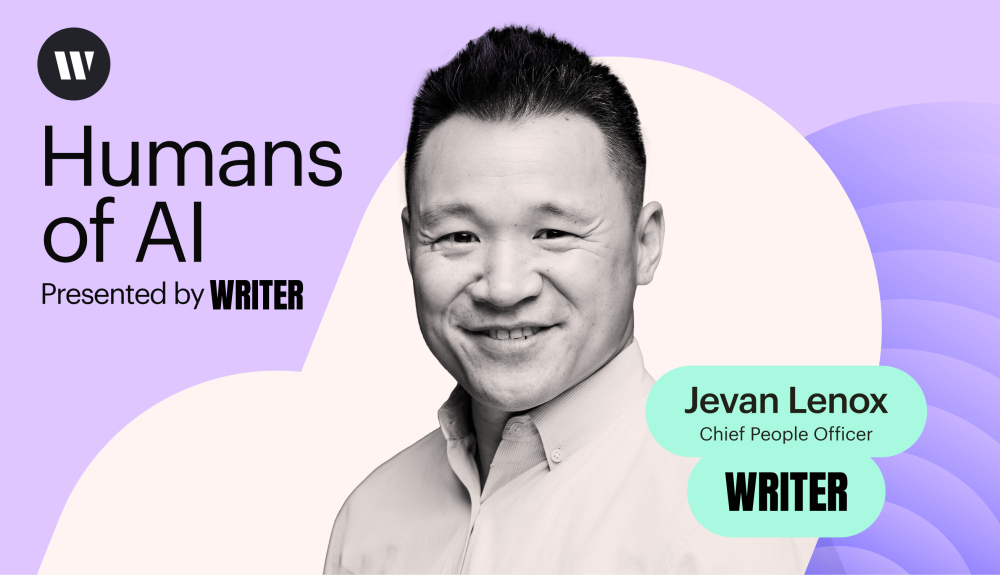
The $10 billion culture gap: Jevan Soo Lenox, Chief People Officer at WRITER
Why culture is the operating system that determines whether AI transforms your organization or destroys it

The difference between a $10 billion company and one that fails often comes down to one thing: culture. Not the technology. Not the timing. Not even the intellectual property. The invisible architecture of how people work together determines everything.
In the age of AI, that gap is about to get much, much wider.
In this episode of Humans of AI, we sit down with Jevan Soo Lenox, Chief People Officer at WRITER, to explore why AI adoption is fundamentally a cultural problem—not a technical one. With years of experience leading people teams at companies like Insitro (applying AI to drug discovery) and Stitch Fix (where machine learning transformed retail), Jevan has spent his career at the intersection of cutting-edge technology and human organizations.
What he’s learned might surprise you: The companies that win with AI aren’t the ones with the best models. They’re the ones with cultures built for what’s coming.
- AI amplifies everything – If you have a culture of fear, you get fear at scale. If you have silos, you get automated silos. But build it right? You get innovation at scale.
- Everyone’s role is evolving – We’re all learning to zoom out, define outcomes, and orchestrate workflows in ways that used to be management-only. (Sound familiar?)
- Identity matters – Companies that help people navigate the identity shift (showing them where they add irreplaceable value) keep their best talent. Those that just mandate adoption? Quiet quitting at scale.
- Culture is competitive infrastructure – Not HR philosophy. The operating system that runs everything else.

The observer on the jungle gym
Before we dive into the insights from this conversation, there’s an origin story worth knowing. As a young boy, Jevan had an unusual recess routine. While other kids were playing and cartwheeling around him, he would sit on the jungle gym with a book, reading—but also watching.
Growing up as a closeted gay boy and one of the only Chinese American kids in a conservative New Jersey town, Jevan learned early not to stand out. But that didn’t mean he wasn’t paying attention. Quite the opposite. He spent countless recesses observing dynamics: how kids showed up in different contexts, how they worked with each other or didn’t work with each other, what made individuals and groups tick.
“I just spent a lot of time observing and seeing dynamics and seeing other kids, how they showed up in certain contexts, how they worked with each other or didn’t work with each other,” Jevan reflects. “And so I think that there’s something about that that just really instilled a curiosity about both individuals and sort of social units and what made them.”
That curiosity would shape his entire career path. The alternate careers he considered—psychologist, marketer focused on consumer psychographics—all connected back to the same fascination: understanding what drives people, what motivates them, and how to use that insight productively.
What he was really learning on that jungle gym was how to read systems. The invisible architecture of how humans work together—or break down. And that skill is exactly what organizations need right now.
AI doesn’t just change processes—it amplifies everything
Here’s what makes AI different from every other technology shift we’ve seen: it doesn’t just change your processes. It amplifies everything. Including your cultural dysfunction.
“So now everyone in your organization has access to tools that can amplify their work,” Jevan explains. “Which means if you have a culture of fear, you get fear at scale. If you have silos, you get automated silos. If you have people who won’t speak up about problems, you get problems that compound faster than humans can catch them.”
The flip side? If you build it right, you get innovation at scale. Ideas that move faster. Problems that surface sooner. People who feel empowered to experiment.
The research backs this up. When employees strongly agree that leadership has communicated a clear plan for integrating AI, they’re three times as likely to feel prepared to work with it. Culture isn’t soft stuff—it’s competitive infrastructure.
The shift to distributed strategic thinking
One of the most profound changes AI brings is a democratization of strategic thinking. Skills that used to be reserved for management are now essential for everyone.
“To really harness the power of this AI technology, each of us as individuals needs to be able to zoom out,” Jevan shares. “That means we each should probably have more responsibility now to think about outcomes and to get really crisp on what are we seeking to achieve here? What are the negative outcomes that could come of this?”
Everyone now needs capabilities that used to be management-only:
- Defining outcomes rather than following processes
- Orchestrating workflows across systems and tools
- Managing digital teammates (AI agents)
- Thinking about second-order effects
- Understanding the broader context of their work
This isn’t about making everyone a manager. It’s about recognizing that AI gives individuals the power to create outcomes at scale—which means they need the judgment and strategic thinking to wield that power responsibly.
From outcomes over processes: The new adaptation strategy
In traditional hierarchical organizations, processes were king. Follow the process, and you’ll get the right outcome. But AI changes that equation entirely.
“Outcomes, not rules. North Stars, not rigid processes,” Jevan emphasizes. This is especially critical during rapid growth—WRITER has been doubling headcount year over year, and maintaining culture through that kind of expansion requires a different approach.
When you’re constantly evolving, you can’t rely on rigid processes that become outdated before they’re even documented. Instead, you need teams aligned around clear outcomes who can adapt their approach as circumstances change.
This shift from efficiency culture to resilience culture is what separates organizations that thrive with AI from those that struggle. Efficiency culture optimizes for execution. Resilience culture optimizes for adaptation.
Navigating the identity shift
Perhaps the most overlooked aspect of AI transformation is the profound identity shift it creates for employees. When AI can handle tasks that previously defined your role, it forces a fundamental question: What value do I bring?
“This is the difference between AI as replacement and AI as amplification,” Jevan notes. The companies that help people navigate this identity shift—that help them see where they still add irreplaceable value—those are the ones that keep their best talent.
The ones that just mandate adoption and measure usage? They get quiet quitting at scale.
The key is helping people understand that AI doesn’t replace human judgment, creativity, and relationship-building. It amplifies it. But making that shift requires intentional change management, clear communication, and a culture that values adaptation.
What leadership looks like in the AI era
If the skills people need are changing, then the people responsible for building organizations are facing something different too. Jevan’s job has fundamentally changed. And so has every leadership role.
“No one has the playbook,” he admits candidly. “Not the consultants. Not the thought leaders. Not your competitors.”
This is both liberating and terrifying. On one hand, everyone is figuring this out together. On the other hand, the stakes have never been higher.
The shift is from:
- Individual heroics to systemic thinking
- Execution to adaptation
- Efficiency culture to resilience culture
- Command and control to distributed autonomy with governance
Leaders who understand that culture is the operating system—not the nice-to-have—are the ones positioned to build the future.
Culture as competitive infrastructure
The central insight from this conversation is deceptively simple but profoundly important: culture is not HR philosophy. It’s competitive infrastructure.
“The question isn’t whether your organization values culture,” Jevan concludes. “The question is whether your culture is built for what’s coming.”
In Jevan’s early career, he learned to read systems—the invisible architecture of how people work together or break down. That skill, being able to see the cultural patterns that determine whether technology succeeds or fails, is exactly what organizations need right now.
The companies that see this—that invest in building cultures of psychological safety, distributed strategic thinking, and continuous adaptation—will be the ones that turn AI from a risk into their greatest competitive advantage.
Key takeaways
1. AI amplifies culture, both good and bad
Every cultural strength gets magnified. So does every dysfunction. Before you deploy AI at scale, fix your culture.
2. Strategic thinking must become distributed
Everyone needs management-level skills now: defining outcomes, orchestrating workflows, managing digital teammates, thinking about second-order effects.
3. You can mandate adoption, but not meaningful engagement
Help people navigate the identity shift. Show them where they add irreplaceable value. Make the transition from AI as replacement to AI as amplification.
4. Shift from efficiency culture to resilience culture
Optimize for adaptation, not just execution. Outcomes over processes. North Stars over rigid rules.
5. Leadership has fundamentally changed
No one has the playbook. The winners will be the ones who see culture as the operating system that runs everything else—and invest accordingly.
The $10 billion future
That kid on the jungle gym—young Jevan Lenox—learned something most of us miss: The invisible architecture of how humans work together determines everything. Whether brilliant technology succeeds or fails. Whether organizations thrive or collapse.
He’s betting that the leaders who understand this—who see culture not as soft stuff but as the operating system that runs everything else—those are the ones who build the future.
The $10 billion future.
More resources
Humans in the loop
– 10 min read
The hybrid AI-human workforce: When everyone becomes a manager
Alaura Weaver
Humans in the loop
– 7 min read
What’s your company’s AIQ? Featuring J.P. Gownder, Forrester VP and principal analyst
Alaura Weaver