
Innovation
– 17 min read
How WRITER Skills turn your team’s expertise into reusable AI capabilities

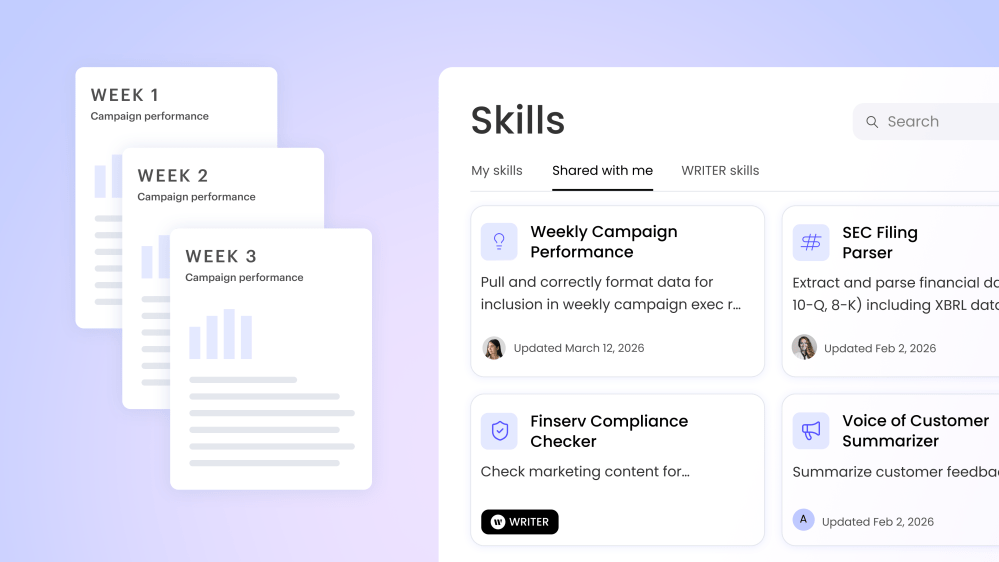
If you’re evaluating AI agent platforms or already using WRITER Agent, you’ve likely encountered the challenge — your agents produce inconsistent outputs because they lack your team’s specific expertise and standards. You end up spending time correcting, refining, and re-prompting to get the quality you need.
WRITER Skills solve this by letting you encode your team’s unique approaches directly into the platform. Once created, a Skill ensures WRITER Agent applies your exact methodology — from content structure to brand compliance checks — every single time, across every team member and workflow.
Unlike other platforms where you’re copying custom instructions into each conversation or building technical function calls, WRITER Skills are built for business teams. You create them through natural language, share them across your organization, and compose them into Playbooks — all without writing code.
The problem: Your AI agents don’t know how your team works
You’ve deployed AI agents. Your team is using them. But you’re seeing a fundamental problem: the outputs don’t match your standards.
According to WRITER & Workplace Intelligence research, 61% of executives say employees have been left to figure AI out on their own, with 55% reporting that AI use is a chaotic free-for-all at their company. The result? Five team members using the same AI agent produce five completely different outputs for the same task. Same agent, same prompt, wildly different results.
Why does this happen? Because generic AI agents don’t understand your specific approaches:
Your content structure methodology. One writer structures thought leadership posts with data-first hooks. Another leads with customer stories. A third uses problem-solution frameworks. Without encoding your proven approach, every piece reads differently.
Your quality standards. What makes compelling landing page copy at your company? Which elements drive conversion? What A/B testing framework do you follow? Generic agents don’t know.
Your decision frameworks. If launching to enterprises, emphasize security and compliance. If targeting mid-market, focus on speed to value and ease of implementation. These “if-then” rules live in your team’s heads — not in generic AI.
Your compliance requirements. Regulated industries have specific claim substantiation rules, required disclaimers, and approval workflows. Generic agents can’t encode these constraints.
The cost is real. Onboarding new marketers means explaining your approach from scratch. Your best strategist’s expertise disappears when they’re on vacation. Output quality depends on who’s available. A task that should take 30 minutes stretches to two hours.
WRITER Skills solve this by capturing your institutional knowledge once and making it reusable everywhere. You codify how your best people work. Then scale that expertise across your entire team.
How WRITER Skills work
WRITER Skills capture your team’s unique approaches through three interconnected layers:
1. Documentation layer: The “how-to” manual
Think of this as the best practices guide your senior marketer would walk a new team member through. In WRITER, you document:
Your specific process. Not generic “create landing page copy” but “start with persona pain points from our Q4 research, lead with a value proposition that emphasizes ROI for CFOs, include three proof points with customer testimonials, and structure CTAs based on our conversion testing framework.”
Your brand requirements. “Use first-person plural (‘we believe’), active voice, avoid jargon unless our CMO personas use it, and maintain confident-yet-humble tone per our brand guidelines.”
Your quality checklist. “Verify all statistics include citations, confirm CTAs match campaign goals, check that competitive claims are substantiated, ensure format matches our template.”
This documentation becomes the “expert knowledge” WRITER Agent follows every time someone uses this Skill.
2. Decision logic: The “if-then” rules
This layer encodes the judgment calls your experienced team members make instinctively:
Audience-based variations. “If targeting C-suite executives, prioritize ROI metrics and business impact. If targeting practitioners, emphasize ease of implementation and time savings. If this is a product launch, include analyst coverage strategy and competitive positioning.”
Channel-specific adaptations. “If this is for LinkedIn, use thought leadership framing with data citations. If for paid ads, lead with pain point and include clear CTA. If for email nurture, structure as problem → insight → solution.”
Quality gates. “If campaign budget exceeds $50K, require VP approval. If making competitive claims, verify claim substantiation.”
These decision frameworks are what separate good work from great work. WRITER Skills capture them as executable logic.
3. Quality standards: The output specifications
This layer defines success criteria through examples and templates:
Output specifications. “Email campaigns should be 200-300 words, include subject line with clear benefit, contain 2-3 key messages with supporting evidence, feature one primary CTA, and include personalization tokens for segment-specific content.”
Format requirements. “Use our standard template: Hook (problem statement) → Value Proposition → 2-3 Benefits with Proof → Social Proof → CTA → P.S. with urgency driver.”
Style guidelines. “Subject lines should ask questions or make bold claims. Each benefit should include one customer metric. CTAs must be action-oriented verbs, not generic ‘learn more.'”
Compliance requirements. “Ensure all claims are compliant with relevant company rules and industry regulations.”
Together, these three layers ensure WRITER Agent produces outputs that match your standards — not just approximate them.
Creating Skills in WRITER: The business-user approach
The creation process starts with a conversation. You describe to WRITER Agent what you want the Skill to do in plain language.
For standardization: “I need a Skill that generates social media post series following our proven framework: hook with surprising data, personal story connection, actionable insight, and engagement question — optimized for LinkedIn’s algorithm.”
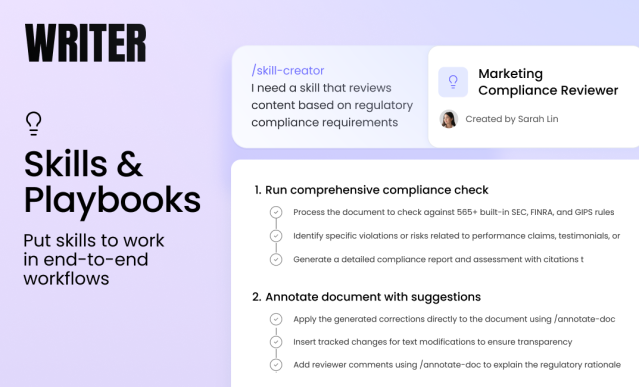
For compliance: “I need a Skill that ensures all generated marketing asset copy aligns to FINRA rules, and proactively identifies any compliance risks in our messaging.”
For quality control: “I need a Skill that reviews content for brand voice alignment, flags unapproved terminology, and verifies all claims are substantiated with proper citations.”
Refine through iteration. WRITER helps you structure this into a Skill. You test it on a real project, gather team feedback, and refine. “Actually, we also need it to automatically pull competitive insights from our Knowledge Graph and check that all claims are substantiated.”
Share across your team. Once the Skill works, you make it available to your organization. Anyone can discover it in the Skills library, see exactly what it does, and use it in their work.
Finding what already exists. Browse the Skills library by keyword. Filter by creator or team. See descriptions, examples, and usage stats. Build on what exists instead of recreating from scratch.
Compose into Playbooks. Skills become building blocks. Your “Product Launch Campaign” Playbook might use your Competitive Analysis Skill, your Landing Page Copy Skill, and your Email Sequence Skill — orchestrating them into a complete workflow.
What this looks like in practice
Before WRITER Skills:
- Copy custom instructions into each new conversation
- Hope team members follow the same approach
- No version control — everyone has slightly different instructions
- New team members recreate everything from scratch
- No way to discover what approaches already exist
With WRITER Skills:
- Create the Skill once through natural language
- Everyone automatically uses the latest version
- Built-in version history shows what changed and when
- New team members see what Skills exist on day one
- Skills attach automatically to relevant Playbooks and projects
WRITER Skills vs. other platforms
Not all AI platforms handle Skills the same way. Understanding how Skills fit into this architecture for AI agents in the enterprise shows why the platform enables what others can’t.
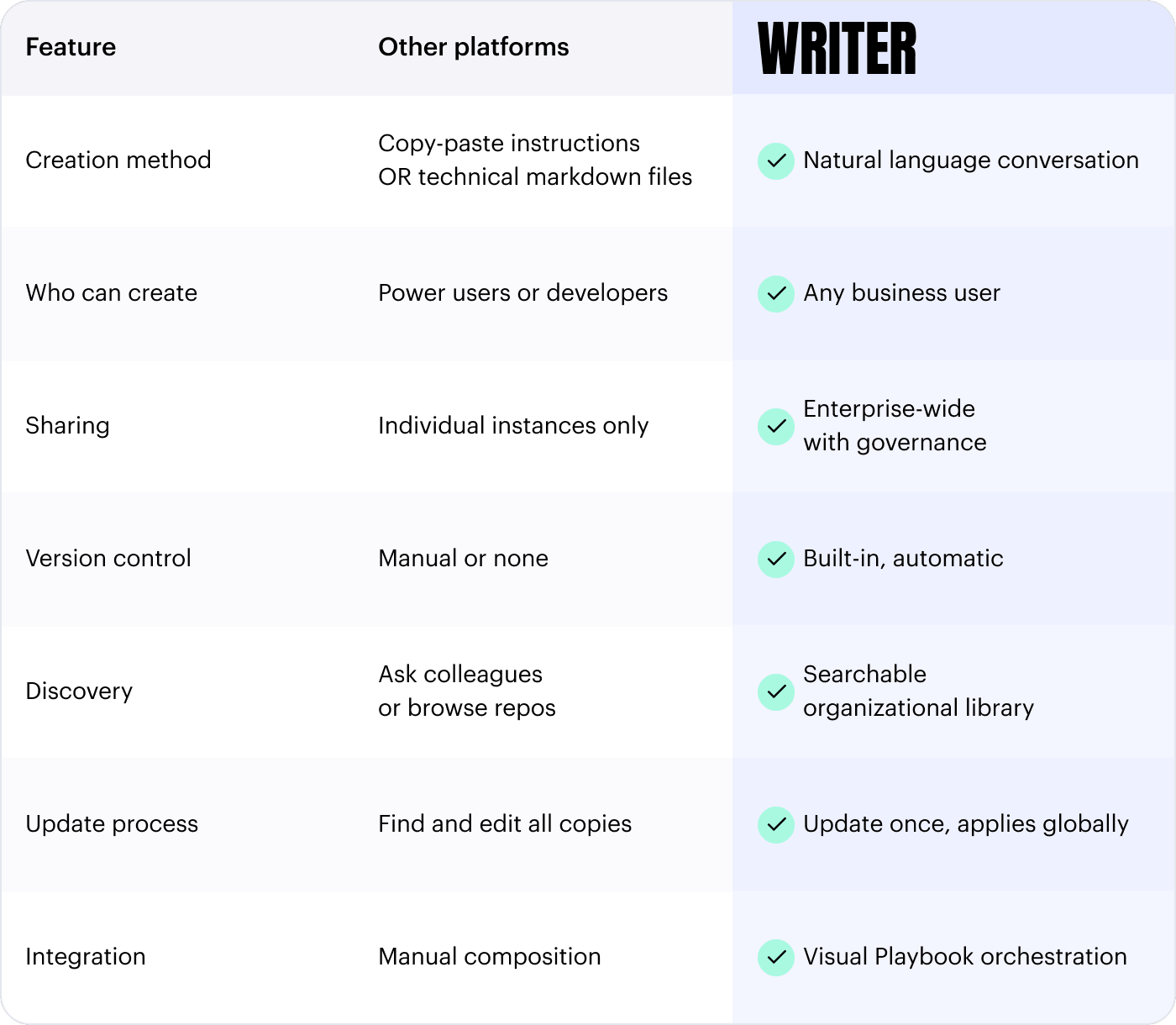
Other platforms: Manual custom instructions
Many AI platforms require you to write custom instructions directly into each conversation.
How it works: You draft detailed instructions as text prompts. Copy and paste these into every new conversation. Each team member maintains their own version. Updates require manually finding and editing all copies.
The problem: No sharing mechanism — everyone recreates from scratch. Inconsistency across team members. Version control is manual or non-existent. Knowledge trapped in individual chat histories.
When messaging strategy changes: Email everyone to update their custom instructions. Hope they do it. No way to verify who’s using the new messaging.
When this makes sense: Individual contributors working on personal projects with no need to scale.
Other platforms: Technical/developer-friendly approaches
Some platforms require technical expertise to create Skills — whether through coding, organizing markdown files in complex file system structures, or uploading pre-built Skills that technical users created.
How it works: You write markdown skill files yourself, organize them in specific file system structures, or have developers build Skills that you run in your instance. Requires understanding technical concepts, file management, and platform-specific syntax.
The problem: Not accessible to average business users. Marketing teams need technical support to create or modify skills. Iteration requires understanding developer concepts. Most critically, skills remain siloed to individual instances — there’s no enterprise-wide sharing or governance.
When this makes sense: Individual power users comfortable with technical workflows who don’t need to share skills across teams.
WRITER: Enterprise-wide Skill creation and sharing
WRITER offers structured, no-code Skill creation through natural language — designed for teams and organizations, not just individuals.
How it works: Describe what you want through conversation. WRITER structures it into a Skill. Built-in enterprise sharing, permissions, and versioning. Integrated organizational library shows all Skills. Skills attach to projects and Playbooks seamlessly across your entire organization.
Why this matters for teams: No technical skills required — marketers create marketing Skills. Fast iteration based on team feedback. Enterprise-wide sharing with governance controls — one team creates a Skill, every team can use it. Discoverable library shows what exists across your organization. Version history tracks changes automatically. IT maintains visibility and control.
When messaging strategy changes: Update the Messaging Framework Skill once. Everyone automatically uses the new positioning next time they create content. Version history shows exactly what changed.
Skills in WRITER’s team-first architecture
WRITER is designed from the ground up for teams and organizations, not individual productivity. Understanding how Skills fit into this architecture shows why the platform enables what others can’t.
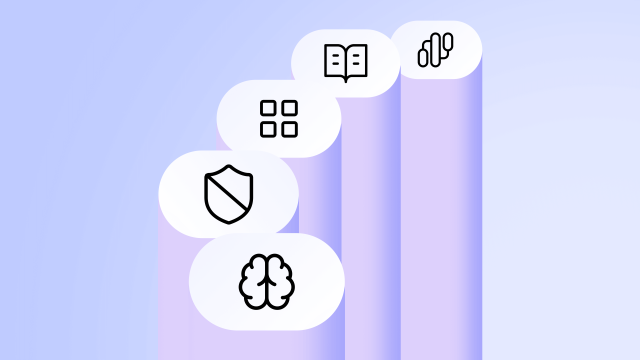
The complete architecture
Instructions set the agent’s high-level mission and constraints. “You are a content marketing agent focused on thought leadership with CMOs at Global 2000 companies.”
Knowledge Graph provides factual context — your company’s positioning, competitive intelligence, persona research, product specifications.
Voice & Style ensures brand consistency — tone, terminology, sentence structure that match your brand guidelines.
Connectors give agents access to your systems — CRM, analytics, marketing automation, data warehouse.
Playbooks orchestrate multi-step workflows — the complete “Product Launch Campaign” process from research to execution.
Skills execute specific tasks correctly — Landing Page Copy Framework, SEO Optimization, Competitive Analysis, Email Sequence Generator.
How these components work together
Consider creating a thought leadership blog post in WRITER:
Instructions tell the agent: “Create content that establishes thought leadership with CMOs.”
Knowledge Graph provides: Your company’s differentiation, recent analyst coverage, customer wins.
Voice ensures: Every sentence sounds like your brand — confident but not arrogant, clear not clever.
Connectors pull: Real-time data from your analytics platform showing top-performing topics.
Your Content Optimization Skill structures: 40-60 word direct answer, natural language headers, FAQ section, proper citations.
Your SEO Research Skill identifies: High-intent keywords, competitive gaps, trending topics in your space.
Playbook orchestrates: Research → outline → draft → optimization → review → publish.
Skills don’t replace other components — they complement them. Knowledge Graph tells agents what’s true about your company. Skills tell them how to execute specific tasks correctly.
Why this architecture enables complex orchestration
Creating individual Skills is one challenge. Orchestrating them into multi-step workflows that run reliably is where most platforms fail — and where WRITER’s team-first architecture makes the critical difference.
The individual productivity challenge
On platforms designed for individual use, orchestrating multiple Skills into agentic workflows is technically complex. You might be able to create Skills easily, but composing them requires understanding developer concepts like JSON schemas, branches, and pull requests. Even experienced GTM leaders describe moving from “one-skill prompts” to “actually architecting agents” as entering “the pit of despair” — a learning curve so steep that most people quit.
The WRITER orchestration advantage
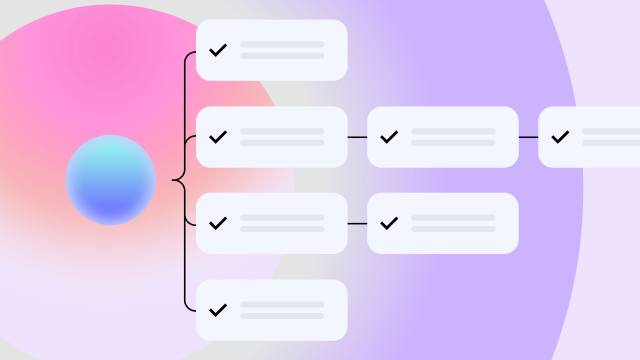
WRITER solves this through Playbooks — visual workflows that orchestrate multiple Skills without requiring technical expertise:
No coding required. You build workflows by describing them conversationally — “First, use the Competitive Analysis Skill to gather intelligence. Then, use the Messaging Framework Skill to develop positioning. Finally, use the Landing Page Copy Skill to draft the page.”
Built-in automation. Schedule Playbooks to run automatically. Connect triggers from your business systems. No need to build custom automation infrastructure.
Team accessibility. Anyone on your marketing team can create and modify Playbooks. The CMO creates a Product Launch workflow. The demand gen manager creates a Campaign Execution workflow. The content lead creates an Editorial Calendar workflow. All without waiting for engineering.
This architectural difference is critical. Platforms designed for individual productivity require technical skills to move from simple prompts to complex orchestration. WRITER is designed for teams from the ground up — Skills are shareable building blocks, Playbooks are orchestration, and both are accessible to business users.
The result — You move from individual productivity hacks to reliable business processes without needing to become a developer.
When to create Skills: The three-criteria framework
Use this framework to identify the best candidates for Skills:
Frequency: Do you do this task three plus times per week? If your team creates email campaigns twice a year, document it — don’t build a Skill. If you launch three email campaigns weekly, that’s a perfect Skill candidate.
Consistency: Does quality suffer when rushed or done by less-experienced team members? If anyone on your team can do it equally well with no guidance, you don’t need a Skill. If it requires your senior strategist’s expertise to get it right, that expertise should be a Skill.
Structure: Can you articulate clear steps or decision points? If the task is purely creative with no repeatable framework, it’s not Skill-ready. If you can describe “we always do X, then check Y, and — if Z is true — we do A instead of B,” that’s perfect for a Skill.
When NOT to create a Skill
Skills work best for repeatable, structured work. They’re not the right tool for:
Purely creative tasks with no repeatable framework. Brand campaign concepts, creative brainstorming sessions, or one-of-a-kind thought leadership pieces that require pure originality — these shouldn’t be constrained by Skills.
One-time projects that won’t repeat. If you’re only going to do this once (like a special anniversary campaign or one-off partnership), document it for reference but don’t build a Skill.
Tasks that change too frequently. Weekly trend commentary, rapidly evolving social media tactics, or processes still being figured out — wait until the approach stabilizes before creating a Skill.
Simple tasks anyone can do well. If every team member already produces consistent, quality results with no guidance, you don’t need a Skill. Only encode expertise that genuinely differentiates your best performers from everyone else.
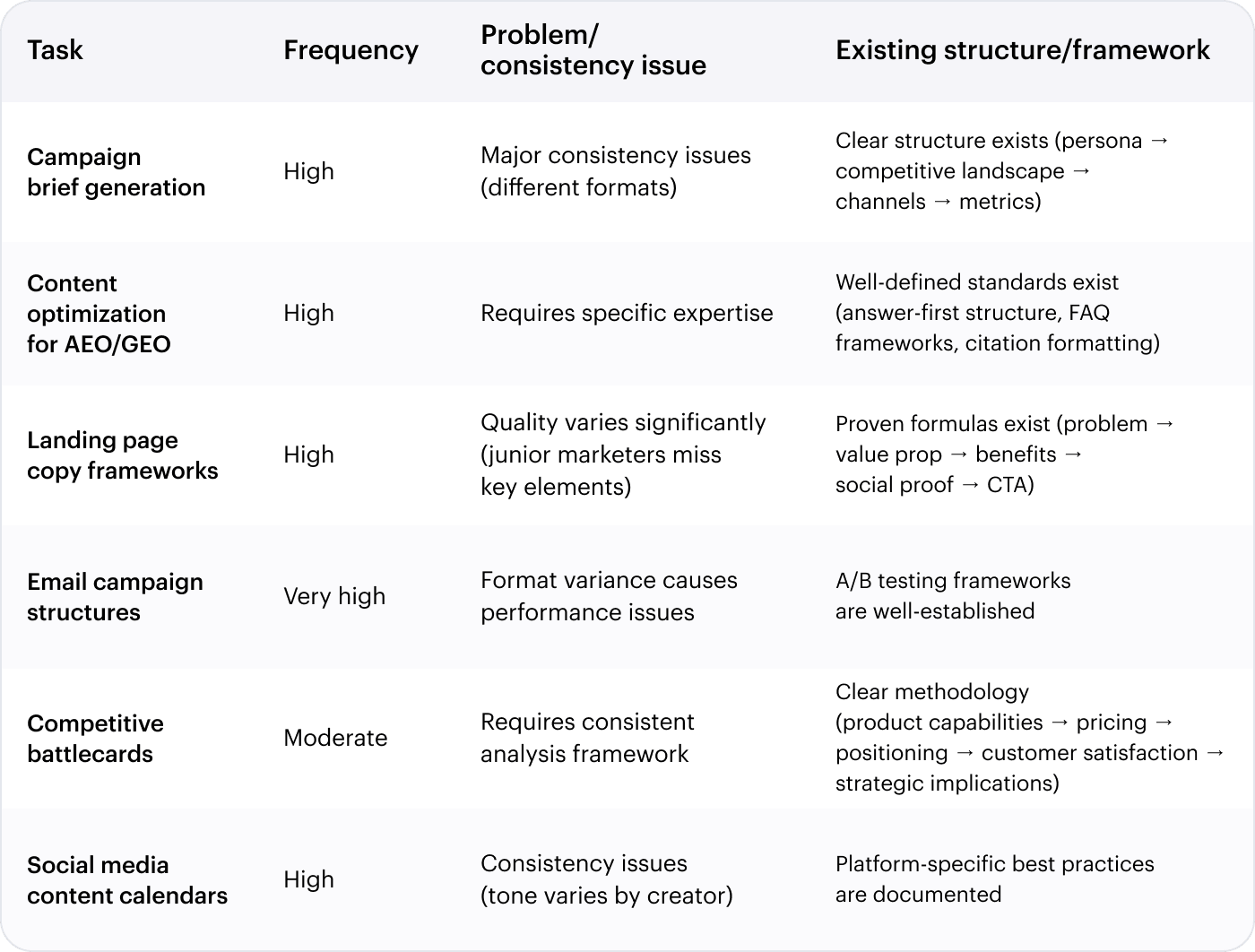
Common starting points for marketing teams
Based on WRITER customer deployments, these Skills deliver immediate value:
Getting started with Skills in WRITER
If you’re an existing WRITER customer, here’s how to identify your first Skill:
Step 1: Identify a high-value candidate using the three-criteria framework (frequency, consistency needs, structured approach). Look for tasks your senior team members excel at but junior members struggle with.
Step 2: Document your current approach. How does your best team member do this task? What steps do they follow? What decisions do they make along the way? What defines “good” output?
Step 3: Create the Skill through conversation with WRITER Agent. Describe what you want, refine through Q&A, test on a real project.
Step 4: Gather team feedback. Have two to three team members use it on real work. What did it get right? What needs adjustment?
Step 5: Refine and share. Update based on feedback. Then make it available to relevant teams.
Step 6: Compose into Playbooks. Once the Skill works reliably, integrate it into your multi-step workflows.
New team members benefit immediately. When someone new joins, they browse the Skills library on day one. See Landing Page Copy Skill, Email Sequence Skill, Competitive Analysis Skill — all with descriptions and usage examples. Start producing quality work immediately instead of spending weeks learning “how we do things here.”
Skill governance
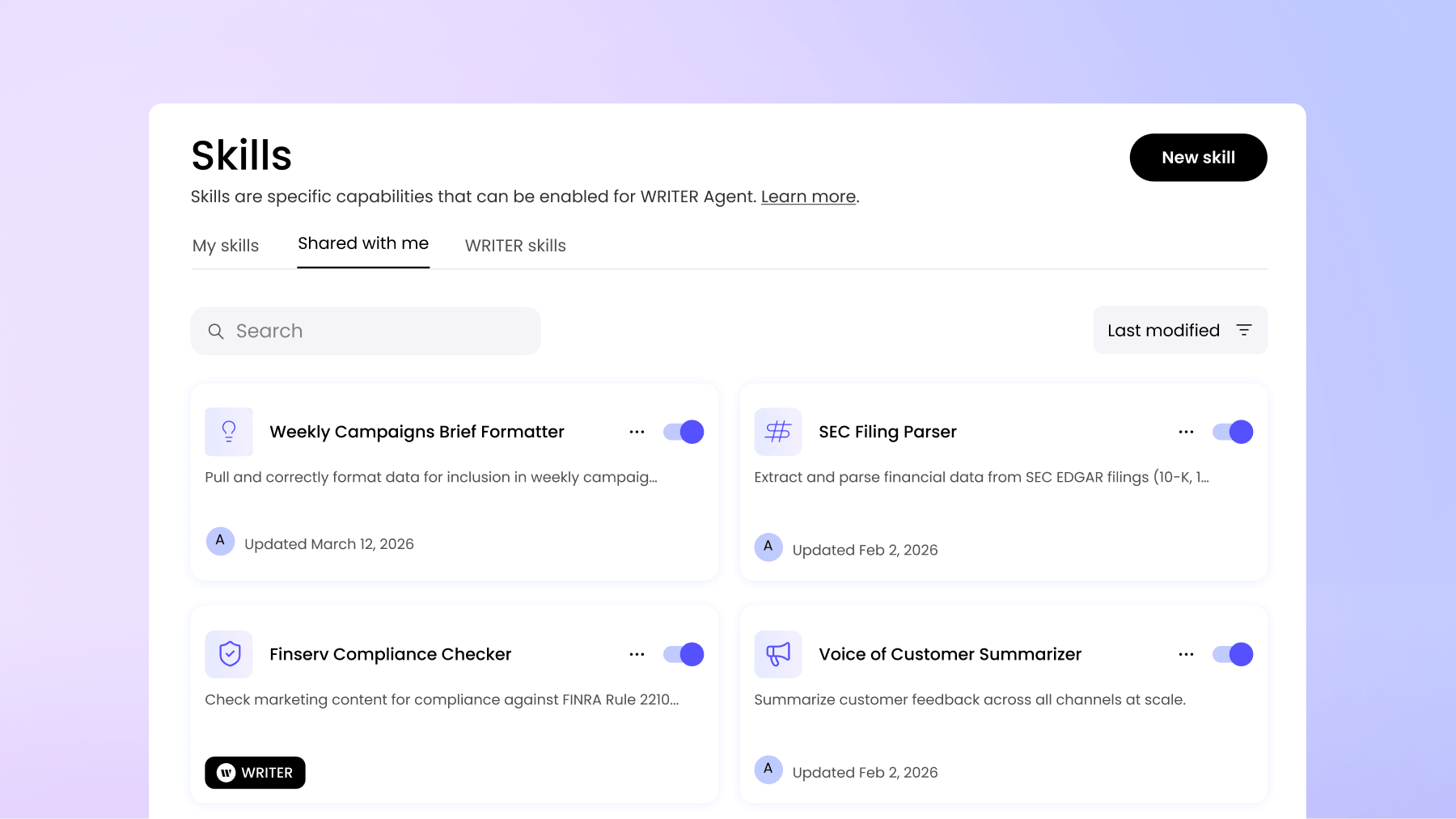
As your Skills library grows, assign Skill owners for each functional area. With enterprise-grade agent supervision, IT maintains visibility into all Skills while empowering teams to create and manage their own expertise. Your content lead owns content optimization Skills. Your demand gen manager owns campaign execution Skills. Review Skills quarterly for relevance. Archive outdated Skills rather than deleting them (this preserves institutional knowledge). Most teams maintain 10-20 core Skills per function — enough to capture expertise without creating overwhelming choice.
Your competitive advantage, encoded
Your competitors use the same AI tools and platforms. What differentiates you is the expertise you encode into them.
WRITER Skills capture your methodologies, quality standards, and decision frameworks — the institutional knowledge that makes your marketing team exceptional. When your best strategist’s expertise becomes a Skill, every team member works at that level.
Research shows 28% of employees have seen AI produce dangerously wrong, unethical, or biased results. Generic agents create risk. WRITER Skills turn your institutional knowledge into the foundation every AI interaction builds on.
Next steps:
Evaluating WRITER? Request a demo to see Skills in action.
Already a customer? Start building your first Skill today.
Frequently asked questions about WRITER Skills
Yes. WRITER Skills integrate with your CRM systems, analytics platforms, marketing automation, and data warehouse through Connectors. A campaign-reporting Skill can pull real-time data from HubSpot, combine it with pipeline data from Salesforce, and generate a performance report showing which campaigns drive qualified opportunities.
Initial creation takes 30-60 minutes using WRITER’s conversational interface. However, the most effective Skills evolve through iteration. Plan for the initial build, then two to three refinement cycles based on team feedback over the first month. The time investment is front-loaded but pays dividends — you spend an hour documenting your email campaign approach once, then save 90 minutes every time someone builds a sequence.
The best Skill creators are experienced practitioners who deeply understand both the task and the quality standards required. Your demand gen lead should create email campaign Skills. Your content strategist should create optimization Skills. Your brand manager should create messaging consistency Skills. The people closest to the work create the best Skills — and with WRITER’s natural language interface, they can do it themselves without engineering support.
WRITER Skills are platform-native components designed for enterprise teams. Unlike pasting custom instructions into individual conversations, WRITER Skills have built-in version control, sharing permissions, usage tracking, and integration with Playbooks. They’re discoverable in a centralized library, attach automatically to relevant workflows, and update globally when you refine them. Most importantly, they’re built for business users — you create them through conversation, not code.
Yes. That’s the strategic advantage. A Landing Page Copy Skill created by your product marketing team can be used by demand gen, content, events, and partner marketing. Everyone benefits from the same institutional knowledge. Skills create consistency not just within teams, but across them — your entire marketing organization follows the same proven frameworks and produces the same quality outputs.
WRITER Skills are designed for iteration. When your messaging strategy shifts, compliance requirements update, or you discover a better approach, update the Skill in WRITER’s interface. All future uses automatically reflect the improvements. Version history shows exactly what changed and when. This is where Skills surpass documentation — traditional documentation goes stale because updating it doesn’t change how people work. WRITER Skills update both the knowledge and the execution simultaneously.
Skills are the building blocks that Playbooks orchestrate. A “Product Launch Campaign” Playbook might use your Competitive Analysis Skill to gather intelligence, your Messaging Framework Skill to develop positioning, your Landing Page Copy Skill to draft pages, and your Email Sequence Skill to plan nurture — all automatically executing your proven methodologies in the right sequence. The Playbook handles the orchestration. Skills ensure each step follows your standards.
More resources


AI agents at work
– 17 min read
How to build an AI-native marketing engine: The platform capabilities that make it possible

Diego Lomanto, CMO