
Enterprise transformation
– 16 min read
Your next headcount is an AI Agent Owner: The new roles that define a successful agentic enterprise


Let’s get one thing clear from the start: the agentic AI revolution isn’t about replacing your people. It’s about redefining their roles — and that’s a profoundly different story.
- The agentic AI revolution isn’t about job displacement — it’s about role redefinition. While 92 million jobs may be displaced by 2030, 170 million new roles will be created, with productivity gains of up to 30%.
- Three critical roles define the agentic enterprise: AI Agent Builder (bridges business needs and technical execution), AI Owner (maximizes strategic impact), and AI Champion (drives cultural adoption). Forward-thinking companies are already hiring or developing these functions.
- “Big G, Little g” governance balances safety with agility. “Big G” provides enterprise-wide guardrails, while “little g” enables decentralized, day-to-day decision-making. This framework prevents both paralysis and chaos at scale.
- Individual contributors now need management skills. Every employee is effectively managing AI agents, requiring training in strategic thinking, performance management, delegation, and right-to-left planning—a seismic shift in professional development.
- Start with a 90-day pilot, not a company-wide transformation. Month 1: Assess and secure executive alignment. Month 2: Run pilots with interim AI Owners. Month 3: Formalize roles and governance. This phased approach works for Fortune 500 complexity.

I know the headlines are alarming. The World Economic Forum estimates that 92 million jobs could be displaced by AI by 2030. But here’s what doesn’t make the front page: that same research predicts 170 million new roles could be created in the process.
Key Stat: By one estimate, agentic AI systems could increase average worker productivity by up to 30%, while job postings in agentic AI increased by 985% in the 2023-24 period.
A narrow narrative of displacement misses the bigger picture entirely. Let’s strive for human augmentation, not human obsolescence.
We’re in the middle of the greatest technological revolution of our lives. Revolutions disrupt the status quo by redefining and rapidly embedding what’s possible. Agentic AI isn’t just changing how we work; it’s unlocking productivity gains of up to 30% and reshaping what work actually means. The question for us as people leaders isn’t whether this transformation is happening — it’s whether we’re going to lead it or let it happen to us.
Here’s my call-to-arms: to allay employment fears around the use of agentic systems, ensure AI delivers real value for our organizations, and secure a more resilient future for all of us, CHROs must nurture a people-anchored culture and operating model where AI is deliberately used as a force multiplier for human workers. That’s not just a mandate for technology leaders — it’s a mandate for us.
Introducing the new org chart
If you’re a CHRO reading this, I want you to think about your next headcount plan. The agentic enterprise demands a new kind of organizational architecture — one built around human-agent collaboration rather than traditional human-only hierarchies.
What does this mean practically? It means the org chart of the future includes roles like AI Agent Builder, AI Owner, and AI Champion — roles that sit at the intersection of technology, business strategy, and human enablement.
These aren’t theoretical job titles. They’re strategic roles that forward-thinking companies are already creating to bridge the gap between technological possibility and business value.
The three critical roles you need to create
1. The AI Agent Builder: Your new architect of automation
Think of the AI Agent Builder as the bridge between identified business needs and successful technical execution. This role— which can be formal or informal depending on your organizational structure — is responsible for architecting and building bespoke AI agents that solve specific business problems and automate complex workflows.
AI Agent Builders don’t just write code. They master two critical technical disciplines:
Prompt engineering: Crafting the precise instructions that guide agent behavior and decision-making
Context engineering: Imbuing agents with the right data, knowledge, and tools to execute effectively
They collaborate deeply with business stakeholders to identify high-value use cases, then rigorously test agent performance against defined business objectives. It’s part business analyst, part technologist, part organizational designer. Moreover, they can coach your other employees on simpler builds — amplifying their leverage and impact across the company.
Strategic importance: This is the role that translates your business strategy into automated workflows in ways that are reliable, integrated, and organizationally visible. Without it, you’re leaving your agentic transformation to scattered activity and chance.
2. The AI Owner: Your programmatic driver of strategic impact
The AI Owner is the role I think is most critical for HR leaders to understand. We’ve all seen the difficulties of executing organization-wide transformations, and the need for strong leaders to be at the helm.
Core mandate: Maximize the impact of AI adoption by identifying high-value opportunities and overseeing transformative change management. This isn’t about experimentation for the sake of it—it’s about focused, strategic thinking that prioritizes initiatives with the highest business impact.
This role requires someone who can zoom out and take a 30,000-foot view of the organization, seeing cross-functional dependencies and opportunities, assess and galvanize the spread of AI across business units, identify where teams face implementation challenges, and direct AI innovation to highest-value areas.
Why this matters: The AI Owner is your critical and focused business thinker, your ‘GM’ of AI for your business — someone who asks hard questions about ROI, about organizational readiness, about whether we’re solving the right problems in the right way — and then pushes your organization to close those gaps and meet the moment.
3. The AI Champion: Your cultural change agent
Culture doesn’t change through mandates. It changes through modeling, advocacy, and grassroots adoption. That’s where the AI Champion comes in.
This role — which should be embedded across teams rather than centralized — is responsible for advocating for function- and team-level high-value and responsible AI use, accelerating adoption, supporting intentional experimentation, and facilitating knowledge-sharing. AI Champions identify potentially transformative use cases, shepherd pilot projects, and most importantly, they build organizational awareness and literacy around building and expanding agentic systems.
Strategic value: Without AI Champions distributed throughout your organization, your agentic transformation becomes a top-down mandate rather than an organic and sustainable shift in how people work. Think of this as the yang to the AI Owner’s yin — ensuring that top-down, enterprise-wide AI priorities are understood and embedded into every team and function in ways that are tailored for success.
Real talk: What we’re learning from early adopters
At our recent AI Leaders Forum, leaders from Fortune 500 companies shared what they’re learning as they build these new functions. A few themes emerged:
On the AI Owner role: One global financial services company (15,000+ employees) initially embedded the AI Owner function within their CTO organization. Within six months, they moved it to report directly to the COO. Why? “This isn’t a technology problem,” their CHRO told us. “It’s an operational transformation problem. The AI Owner needs visibility across every business unit and the authority to redirect resources to high-impact areas.”
On AI Champions: A healthcare organization discovered that their most effective AI Champions weren’t the most technically sophisticated employees—they were the ones with the strongest relationships and trust within their teams. “We learned that psychological safety matters more than technical expertise,” their VP of Talent Development shared.
On organizational resistance: Multiple leaders acknowledged pushback from middle managers who feared these new roles would diminish their authority. The solution? Reframe AI Owners and Champions as enablers rather than overseers. They’re there to support and empower, not to police or punish.
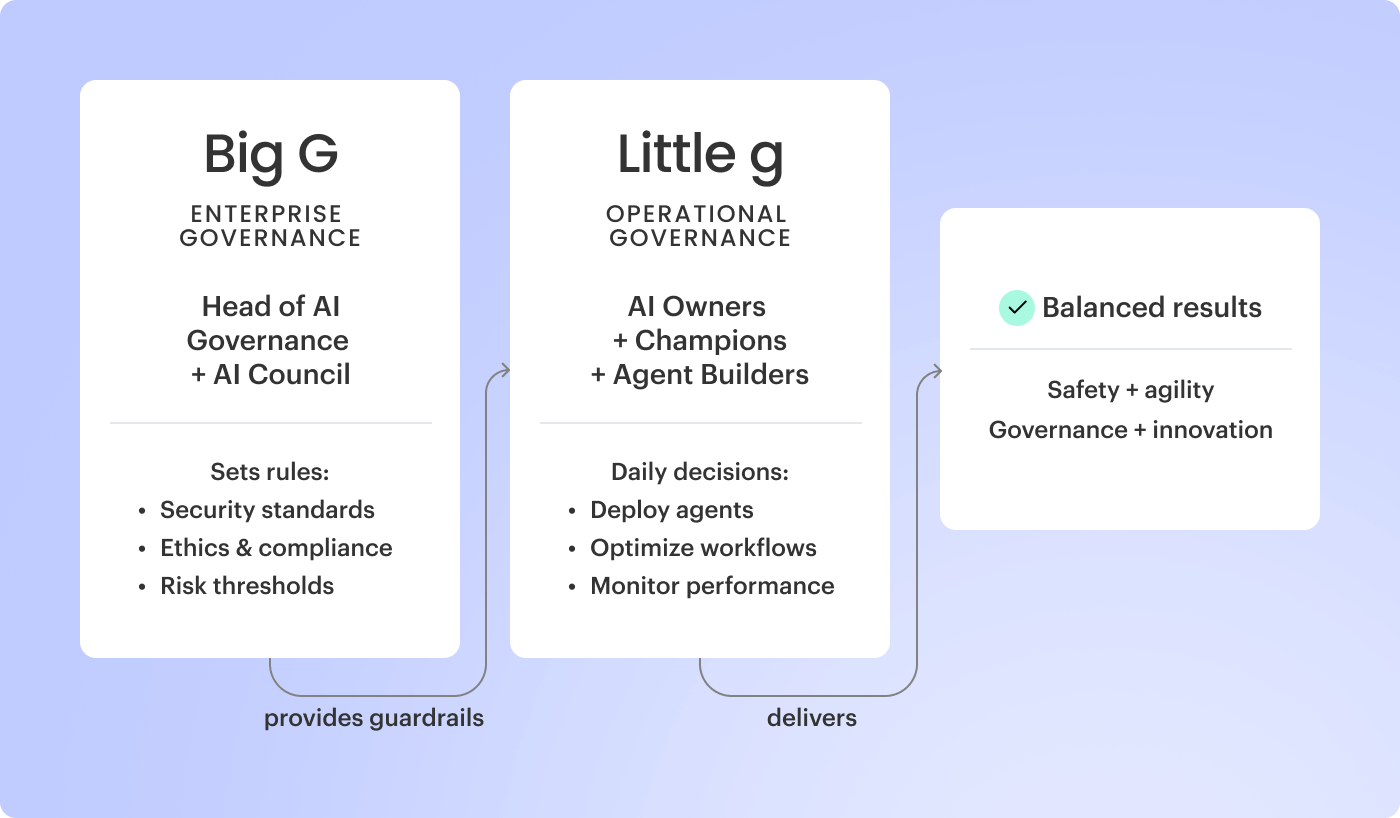
Big G, Little g: The governance framework that makes it all work
Here’s where it gets practical. How do these roles actually work together? How do you balance enterprise-wide standards with the agility and specificity that teams need to innovate?
Understanding the two-layer system
“Big G” is your centralized, top-down constitution for the agentic enterprise. It’s established by your Head of AI Governance and cross-functional AI council, and it provides the non-negotiable principles within which all agents and initiatives must operate. Think of it as your enterprise-wide rulebook: data security standards, ethical guidelines, compliance requirements, risk thresholds.
“little g” is where the magic happens. It’s the decentralized, dynamic set of practices that teams use to manage their agents day-to-day. This is where your AI Champions and AI Agent Builders live—embedded directly within business units, not in some separate AI organization.
They’re making decisions about which agents to deploy, how to optimize workflows, and how to solve specific business problems within the guardrails of Big G. Your marketing team has its own AI Agent Builders working on content automation. Your finance team has builders focused on reporting and analysis. Your customer service team has builders creating support agents. The work happens where the business problems live.
The shift that catches everyone off-guard
Here’s why this matters for people leaders: “little g” is where a new suite of managerial skills becomes critical, as leaders shift from doing the work to defining it. Your managers aren’t just managing people anymore; they’re orchestrating human-agent teams.
But here’s the part that I think is catching many of us HR leaders off guard: this isn’t just about traditional people managers anymore.
Individual contributors — people who have never had direct reports — are now all effectively managers too, managing AI agents. They’re defining work, setting parameters, providing iterative and constructive feedback, and making strategic decisions about when to delegate to an agent versus when to do the work themselves.
The skills everyone now needs
This means we need to democratize management skills across the entire organization. Your individual contributors now need training in:
- Strategic, systems thinking: Understanding how their work connects to broader business goals and outcomes and deconstructing it into component parts
- Operations and process optimization: Working backward from desired outcomes to define the work, reworking workflows in little or big ways
- Performance management: Evaluating agent output, providing guidance, and knowing when to intervene
- Delegation and orchestration: Determining what to assign to agents versus what requires human judgment
- Feedback and iteration: Refining agent behavior over time to improve performance
💡 Key Insight: This is a seismic shift in how we think about professional development. We’re not just upskilling people on tools; we’re fundamentally expanding the scope of individual accountability and decision-making authority.
The linchpin of this framework is in its balancing act. “Big G” offers ethical and regulatory consistency, while “little g” enables teams and individuals to apply those principles at a localized level. You get both safety and agility. You get both governance and innovation.
Addressing the objections you’ll face
Let me address the concerns I know you’re already thinking about — because I hear them from many CHROs I talk to.
“We can’t afford new headcount right now.”
My response: You’re already paying for this problem — you just don’t see the line item yet.
The cost of not having an AI Owner shows up as:
- Failed pilot projects that never scale Gartner predicts 40% of agentic AI projects will be canceled by 2027
- Productivity locked in silos while other teams reinvent the wheel
- Security incidents from ungoverned shadow AI
- Competitive disadvantage as more nimble companies pull ahead
The reframe: This isn’t new headcount — it’s strategic redeployment. Start by evolving existing roles. Your best project manager could become your AI Program Director. Your most respected cross-functional leader could become your AI Owner. We don’t need to hire from scratch; we need to redesign for impact. And what a way to develop your highest-potential leaders by giving them a once-in-a-career opportunity to work on company-wide, strategic, critical initiatives.
“Isn’t this the CTO’s problem?”
My response: If a CHRO thinks AI transformation is just a technology problem, they’ve already lost. And they’re signing up for their own obsolescence.
Technology can build the agents. Technology can ensure they’re secure and compliant. But technology can’t:
- Change how 10,000 employees think about and manage their work
- Redesign performance management systems for human-agent teams
- Reskill individual contributors to think strategically and from a systems view
- Overcome the cultural resistance and fear that comes with role and organizational redefinition
- Ensure the “soul” of your company — your people — are empowered rather than displaced
The reality: Nearly 72% of executives expect generative AI to augment their workforce and boost productivity, yet 68% are concerned about its impact on how people work. That tension? That’s HR’s mandate to resolve.
The opportunity: This is our chance to be the essential architect of organizational transformation, not just the administrator of it.
“We’re a 100,000-person company. We can’t move this fast.”
My response: You’re right. And you shouldn’t try to.
Here’s a 90-day roadmap that works for Fortune 500 complexity — focused on piloting, learning, and building repeatable patterns before you scale:
Month 1: Assess + Align
Week 1-2:
- Audit your current AI initiatives. Where are agents already being used (officially or unofficially)?
- Map your stakeholders: Who’s experimenting? Who’s resistant? Who has influence?
- Identify your first AI Champion candidates—look for credibility + curiosity, not just technical expertise
Week 3-4:
- Secure executive sponsorship. Meet with your CEO, CFO, and CTO individually. Use the Big G, Little g framework to explain why this is both a governance and an enablement challenge.
- Create your business case: What’s the cost of failed pilots? What’s the opportunity of scaled adoption?
Month 2: Pilot + Learn
Week 5-6:
- Choose your pilot business unit (high impact, high buy-in, manageable complexity)
- Appoint an interim AI Owner for the pilot (test the role before you formalize it)
- Launch 2-3 high-value agent use cases with clear success metrics
Week 7-8:
- Run weekly retrospectives. What’s working? What’s not? What skills are people missing?
- Document your learnings. You’re building the playbook for scale.
- Identify your first formal hire or promotion: AI Program Director or AI Owner
Month 3: Formalize + Communicate
Week 9-10:
- Write your “Big G” governance policy (use RACI matrices to clarify roles)
- Create role descriptions for AI Owner, AI Champions, and AI Agent Builders
- Open your first formal requisitions or redeploy existing high-performers into the roles
Week 11-12:
- Launch a company-wide communication campaign: “Here’s what we’re building and why”
- Host a town hall with your executive team. Make the case for role redefinition, not job displacement.
- Begin training your first cohort of AI Champions
- Integrate the next quarter’s AI roadmap into your existing business planning and rhythms
By Day 90, you should have:
✅ 1 pilot business unit with measurable results
✅ 1 formal AI Owner or Program Director hired (or redeployed)
✅ 5-10 trained AI Champions evangelizing across teams
✅ A governance framework that can scale
✅ Executive alignment on the strategic importance of workforce enablement
✅ A documented playbook for expanding to the next 5 business units
Then what?
- Months 4-6: Scale governance and expand to additional business units.
- Months 7-12: Democratize management skills training and embed AI capabilities across the organization. You’re not transforming overnight — you’re creating repeatable patterns that scale safely.
The call for leadership
Here’s the reality: you can have the best AI technology in the world, and it won’t matter if your people don’t know how to work with it — or worse, if they’re afraid of it.
Building this new workforce requires bold, visionary leadership from the HR function. It requires us to move from thinking about AI as someone else’s problem to recognizing it as central to our mandate. And it requires us to go on offense in driving the transformation of our organizations and the leadership capabilities of our people.
This isn’t just about upskilling. It’s about fundamentally rethinking how we develop talent, how we structure teams, and how we measure performance. It demands a culture of continuous learning and adaptation, where employees are empowered to work alongside AI to create new value.
Practically, this means:
- Rethinking talent acquisition to emphasize agentic-specific skills and apprenticeships
- Investing in multi-faceted training and development — online courses, bootcamps, apprenticeships — to transform mindsets and capabilities
- Securing executive sponsorship from the outset to dispel fears and build understanding of ROI
- Creating clarity through governance structures that define how new AI roles interact and collaborate
The organizations that will succeed are those where the “soul” of the company — its people — continues to be prioritized. Technology might be the catalyst, but culture is the foundation.
The future belongs to the people-first and the AI-native
We’re in uncharted territory. No one has all the answers. The landscape shifts every three to six months. But here’s what I know: the companies that will win in the agentic era are the ones that invest deeply and strategically in their people. This is a ‘yes and’ moment in both investing in transformative new technology and equipping our employees to harness its potential.
Success won’t be measured by the size of your team or the sophistication of your technology stack. It will be measured by how effectively your people and agents collaborate to deliver business outcomes. That’s the new competitive advantage.
As organizations evolve from hierarchical structures to dynamic networks of humans and agents working in unison, the role of HR becomes more critical, not less. We’re not just managing people anymore; we’re architecting the future of work. Let’s each of us be the compass that guides our organizations through this wilderness of complexity and change.
So here’s my challenge to you:
Look at your org chart. Look at your talent strategy for 2026. Are you designing for the organization you had, or the one you need to build? Are you creating roles that bridge technology and human capability? Are you investing in the cultural foundation that makes human-agent collaboration not just possible, but powerful?
The future is already here. It’s time to redesign our companies to match it.
Take the next step
Ready to design the org chart of the future? Download “The Agentic Compact” to get the complete framework for workforce enablement in the AI era — including:
- Detailed role descriptions for each agentic role (mandates, responsibilities, strategic importance)
- A CIO’s operational blueprint for implementing agentic systems
- Guidance on using RACI frameworks to coordinate new roles
- The six articles of responsible AI governance that inform your people strategy
Jevan Soo Lenox is Chief People Officer at WRITER, where he leads the people strategy for an AI-first organization. Previously, he led people functions at companies applying AI to e-commerce and biotech, giving him a front-row seat to the promises and challenges of workforce transformation in the age of intelligent systems.
From pilots to performance
How enterprise marketers scale AI and prove ROI
The 12 marketing agent systems driving real ROI at leading enterprises
See moreMore resources
Humans in the loop
– 8 min read
The $10 billion culture gap: Jevan Soo Lenox, Chief People Officer at WRITER

Alaura Weaver

Enterprise transformation
– 10 min read
Empowering your AI champions to become AI builders

Writer Team