AI agents at work
– 17 min read
AI made your marketing team faster. Why isn’t it showing up in the results?


Only 5% of marketing leaders report significant gains on business outcomes from AI.
That number comes from Gartner’s 2025 survey — and it should be uncomfortable to read. Because the productivity gains are real. Early adopters report 41% ROI on AI investments. Marketing and sales generate roughly 20% of AI’s total business value. The tools work. The returns are measurable.
So what explains the gap?
Most enterprise marketing teams are capturing productivity without translating it into strategic advantage. They’re getting ROI on the AI investment — more emails sent, more drafts created, more posts published — without transforming what their organization can actually do.
When every marketer becomes 20% faster, it feels like progress. But when everyone has the same AI tools, productivity gains alone don’t create competitive advantage. What creates a competitive advantage is what you DO with the productivity gains. Are they going back into the system and compounding over time?
Your competitors aren’t just working faster. Some of them have made a shift that changes the math entirely — building systems that handle entire categories of work autonomously, freeing capacity that compounds quarter over quarter. While some teams measure gains in percentages, these teams measure it in “work we couldn’t do before that we now do systematically.”
This is the path from 1x to 10x marketers. The gap between them isn’t chasing the latest AI model or bigger budgets. It’s mindset — recognizing that AI isn’t a productivity tool but a transformation of how work happens — combined with infrastructure that makes that transformation accessible to marketers, not just engineers.
What do we mean by “10x”?
You’re probably thinking: “10x sounds like vendor hyperbole.”
Fair. Here’s what we actually mean: 10x isn’t about creating ten times more content. It’s about what becomes possible when you eliminate six months of manual work annually and reinvest that capacity into strategic differentiation.
Vodafone UK eliminated 1,000 hours per year from their campaign workflow. EE went from 30% to 100% of products meeting quality standards while cutting creation time by 90%. Qualcomm freed up 2,400 hours monthly for legal and brand teams.
Is that literally 10x productivity? Not always. But it’s transformational enough that the teams experiencing it describe operating at an entirely different level. The label matters less than the operating model shift.
A note on scope: This framework applies to marketing teams managing complexity across functions, regions, or brands — not individual contributors using consumer AI tools for blog drafts.
In this article
The 1x marketer: AI as a personal productivity tool
The 5x marketer: AI as workflow infrastructure
The 10x Marketer: AI as team members
Three questions that reveal where you are
Why do most teams stay stuck at 1x?
Your path from 1x to 10x
What 10x marketing requires
The complete playbook
Frequently asked questions
The 1x marketer: AI as a personal productivity tool
The 1x marketer represents the most common AI adoption pattern in enterprise marketing today. The tools are accessible, the barrier to entry is low, and the productivity gains feel real.
How do 1x marketers work with AI?
You need to create something — an email, a social post, a brief. You open ChatGPT or Claude and type a prompt. You get output, iterate a few times, copy-paste the result, manually edit to add your voice and context. You go back to generate versions for each channel. You post them one by one. You track results manually, if at all. You start from scratch for the next asset.
There’s no workflow. Just a collection of one-off interactions that don’t scale or compound. You’re probably 10-20% more productive. But you’re still doing all the thinking, all the coordinating, and all the quality assurance.
Why marketers stay in ad-hoc mode
If workflows are more efficient, why do smart marketers resist them? Two reasons.
First, fear of losing creative control. The concern is real: “If AI generates everything automatically, where do I add my perspective? How do I course-correct when something feels off-brand?”
Second, a misconception about what workflows mean. There’s a common misunderstanding that workflow automation means “set it and forget it” — that once you build a workflow, you surrender judgment.
But here’s what 5x and 10x marketers understand that 1x marketers don’t: Workflows don’t eliminate human judgment. They move it upstream.
Instead of editing every word at the end, you provide strategic input at key checkpoints — set creative direction at the start, review and approve outputs before publishing, provide feedback that improves the workflow for next time. You’re still iterating. You’re still exercising judgment. You’re just doing it at moments that matter.
Why 1x doesn’t scale at enterprise
For small marketing teams, this 1x approach works fine. Ten people using consumer AI tools get real productivity gains without the organizational complexity.
But for a Global 2000 marketing organization — with teams across regions, functions, and brands — things break almost immediately.
Shadow IT proliferates. When every marketer uses their own AI tools, IT loses visibility and control. Data flows into unsecured third-party systems. Compliance becomes impossible to enforce. What started as “helpful productivity hacks” becomes an audit nightmare.
Brand consistency fractures. Without centralized guardrails, each team member interprets voice differently. Regional teams develop their own standards. The brand fragments. Customer experience suffers. Your 20% productivity gains buy you brand inconsistency that takes months to fix.
Security risks compound — especially in regulated industries. Sensitive customer data, unreleased product details, and confidential strategies get pasted into consumer AI tools with unclear data retention policies. For financial services, healthcare, and pharmaceutical companies, this isn’t just bad practice — it’s potential regulatory violations.
The hidden math: Your team saves 100 hours per month using consumer AI tools. But legal spends 80 hours reviewing brand compliance issues. IT spends 60 hours investigating shadow AI usage. Security spends 40 hours assessing data exposure risks. You’re not ahead. You’re behind, with added organizational friction and risk.
The mindset: “AI is a tool that helps me work faster.”
The reality at scale: Individual tools don’t add up to transformation. They add up to organizational risk you can’t measure and costs you can’t control.
The 5x marketer: AI as workflow infrastructure
The 5x marketer has made one critical shift: AI doesn’t assist individual tasks anymore. It orchestrates complete workflows while the human focuses on strategic oversight.
You create a repeatable process — say, campaign asset generation. You build an AI workflow that handles research, content creation, channel adaptation, formatting, and metadata tagging end-to-end. You review and approve the outputs. The agent publishes and tracks performance. You analyze results and optimize the workflow. Then you run it again. The hundredth execution is as efficient as the first.
Vodafone UK: What 5x looks like in practice
Alex Pott’s demand generation team at Vodafone UK faced a problem every marketing team knows: creating campaign banner variations across different platforms and audience segments. The manual process consumed 15-20 hours per week — time spent on pixel-pushing, resizing, reformatting, and adapting copy for each platform and audience.
With WRITER, they built an AI workflow that handles the banner creation end-to-end. The AI generates platform-specific variations, adapts messaging for different audience segments, and formats everything to spec. The human team focuses on the final quality check.
What used to take a full day now takes 2 hours. The team eliminated 20 hours per week of manual work — 1,000 hours annually.
As Pott explains: “You’ll never take the human away from that final copy check because that’s important for professionalism and quality, but the pace at which they can get to that quality check is unbelievable.”
The compound effect of workflow thinking
5x marketers aren’t just faster at individual tasks. They’ve eliminated entire categories of work from their personal task list. And the gains compound: 20 hours saved per week × 50 weeks = 1,000 hours annually. That’s six months of full-time work reclaimed for strategic initiatives.
The jump from 1x to 5x requires moving beyond one-off prompts to reusable workflow templates that capture your organization’s best practices. Build the workflow once — with brand guidelines, quality standards, and approval gates built in. Your EMEA team clones it, adjusts for regional specifics, and launches in 20 minutes instead of 20 hours.
When workflows become organizational assets instead of individual skills, your gains multiply.
The mindset: “AI is infrastructure that handles workflows while I focus on strategy.”
The 10x Marketer: AI as teammates
The 10x marketer has made a fundamentally different kind of shift. AI agents aren’t just automating workflows — they’re autonomous teammates with specific domains of responsibility. You treat them the way you’d treat a human teammate: you define their role, set expectations, establish quality standards, give them feedback, and let them execute.
You don’t have a workflow anymore. You have an operating model.
The research agent monitors industry news, tracks competitors, and synthesizes insights weekly. The content agent produces campaign assets end-to-end based on your strategic brief. The optimization agent monitors performance and generates recommendations. The localization agent adapts content for different markets automatically.
You’re no longer executing — or even managing individual workflows. You’re conducting an orchestra.
EE: What 10x looks like in practice
Bradley Lane, Head of Product at EE (the UK’s largest mobile network operator), faced an impossible math problem: 4,500 products online, plans to add thousands more, and each product description taking 3 hours to create manually. Only 30% of their products met EE’s “gold standard” for content quality. Scaling the catalog while maintaining brand consistency seemed impossible.
They didn’t just build a workflow. They built an AI-native operating system for product content.
With WRITER, EE embedded their brand voice and guidelines directly into the platform. AI agents now handle product description creation end-to-end — from initial draft through channel adaptation to final formatting. Product content that once took 3 hours now takes 15-20 minutes.
The transformation: 90% time savings on content creation. 30% to 100% of products now meeting gold standard. 4,500+ products managed systematically.
But here’s what makes this 10x, not just 5x: The copywriters didn’t just get faster. Their jobs fundamentally changed.
“It’s enabling the copywriters to have more time to think, not just to process,” Lane explains. “Really to take a step back, look at the results, ensure it’s to our requirements, but also enable the copywriters to do other activities beyond product description creation.”
The team moved from content production to content strategy. From tactical execution to creative direction. From tactical execution to creative direction. From managing volume to elevating quality standards across everything. That’s the operating model shift.
The mindset: “AI agents are teammates with specific responsibilities. My job is to set direction, define quality standards, and solve problems they can’t.”

How to build an AI-native marketing engine: platform requirements that make this operating model possible
Read More
Three questions that reveal where you are
The difference between 1x, 5x, and 10x marketers shows up most clearly in how they respond to common situations. Here are three questions that reveal where you are — and where you could be.
Question 1: When you’re scoping a new initiative, what do you ask first?
The 1x question: “What tools will we need?”
The 10x question: “How can we design this to be AI-native from day one?”
When Vodafone UK saw customer searches through AI platforms explode from 0.5 billion to 4 billion in just 12 months, they didn’t ask “What SEO tools do we need?” They asked “How do customers discover us in an AI-assisted world?” The result was a GEO (Generative Engine Optimization) agent that automatically optimizes content for AI-generated search responses.
The shift: From “What do I need to buy?” to “How would I architect this system?”
Question 2: When you’re facing a capacity problem, what do you ask?
The 1x question: “Who can take this on?”
The 10x question: “Could an agent run this better and free humans up for more strategic work?”
EE’s team could have asked “Who has capacity to create 4,500 product descriptions?” Instead, they asked “Should humans be writing descriptions at all, or should they be curating experiences and setting quality standards?” The answer changed everything about how their team operates.
The shift: From “How do we do more with existing people?” to “What work should humans stop doing entirely?”
Question 3: When you identify a problem, what’s your default solution?
The 1x question: “What software should we buy?”
The 10x question: “Is this a tool purchase or an AI agent opportunity?”
Many teams default to buying point solutions — another email platform, another social scheduler, another analytics dashboard. But often what you actually need isn’t another tool. It’s an AI agent that orchestrates your existing tools and executes the workflows to deliver the outcomes you want.
The shift: From “What should we buy?” to “What should we build?”
Not sure which workflows to build first? The Marketing AI Prioritization Toolkit gives you the Impact × Frequency Matrix and a 30-minute workshop to run with your leadership team. Identify your highest-ROI workflows before you build anything.
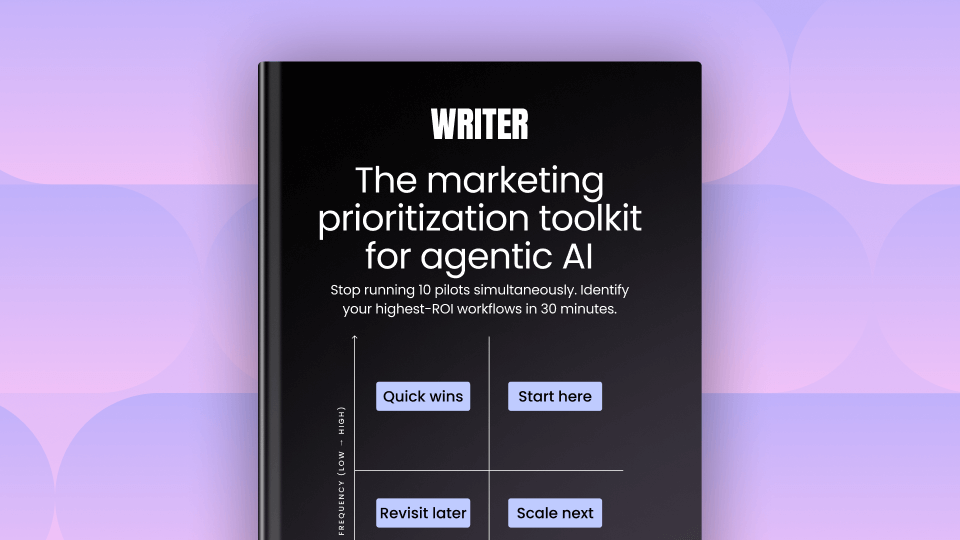
The marketing AI prioritization toolkit
Download the free toolkit
Why do most teams stay stuck at 1x?
If 10x marketing is clearly more powerful, why do most teams stay at 1x? Three reasons:
Barrier 1: Misdiagnosing the constraint
Most teams think their constraint is “we need better tools” or “we need more people.” So they buy more software or request more headcount.
The actual constraint is almost always “we haven’t redesigned our operating model for an AI-native world.”
The 1x team asks “How do we do what we do today, but faster?” and gets marginal gains.
The 10x team asks “If we could redesign how marketing work gets done from scratch, what would that look like?” and gets transformative gains.
Barrier 2: Limited vision of what’s possible
Many marketers still see AI as “good for first drafts” or “helpful for brainstorming.” They haven’t yet seen what’s possible when AI agents handle complete workflows end-to-end with appropriate quality standards and human oversight.
As more examples emerge — Vodafone UK’s campaign automation, EE’s product content engine, Qualcomm’s brand consistency system— teams are realizing the potential is far beyond “slightly faster email drafting.”
Barrier 3: Platform accessibility gap
This is the hidden constraint: Many platforms claim to enable “AI-native marketing” but actually require programming skills, API knowledge, or integration expertise that marketing teams don’t possess.
Brent Summers, Senior Manager of Marketing Technology at Qualcomm, built the company’s #1 most-used agent — a Snapdragon brand compliance tool — in four weeks. As a marketer, not an engineer.
“I’m not an AI engineer. I’m a marketer who saw problems our team faced daily — brand compliance reviews, legal approval workflows — and built agents to solve them. Four weeks from idea to production. The platform let me think in terms of tasks, inputs, and outputs instead of code.”
The capability gap between 1x and 10x isn’t a people problem. It’s a platform problem.
Your path from 1x to 10x
You don’t leap from 1x to 10x overnight. Based on 50+ enterprise implementations,, teams typically progress through predictable stages:
- Weeks 1-4: Use AI for individual tasks. Build comfort with AI-generated outputs. Learn what works.
- Weeks 5-12: Identify repeatable processes worth automating. Build first complete workflows. Start measuring time savings.
- Months 4-6: Build multiple workflows working together. Agents handle complete functional areas. Team focuses more on strategy, less on execution.
- Months 7-12: AI agents have standing responsibilities. Humans are purely in orchestration and creative direction roles. Compounding gains get reinvested in differentiation.
Most teams move from 1x to 5x in 4-6 months with proper training and platform support. The jump to 10x takes organizational commitment — but the teams that get there create competitive advantages that deepen over time.
Where teams actually stall
Most teams stabilize at 3-5x. They build 5-10 solid workflows, achieve meaningful productivity gains, and then plateau. Why?
The “good enough” problem makes urgency disappear. Organizational resistance means leadership doesn’t protect capacity for strategic reinvestment. Platform limitations create a ceiling. And without change management, teams optimize individual tasks without redesigning the operating model.
Only about 20% of teams reach genuine 10x transformation. These are the organizations where leadership made it a strategic priority, protected capacity for reinvestment, and used infrastructure that enabled marketers to build workflows themselves — not submit requests to IT.
If you’re reading this thinking “3-5x would be amazing,” you’re right. That alone is transformative. But understanding the full 10x potential helps you design for it from day one.
The difference between teams that plateau at 3x and teams that reach 10x isn’t talent or budget. It’s whether leadership treats AI adoption as “implement some efficiency tools” or “redesign our operating model.”
What 10x marketing requires
1. A leadership mindset shift
Your CMO and marketing leadership must believe that AI-native marketing is fundamentally different from “marketing with AI tools.” This isn’t about incremental productivity. It’s about transformation — protecting time for people to build workflows, celebrating orchestration over manual execution, measuring both productivity and differentiation.
2. Infrastructure that enables marketers to build
The critical capabilities: marketers (not just engineers) can build agents; integration with your existing martech stack; enterprise governance and compliance built in; organizational memory that compounds over time.
Most teams exploring this evaluate three approaches:
- Building custom: Full control and customization, tailored exactly to your workflows. Cost: $2-5M year one plus $1-2M annually ongoing, with 6-18 months to production and a dedicated engineering team required.
- Enterprise platform (like WRITER): Days to first workflows versus months. Marketing team can build without engineering backlog. No-code tools with pro-code flexibility. Trade-offs: less customization within platform guardrails, dependency on vendor roadmap.
- Hybrid: Many teams use platforms for 80% of use cases and build custom for the 20% that are genuinely unique. That’s often the optimal path.
3. Commitment to reinvestment
The 10x framework only works if you actually reinvest productivity gains into differentiation. When AI gives your content team 15 hours per week back, you can produce 15 more hours of content — a race to the bottom — or invest those hours in breakthrough creative work that sets your brand apart.
Option B requires discipline. It means saying no to some volume opportunities to protect capacity for strategic work. But it’s what creates sustainable competitive advantage.
When everyone has access to AI tools that create content at scale, volume alone won’t save you. What matters is whether you’re using that velocity to do work competitors can’t replicate.
The complete playbook
The 1x to 10x framework shows you what’s possible when you shift from “using AI tools” to “building AI-native systems.”
Mindset alone doesn’t get you there. You need the operational playbook — which workflows to build first, how to design for production from day one, how to scale from 5 to 50+ users in 8-12 weeks, and how to prove ROI to the C-suite.
Ready to move from framework to execution?
“From Pilots to Performance” is the operational playbook built from 50+ enterprise implementations. Inside: the six mistakes keeping you in pilot purgatory, the 12 agent workflows delivering measurable ROI in production right now, an 8-12 week rollout playbook, and measurement frameworks that connect AI adoption to revenue.
No generic AI strategy theory. No fluff. Just the frameworks and patterns that separate the 10% who transform from the 90% who tinker.
We’ll send it directly to your inbox. No demo scheduled unless you want one.
Frequently asked questions
What’s the realistic timeline from 1x to meaningful transformation?
Based on 50+ enterprise implementations, teams typically move from 1x to 5x in 4-6 months with proper training and platform support. The jump to 10x takes 7-12 months and requires organizational commitment — including leadership mindset shift, infrastructure investment, and deliberate reinvestment of productivity gains. Most teams stabilize somewhere between 3x and 5x, which is itself transformative.
Can marketers really build AI agents without coding skills?
Yes, with the right platform infrastructure. Brent Summers at Qualcomm built the company’s #1 most-used agent for Snapdragon brand compliance in four weeks — as a marketer, not an engineer. The platform allowed him to think in terms of tasks, inputs, and outputs instead of code. The capability gap is a platform problem, not a people problem.
What separates teams that reach 10x from those that plateau at 3-5x?
It’s not talent or budget. It’s whether leadership treats AI adoption as “implement some efficiency tools” or “redesign our operating model.” Teams that reach 10x protect capacity for strategic reinvestment rather than defaulting to producing more volume with reclaimed time. They also use infrastructure that lets marketers build and iterate themselves, rather than waiting in engineering queues.
About WRITER
WRITER is the enterprise AI agent platform that helps marketing teams transform from 1x to 10x. Our platform combines powerful AI agents with tools that marketers can actually build with — no coding required — while giving IT full governance and control.
We work with enterprise leaders like Vanguard, Salesforce, Prudential, and Qualcomm to turn AI pilots into company-wide transformation.
The new AI marketing org chart
The four marketers you actually need
More resources

AI agents at work
– 17 min read
The five pillars of AI-native marketing: Why focusing on productivity alone isn’t enough
Diego Lomanto, CMO

Inside WRITER
– 5 min read
Introducing the new partner program enterprise AI actually needs

Maureen Little, SVP of Partnerships and Ecosystem