
AI agents at work
– 18 min read
The conversation that actually drives AI adoption: Three fears every CMO must address


Your content team attended AI training. They completed the certifications. They sat through the demos and nodded enthusiastically.
Three months later, actual usage: 12%.
Here’s the paradox: These same people ARE using ChatGPT — for personal projects, side hustles, helping their kids with homework. But when it comes to work deliverables, they find reasons not to. Individual familiarity with AI tools doesn’t translate to departmental transformation.
Meanwhile, 21% of companies using the same technology are at 75%+ adoption and measuring real business impact. What’s the difference? They’re having a different conversation.
Here’s what your team isn’t telling you: “If AI can do my job, am I still valuable?” Until you address that fear directly, no amount of training will change the numbers.
- Most AI training programs fail because teams aren’t resisting the technology — they’re resisting what it means for their job security, professional identity, and your brand’s soul, and no amount of technical training addresses those fears.
- The 21% of companies reaching 75% adoption aren’t doing more training — they’re having a different conversation that addresses three core fears directly: “Will I still be valuable?”, “Is using AI cheating?”, and “Will everything sound the same?”
- The framework that works: Three strategic questions to ask at every decision point (AI-native design, agents for broken processes, build vs. buy) plus five adoption tactics including requiring leaders to be hands-on users and celebrating agentic thinking publicly.
- Most CMOs make a critical timeline mistake—they wait to start performance system changes until the pilot proves success, adding 6 months to their transformation when they should be running both tracks in parallel from day one.
- Real results from companies addressing resistance directly: 60% adoption by week 8, 75% by month 4, campaign velocity up 40-60%, and creative capacity increased 35-50% — but only when you treat this as a human problem requiring leadership, not a technology problem requiring training.

I’m the CMO of an AI company—which means I live in both worlds simultaneously. I’m not just using AI to transform marketing, I’m selling it while figuring out how to adopt it internally. If our 35-person team isn’t the living proof of what’s possible, we lose credibility instantly.
That dual pressure has taught me something valuable: The challenges your teams are facing — the fears, the resistance patterns, the pilot-to-production gap — they’re playing out the same way across every industry. Financial services, retail, manufacturing, healthcare. The human dynamics don’t change based on what you sell.
I’ve had this conversation with dozens of CMOs at Global 2000 companies. The pattern is remarkably consistent. Leadership invests in AI capabilities, provides training, mandates adoption—then watches as people find reasons not to use the tools.
What I’m sharing here isn’t theory or vendor promises. It’s what actually works—and what actually fails—from being in the arena. Real adoption patterns. Real timeline realities. Real failures we’ve lived through.
Here’s what most organizations get wrong: they treat resistance as a training problem when it’s actually a trust problem. Research backs this up: 54% of executives cite cultural resistance. Organizations with strong change management programs are 6x more likely to reach production—yet most skip this work entirely.
And the urgency is intensifying. Something fundamental shifted this year. AI agents can now execute tasks, not just generate content. They monitor channels, create projects, analyze data across systems, handle multi-step workflows. That’s when light bulbs turn on for marketers. It’s not about fact-checking AI-generated text—it’s about AI handling entire processes you hate doing manually.
Plus, we’re watching what happened to engineering. Good engineers are openly saying they’re 10x more productive with AI. Marketers are asking themselves: “Do I want to be a beneficiary of this evolution or on the losing side?” That’s creating urgency — and fears — that didn’t exist in two years ago.
The 3 real reasons your team won’t use AI (and how to address each)
Before we discuss solutions, we need to understand what we’re really solving for. The real AI adoption challenges in marketing aren’t technical — they’re human. In my conversations with marketing leaders, three core fears emerge repeatedly. Each is legitimate. Each requires a different conversation.
Fear #1: Job security and relevance
What they’re thinking:
“If AI can write blog posts, generate social content, and create email campaigns, why does the company need me? I’ve spent 10 years building expertise in content marketing. Now some VP is telling me AI can do it in 10 minutes. What’s my value proposition when AI handles the execution?”
Why this fear is legitimate:
Because some roles will change dramatically. The person whose entire job is reformatting content for different channels? AI can do that. The coordinator who manually tracks campaign performance? AI can do that better. This fear isn’t irrational—it’s a reasonable response to genuine disruption.
The conversation that changes everything:
“Your job isn’t at risk. Your drudgework is.”
Sit down with your senior copywriter. Map out how she actually spends her time. She’ll discover 60-70% of her week is mechanical work she hates—reformatting content, updating old blog posts, creating social variations, compliance checking, version control. The 30-40% she loves—strategic messaging, voice development, creative concepting—gets squeezed into margins and evenings.
Tell her: “AI handles the 70% you hate so you can spend all your time on the 30% you’re brilliant at. We’re not eliminating your role. We’re eliminating the parts of your role that prevent you from doing your best work.”
At WRITER, AI agents enable our 35-person team to achieve output that would traditionally require 45-50 people. I’ll share the specific math later in this article, but the principle is clear: AI doesn’t eliminate roles—it eliminates the drudgework within roles.
Fear #2: Identity and professional pride
What they’re thinking:
“I take pride in my craft. Using AI feels like cheating or admitting I can’t do it myself. What will people think if they know I’m using AI to write? Will they respect my work less? Will they see me as less creative? I didn’t spend years honing my skills just to become a button-pusher.”
Why this fear is legitimate:
Creative professionals have built their identity around their craft. For years, they’ve been recognized and promoted for their ability to write compelling copy, design beautiful campaigns, create engaging content. Now you’re asking them to let AI do the initial creation? That feels like diminishment, not enhancement.
The reframe that works:
“The best creators in the world use every tool available.”
Architects use CAD software. Musicians use digital audio workstations. Directors use CGI. None of that makes them less creative—it amplifies their creativity. The same principle applies to marketing.
One retail company I worked with saw this transformation firsthand. Their creative team initially resisted AI tools, viewing them as a threat to creative integrity. But when they saw that AI could handle compliance requirements and routine variations, it freed them to conceptualize a campaign that no competitor could match. The campaign drove 250% increase in search traffic because the creative team could focus entirely on breakthrough ideas rather than execution logistics.
The pattern I’ve seen work: Show them breakthrough work created by teams using AI. American Eagle’s campaign putting digital jean shorts on landmarks worldwide — only possible because AI handled routine content production, freeing the creative team for conceptual work. New American Funding’s “Hell Yeah You’re Buying A Home” campaign that cut through mortgage industry blandness — enabled because AI handled compliance drudgework, freeing creatives for bold messaging.
The reframe: “AI doesn’t replace creativity. It removes the obstacles to creativity.”
Fear #3: Loss of control and quality
What they’re thinking:
“I got into marketing because I love creating things that connect with people emotionally. I love crafting messages that resonate, building brand experiences that matter, telling stories that move people. If we’re just letting AI generate everything, won’t we lose what makes our brand special? Won’t everything start sounding the same? I’m seeing generic AI-generated content flooding LinkedIn. I don’t want our brand to become that.”
Why this fear is legitimate:
Because they’re seeing the bad examples everywhere. They’re seeing generic AI-generated content flooding social media. They’re seeing brands that sound identical because they’re all using the same prompts. They’re seeing the race to the bottom—more content, less soul. Their fear is that your company is about to join that race.
The framework that shifts perspective:
Productivity → Differentiation
This is the framework I share with every marketing leader: Use AI to handle speed and scale (the routine production that has to happen). Deliberately reinvest those gains into humanity, high-touch relationships, and relevance (the strategic work that sets you apart).
One technology company took this approach with their product marketing. They built voice profiles into AI agents that they used across hundreds of touchpoints — partner materials, developer docs, vertical content, event activations. Each piece sounded distinctly authentic while speaking its audience’s language. This didn’t make the brand generic. It made the brand more consistent while freeing the creative team to focus on breakthrough campaigns and strategic positioning.
The most successful teams I’ve seen make a clear distinction:
- AI for commodity content: The routine production that must happen at scale
- Human for differentiation: The strategic creative work that sets you apart
The reframe: “AI doesn’t make marketing soulless. It handles the mechanical execution so you can focus entirely on the soul—strategy, creativity, and connection.”
Individual AI vs. Departmental AI: Why this distinction matters
Every few weeks, there’s a new tool that promises to make you faster. Anthropic makes computer automation easier. OpenAI makes individual productivity better. And that’s genuinely great.
But here’s the crucial difference: marketing teams who adopt AI individually gain efficiency, while those who integrate it across the entire department achieve a compounded, strategic advantage in market performance.
Individual AI: You get faster at tasks you already do
- 20% productivity gains per person
- Everyone has the same tools, advantage is temporary
- Bottom-up experimentation with ChatGPT, Midjourney, etc.
Departmental AI: Your team can do things that were previously impossible
- 10x transformation in how work gets done
- Compound systems that deepen competitive advantage over time
- Coordinated workflows with governance, quality, and measurable business impact
I’m seeing this across customers in real time: Vodafone eliminating 1,000 hours annually, EE jumping from 30% to 100% quality standards, Qualcomm freeing 2,400 hours monthly — not from better prompts, but from redesigning how departments actually work.
The productivity race is real. Tools will keep getting better. People will keep getting faster individually.
But the real advantage is in fundamentally redesigning how your department operates. That requires addressing the three fears, not just distributing better tools.
The AI adoption framework that gets marketing teams to 75%+ usage in 8 weeks
Now that you understand what you’re solving for, here’s the complete framework for addressing resistance and driving adoption:
Strategic mindset: The three questions
You have to force teams to prove they can’t do something with AI before defaulting to the old way. Ask these questions at every decision point:
1. When starting something new: “How can we design this to be AI-native from day one?”
Most teams build workflows the old way, then retrofit AI later. That’s backwards. One B2B software company launching a new product line built a content engine with one senior strategist orchestrating AI agents. Output: 10x more content. Cost: 60% less than hiring three writers.
2. When fixing broken processes: “Could an agent run this better and free humans up for strategic work?”
A financial services company had 6-8 hours of manual compliance checking per piece of content. They built an AI agent that dropped it to 15 minutes. Creative capacity increased 40%.
3. When considering purchases: “Is this a tool purchase or an AI agent opportunity?”
Before approving software purchases, require teams to explore building an agent first. One retail company avoided a $50K/year competitive intelligence platform by building an agent for $200/month that was better.
How these questions address the fears:
Each question directly counters one of the core fears we discussed:
- AI-native design shows people their roles expand rather than shrink (addresses job security)
- Building agents for broken processes demonstrates how AI amplifies expertise rather than replaces it (addresses professional identity)
- Thoughtful agent development ensures quality and brand integrity remain high (addresses loss of soul)
Reality check: Not every process needs an agent
We built dozens of AI agents in Q1 2025. Not all are in active use a year later.
Some flopped because they:
- Produced inconsistent output
- Required more human oversight than doing it manually
- Solved problems that weren’t actually worth solving
Even the AI company building these tools gets it wrong some of the time. Ask the three questions rigorously — not every process needs an agent.
Adoption tactics: Five ways to make it stick
1. Leaders must be hands-on users
This is non-negotiable. CMOs need to become second-nature proficient with AI. Otherwise, you won’t understand why and how people will use it.
I use AI constantly—for work and personal projects. I code apps with AI. I turn to it first when figuring things out. It’s become a thought partner, strategy partner, decision partner.
When a team member tells me “I came up with this idea using AI,” my immediate reaction is excitement. That’s being AI-positive, not an AI shamer.
But let me clarify: AI-positive doesn’t mean blindly celebrating any AI usage. It means celebrating when people use AI thoughtfully and apply their expertise to refine it. I push back when someone ships AI-generated work without adding their judgment. The skill isn’t using AI — it’s using AI well.
Case in point: One of our team members used AI to quickly mock up an example for an agency partner — unvetted, not fact-checked, just a “here’s what I’m thinking” sketch. The agency pasted that AI-generated draft directly into a major report headed for publication. If we hadn’t cross-checked the final deliverable, we would have published completely fabricated market claims under our brand.
Now we watermark AI drafts shared externally with “DRAFT – UNVETTED CONTENT – DO NOT USE” and explicitly brief partners that these are conceptual starting points, not source material. Trust but verify applies double when AI is involved.
If your initial reaction to hearing about AI usage is “Are you even doing real work?” — that’s the mindset shift you need. And you can’t fake it. You have to experience the power yourself.
2. Make it required in every planning meeting
Before approving initiatives: “Have we explored the AI-native approach?”
Before hiring: “What would this role look like if an agent handled 50% of the work?”
Before buying software: “Could we build an agent instead?”
3. Celebrate agentic thinking publicly
Recognize team members who redesign workflows to be AI-native. Share success stories. Make “agent-first thinking” part of performance reviews.
4. Require proof of AI exploration first
This is the forcing function that changes behavior. When team members know they have to demonstrate they explored AI solutions before defaulting to old methods, they start thinking differently.
5. Invest time upfront
Yes, building an AI-native approach takes more time initially. You have to design the workflow, test the agent, refine the prompts, handle edge cases. But that investment pays off exponentially. One CPG company spent 2 weeks building a market research agent that saved 600 hours annually and delivered better insights.
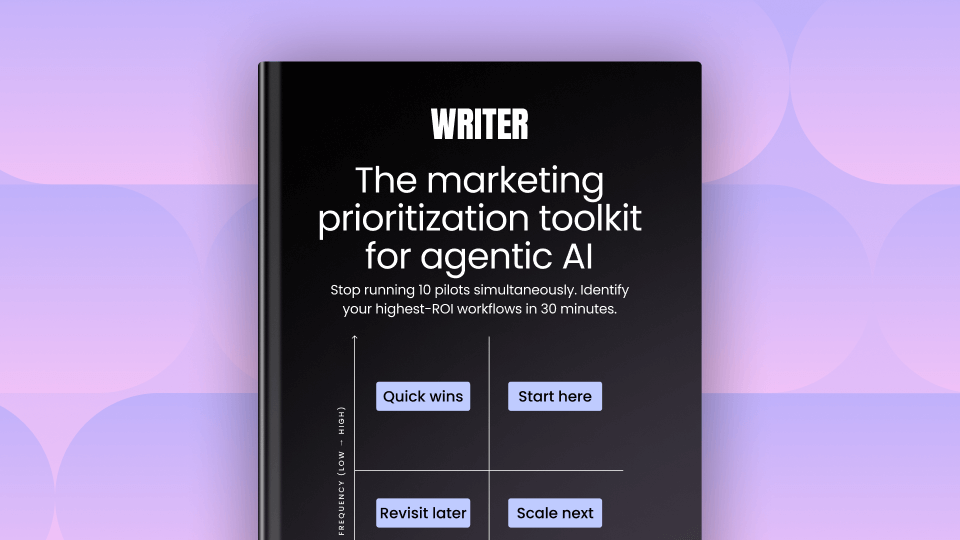
Get the complete toolkit for discovering the AI use cases that drive marketing team transformation
Download here
AI pilot to production timeline: What to expect
The pilot moves fast, but performance system changes take longer. Run both tracks in parallel.
Fast Track: Pilot and Adoption (4-6 weeks)
- Week 1: Discovery sessions with 10-15 people across roles
- Week 1-2: Show what’s possible (concurrent with discovery)
- Week 2-6: Voluntary pilot running
- Week 4-6: Success stories create organic adoption
By week 6, you’ll typically see 60-75% adoption among pilot participants, with non-participants starting to ask how to join.
Long Track: Performance System Alignment (4-6+ months)
For Global 2000 companies, changing how you evaluate, promote, and compensate people requires:
- Business case and stakeholder alignment: Months 1-2
- Legal, HR, and executive approvals: Months 2-4
- Policy documentation and system configuration: Months 3-5
- Manager training and rollout: Months 5-6
Reality check: Your pilot can prove value in 6 weeks. But if you’re a Global 2000 company, changing performance management is a 6-month process involving legal review, multi-stakeholder approval, documentation updates, and manager training.
Don’t wait to start performance changes until after the pilot “proves” success. By the time results are undeniable, you’re starting a 6-month approval process.
The organizations at production scale started building the business case in Month 1. When pilot results came in at Week 6, they were already 3 months into the approval process.
Real results: From resistance to adoption
When you address resistance directly instead of hoping training will solve it, adoption patterns change dramatically. Before: 80% attend training, 12% actual usage after 3 months, lots of “I tried it but…” explanations. After: 30% opt into the pilot voluntarily, 60% adoption by week 8, 75% by month 4. Campaign velocity increases 40-60%. Creative capacity expands 35-50%.
At WRITER, our 35-person team produces output that would have historically required 50 people based on our 2023-2024 operational ratios. We grew output 2.2x with only 1.25x headcount growth — 60-70% of that productivity gain traces directly to AI-automated execution work. But we have advantages you don’t: we make this product, have direct engineering access, and were AI-native from day one. Your results will vary, though the principles scale.

Learn how to calculate and prove AI ROI in your organization
Read More
The critical measurement principle: Don’t stop at input metrics like “40 hours saved per week.” Track what those reclaimed hours enabled—which campaigns launched, what pipeline generated, which strategic initiatives became possible. The CFO cares about business outcomes, not efficiency theater.
Protecting headcount: The CFO conversation
Even with these productivity gains, our CFO still asks: “If AI does so much, why do we need 35 people?”
Here’s the conversation that worked:
I mapped our marketing spend into two buckets: activities that directly drive return on investment (paid ads, events generating $14-20 in pipeline per dollar) and infrastructure that enables ROI (content, agencies, software, people).
AI made infrastructure more efficient—we dropped content costs, reduced agency spend, streamlined software. Same team. Same quality. Lower cost. We moved those savings straight into ads and events. Each dollar there returns 14-20x in pipeline.
“Productivity gains don’t automatically protect headcount. Showing how you’re reinvesting them into revenue-driving differentiation does.”
The winning conversation wasn’t “we’re more efficient, give us less budget.” It was “we restructured spending to drive more revenue per dollar without losing strategic capacity.”
What to do Monday morning
You can’t train your way around fear. But you can address it directly and let people feel the capacity gains.
Your three immediate steps:
- Conduct discovery sessions this week. Pick 10-15 people across different roles. Map how they spend their time. Listen for what they wish they could do but never have capacity for.
- Run a voluntary pilot. Don’t mandate. Ask who wants to experiment. Let capacity gains spread organically over 4-6 weeks.
- Start the performance system business case now. Don’t wait for pilot results. If you start in Month 1, approvals finish by Month 6. If you wait until Week 8, you’re adding 6 months to your timeline.
The conversation about AI resistance isn’t a one-time event. It’s an ongoing dialogue about what kind of marketing organization you’re building — one where people do repetitive work faster, or one where people apply expertise to strategic problems that matter.
The 79% stuck in pilot purgatory treated this as a technology problem. The 21% who reach production understand it’s a human problem that requires leadership.
Learn how CMOs at Global 2000 companies scaled AI from 5 experimenters to 50+ active users:
✓ The 3 capacity metrics that connect AI wins to EBIT
✓ 12 proven production workflows (compliance, localization, competitive intelligence)
✓ Week-by-week rollout plan: 8-12 weeks from pilot to 85% adoption

Free download: From pilot to performance in 8-12 weeks
Get the CMO playbook
You’re not alone in this
We’re all feeling the pressure right now. Every CMO I talk to — whether you’re in financial services, retail, technology, healthcare — you’re navigating the same core challenges:
Growth targets that keep climbing. The need to differentiate in markets more crowded and noisy than ever. Macro uncertainty from global political turmoil making strategic planning feel like guesswork. And layered on top: transforming your organization while the ground is shifting.
This is universal. We’re all in it.
And right now, in 2026, the stakes are higher than they’ve ever been. This isn’t about incremental improvement anymore. Your competitors — especially private companies without quarterly pressure — are moving fast. They’re redesigning entire marketing functions to be AI-native. The gap between organizations treating this as a training problem and those addressing the human challenges directly is widening every quarter.
You’re not just deciding whether to adopt AI. You’re deciding whether to lead or follow.
Here’s the paradox I wrestle with: Even with my team being this far ahead, it doesn’t feel like enough to me. That gap between where we are and where I think we should be feels enormous. I suspect you feel that too—regardless of where you are on the adoption curve.
The difference between feeling that pressure and letting it paralyze you is having a framework and starting the conversation.
The choice is yours. The conversation starts Monday.
About the Author
Diego Lomanto is Chief Marketing Officer at WRITER, where he leads go-to-market strategy for the enterprise AI platform. He works closely with CMOs and marketing leaders at Global 2000 companies navigating AI transformation.
Continue the conversation:
→ [Connect on LinkedIn]
→ [Download the toolkit] to get started Monday
More resources

AI agents at work
– 17 min read
The five pillars of AI-native marketing: Why focusing on productivity alone isn’t enough
Diego Lomanto, CMO
AI agents at work
– 17 min read
How to build an AI-native marketing engine: The platform capabilities that make it possible
Diego Lomanto, CMO

AI agents at work
– 24 min read
Agentic AI for marketing teams: Use cases from content generation to campaign orchestration
Diego Lomanto, CMO