
Enterprise transformation
– 15 min read
Stop selling AI efficiency to your CFO. Here’s what finance actually wants to hear


Last spring, my CFO Roger, pulled me into his office for what I assumed would be another budget review. Twenty years into my career as a CMO, I know the script by heart: defend the events budget, explain why brand investments don’t show immediate ROI, promise to “do more with less.”
But Roger surprised me.
“I’ve been looking at your spending,” he said. I braced myself. “You’re spending less on agencies and content production. And you’re moving that money into ads and events.”
I thought: Okay, here comes the analysis. He’s been studying the numbers.
Then Roger said something I’d never heard from a CFO in 20 years: “I admire that.”
I stopped. CFOs tolerate that you’re spending money. They question it. They push back on it. But admire it? Never.
I didn’t fully understand what Roger saw in those numbers — not yet. But that conversation changed everything about how I think about AI investment, and how I communicate it to finance. Roger gave me a framework that transformed not just our budget conversations, but our entire partnership.
If you’re building an AI business case and leading with efficiency gains — “We’ll reduce content costs by 30%!” or “AI will help us do more with less!” — you’re accidentally handing your CFO the justification to take resources away. Here’s the framework that changed how I approach these conversations, and how it can protect your budget while accelerating your transformation.
- The efficiency trap: Pitching AI as “30% faster” gives CFOs budget-cut ammunition
- Two-bucket framework: Rebalance spend from enablement (Bucket 2) to revenue-driving activities (Bucket 1)
- CFO translation: “We’ll reallocate $500K to demand gen and improve revenue 40%,” not “We’ll spend less”
- Three pillars CFOs fund: Visibility (lower CAC), Differentiation (compliance moat), Always-On (strategic capacity)
- Action: Use the ROI Calculator to model your rebalancing scenario before finance meetings

The efficiency trap (and why CFOs see right through it)
Here’s the mistake I see most CMOs make when pitching AI transformation: they lead with productivity metrics.
“AI will make us 30% faster at content production.”
“We can reduce our agency costs by $500K.”
“Our team will be able to do more with less.”
It sounds compelling. CFOs love efficiency, right? But here’s what I learned the hard way: the second you lead with efficiency as your AI story, you’ve just handed your CFO the justification to take resources away.
Think about it from their perspective. When you say “AI makes us 30% more efficient,” they hear “you need 30% fewer resources to do the same work.” That’s not a growth conversation. That’s a budget cut waiting to happen.
The problem is that we’re all under real pressure. We must justify every dollar with clear ROI. Our boards are skeptical after watching disappointing AI pilots go nowhere. We’re already managing those 15 to 20 different marketing technology platforms, and the last thing our teams want is “another tool.” Meanwhile, we’re spending anywhere from $250 thousand to $2 million annually on agencies — a dependency we know needs to transform, but we can’t just eliminate overnight without the capacity to replace it.
So we default to efficiency language because we think it’s what finance wants to hear. But CFOs aren’t looking to just cut costs — they want to improve margins. So they are looking for both growth and efficiency.
Here’s the disconnect: CMOs measure campaign performance, brand lift, and pipeline influence. CFOs measure returns, payback periods, and cost efficiency. We’re speaking different languages, and “we’ll do the same work cheaper” isn’t a translation — it’s a capitulation.
What Roger showed me is that CFOs don’t actually want you to do the same work cheaper. They want you to do more valuable work with the resources you have. They want strategic resource allocation, not expense reduction.
That reframe changes everything. And it starts with understanding how your CFO thinks about your budget.
The two-bucket framework: Your translation layer
Roger explained it to me this way: Everything marketing spends falls into two buckets.
Bucket 1 drives return. Ads, events, demand generation. He calls it ROMI — Return on Marketing Investment. (Side note: Roger loves this term. I think he secretly wants to be a marketer and name things. But it’s a great term. Most of us use Return on Ad Spend, but that’s too limiting — there are a lot more things that drive marketing return than ads, and Roger recognizes this.)
Bucket 2 enables return. Content production, agencies, software, operations. All the infrastructure that makes Bucket 1 possible.
Then Roger asked the question that reframed everything: “How do we get more efficient on Bucket 2 so we can spend MORE on Bucket 1? Not spend less. Rebalance. Higher ROMI.”
That’s what he saw in my budget that made him say, “I admire that.” I had been quietly shifting dollars from production overhead (Bucket 2) into demand generation (Bucket 1) without even realizing I was doing it. Roger saw the pattern before I had language for it.
This is the translation layer most CMOs are missing.
THE LANGUAGE CFOs ACTUALLY UNDERSTAND
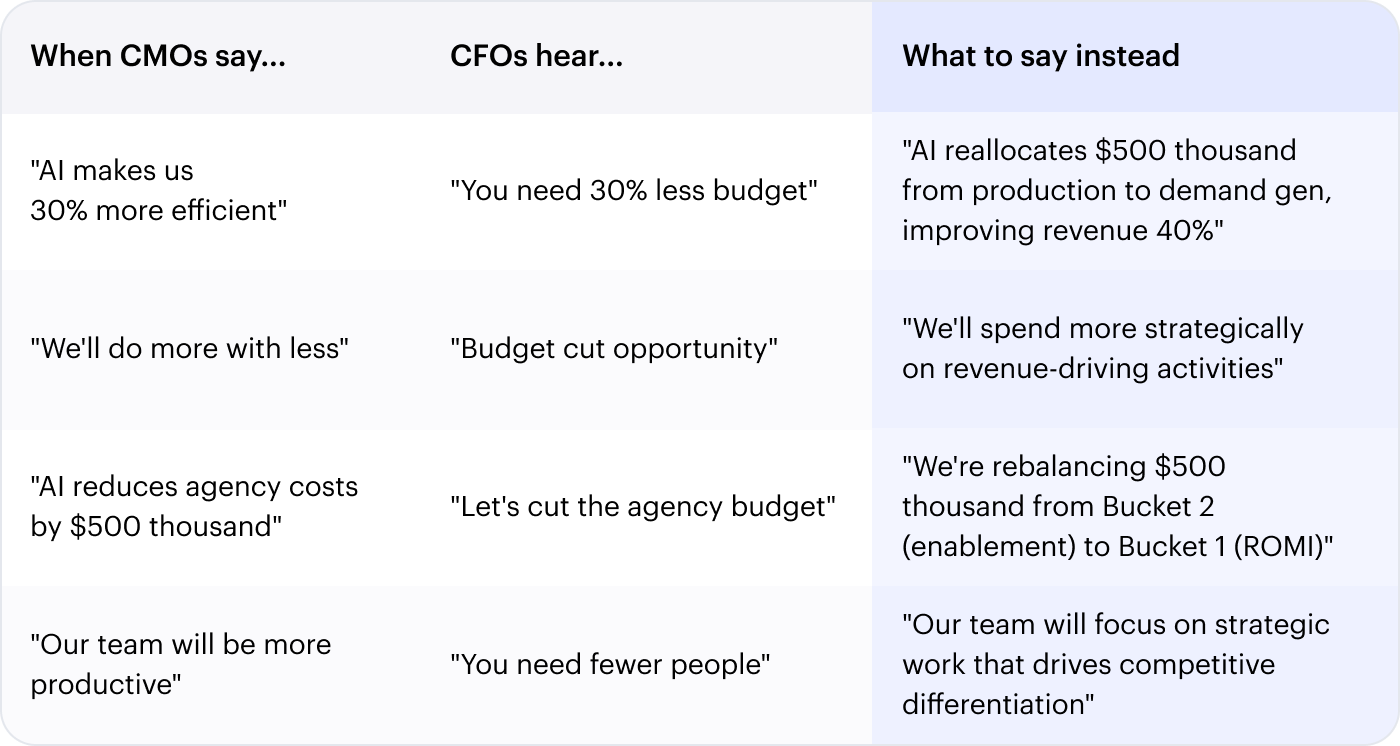
When you say: “AI will reduce our content production costs by 30%”
Your CFO hears: “Marketing will need 30% less budget”
What you should say instead: “AI will help us reallocate $500 thousand from production costs to demand generation, improving our marketing-influenced revenue by 40% while maintaining — or increasing — output quality and brand consistency.”
Now you’re speaking their language. You’re not proposing cost-cutting. You’re proposing revenue acceleration through strategic resource optimization.
How to apply this framework
Audit your two buckets. Look at your current budget allocation. How much goes to agencies, content production, creative services, and operational tools versus how much goes to media buying, events, and direct demand generation? For most enterprise marketing teams, 40-60% of budget sits in Bucket 2.
Calculate your rebalancing opportunity. If AI can deliver 30-40% efficiency gains in Bucket 2 activities, what does that free up? A team spending $2 million on agencies and production could reallocate $600 thousand-$800 thousand toward demand generation without reducing output. That’s not a budget cut — it’s a force multiplier.
Frame it as ROMI improvement, not cost reduction. The business case isn’t “we’ll spend less.” It’s “we’ll generate more revenue per dollar invested in marketing.” That’s a conversation CFOs want to have.
Before you build your full business case, test your math. WRITER’s Marketing AI ROI Calculator provides personalized projections based on your team size, agency spend, and growth goals — so you can walk into finance meetings with real numbers, not just your hypothesis.
The three pillars CFOs actually fund
Once Roger and I aligned on the two-bucket framework, I realized my mistake wasn’t talking about productivity — it was stopping there. Roger showed me that CFOs don’t fund productivity for its own sake. They fund productivity that creates competitive separation.
We reframed the entire marketing function around three pillars that CFOs inherently understand. Each one delivers the efficiency Roger could measure, but more importantly, each one converts that efficiency into strategic advantage he could defend to the board. Productivity became the fuel, not the destination.
PILLAR 1: VISIBILITY (MEET BUYERS WHERE THEY ACTUALLY ARE)
When I talk to Roger about “omnichannel presence” or “customer journey optimization,” his eyes glaze over. When I talk about reducing customer acquisition cost while increasing marketing-influenced pipeline, I have his full attention.
AI doesn’t just help us be in more places — it helps us be in the right places at the right moments without multiplying our headcount. That’s not marketing fluff. In markets where buying behavior is shifting to AI-native research and evaluation, visibility is existential. Miss the moment when your buyer is forming their consideration set, and you’ve lost before the RFP ever hits your inbox.

How to build an AI-native marketing engine: The platform capabilities that make it possible
Learn more
The metric CFOs care about: Lower CAC, higher marketing-influenced revenue. Visibility is how you protect and grow market share efficiently.
PILLAR 2: DIFFERENTIATION (PROTECT BRAND IN A COMMODITIZED MARKET)
AI made content cheap, but it’s eroding brand trust. When anyone can generate marketing assets in seconds, volume isn’t your competitive advantage — trust is.
This is where I had to reframe differentiation in Roger’s language. I explained: “We need AI that encodes our brand standards, maintains compliance, and operates within regulatory guardrails. Not as a constraint — as a competitive moat.”
Roger saw something I hadn’t fully articulated to finance before. Multi-week compliance review cycles aren’t just operational friction — they’re revenue delays. Brand missteps aren’t just embarrassing — they’re balance sheet risks. And in regulated industries, non-compliance isn’t just costly — it’s catastrophic.
When I framed governance as “the control mechanism that lets marketing move fast without creating risk exposure,” Roger immediately understood the Bucket 2 efficiency: fewer review cycles, less agency dependency on compliance specialists, lower risk premium.
AI with governance built in became, in Roger’s words, “a defensive expenditure that unlocks offensive capability.” That’s CFO language for: this protects what we’ve built while accelerating what we’re building.
Trust drives scale. Without governance, AI stays trapped in pilot purgatory. With it, you can safely democratize AI adoption across marketing.

As AI content creation explodes, invest in trust and differentiation
Learn more
PILLAR 3: ALWAYS-ON (ORCHESTRATE AT MACHINE SPEED)
When I talk about “agile campaigns” or “real-time optimization,” Roger translates it into a single question: “Will this help us respond faster than our competitors?”
Speed-to-market isn’t just operational efficiency — it’s revenue protection. The ability to launch campaigns, adjust messaging, and capitalize on market opportunities at machine speed means we’re capturing revenue windows our competitors miss.
But here’s where I’ve seen CMOs lose these conversations: framing AI as headcount reduction. When I explain it to Roger, I’m explicit about where the capacity goes. AI automation doesn’t eliminate marketers — it eliminates the manual production work that buries them. That freed capacity gets redeployed to the work that actually moves revenue: creative strategy, customer insight, competitive positioning, and relationship building.
Roger sees this clearly in the two-bucket framework. When marketers aren’t coordinating with five agencies and managing approval workflows, they’re doing the strategic work that differentiates us in the market. That differentiation drives pricing power, customer retention, and competitive defensibility — all metrics he tracks on the P&L.
The CFO question isn’t “Will this save us headcount?” It’s “Will this make our existing team exponentially more strategic?”
When you frame capacity expansion as strategic redeployment rather than cost reduction, you’re speaking their language.
The metric CFOs care about: Campaign velocity improvements, time-to-market reductions, and the competitive defensibility that comes from organizational agility.

AI made your marketing team faster. Why isn’t it showing up in the results?
Learn more
Your action plan: Building the business case
Before your next finance meeting, here’s your preparation checklist:
1. Audit your two buckets
Pull your last quarter’s marketing spend and categorize it honestly. How much went to Bucket 2 (agencies, content production, creative services, operational tools) versus Bucket 1 (media buying, events, direct demand generation)?
For most enterprise marketing teams, 40-60% of budget sits in Bucket 2. That’s your rebalancing opportunity.
2. Model the rebalancing scenario
If AI can deliver 30-40% efficiency gains in Bucket 2 activities, what does that free up? A team spending $2 million on agencies and production could reallocate $600 thousand-$800 thousand toward demand generation without reducing output.
Don’t walk into the meeting with hypothetical productivity claims. Run the actual numbers for your team. Writer’s Marketing AI ROI Calculator provides personalized projections based on your team size, agency spend, and growth goals — so you can present Roger’s language, not just your wishlist.
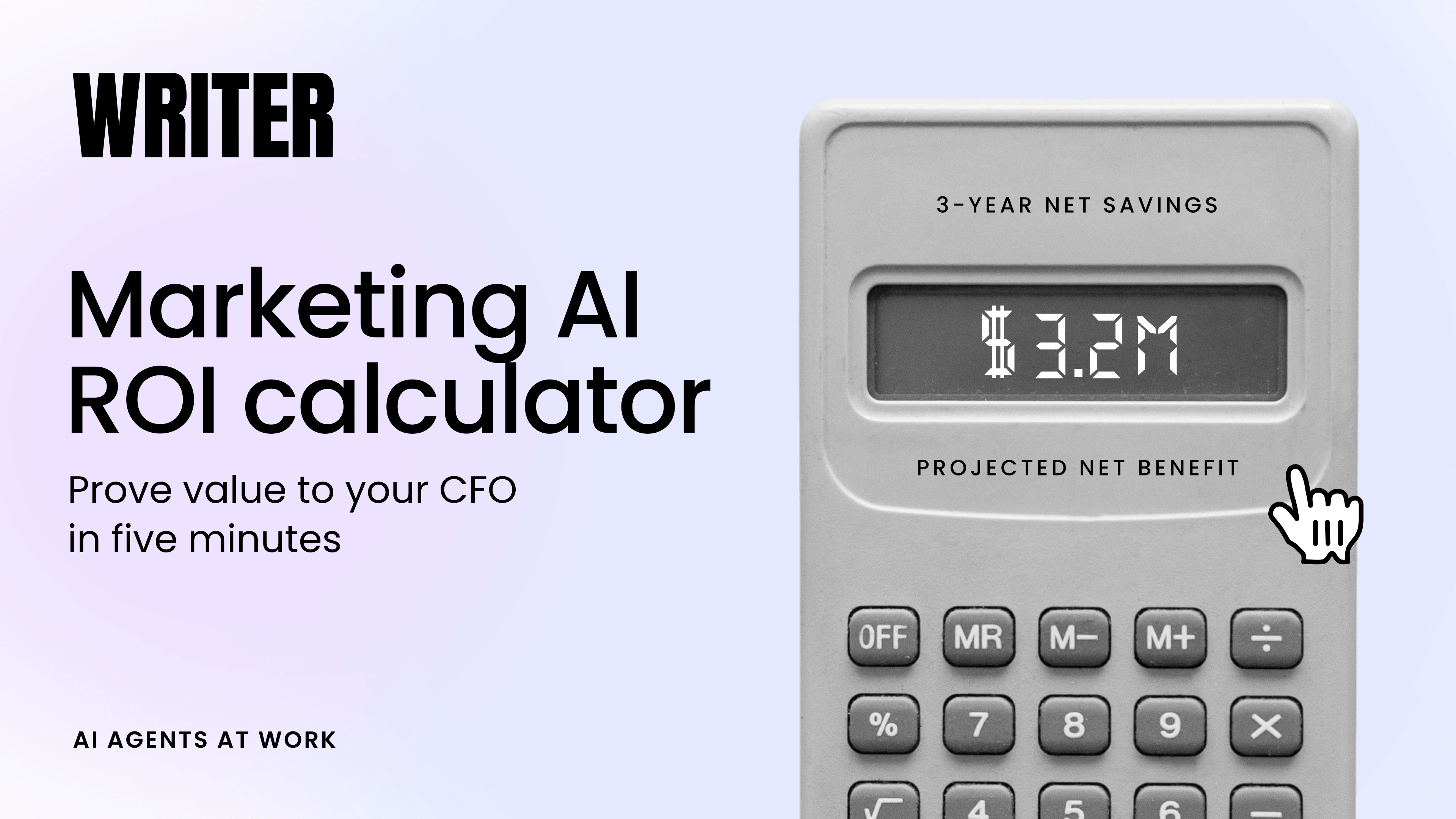
Calculate your marketing AI ROI now. See personalized projections based on your team size and agency spend
Run the numbers
3. Translate the three pillars into CFO metrics
- Visibility → “We’ll reduce CAC by X% while increasing marketing-influenced pipeline”
- Differentiation → “We’ll cut compliance review cycles from weeks to days, reducing time-to-market by Y%”
- Always-On → “We’ll increase campaign velocity by Z%, capturing revenue windows competitors miss”
Frame everything as ROMI improvement and strategic capacity redeployment, never as cost reduction.
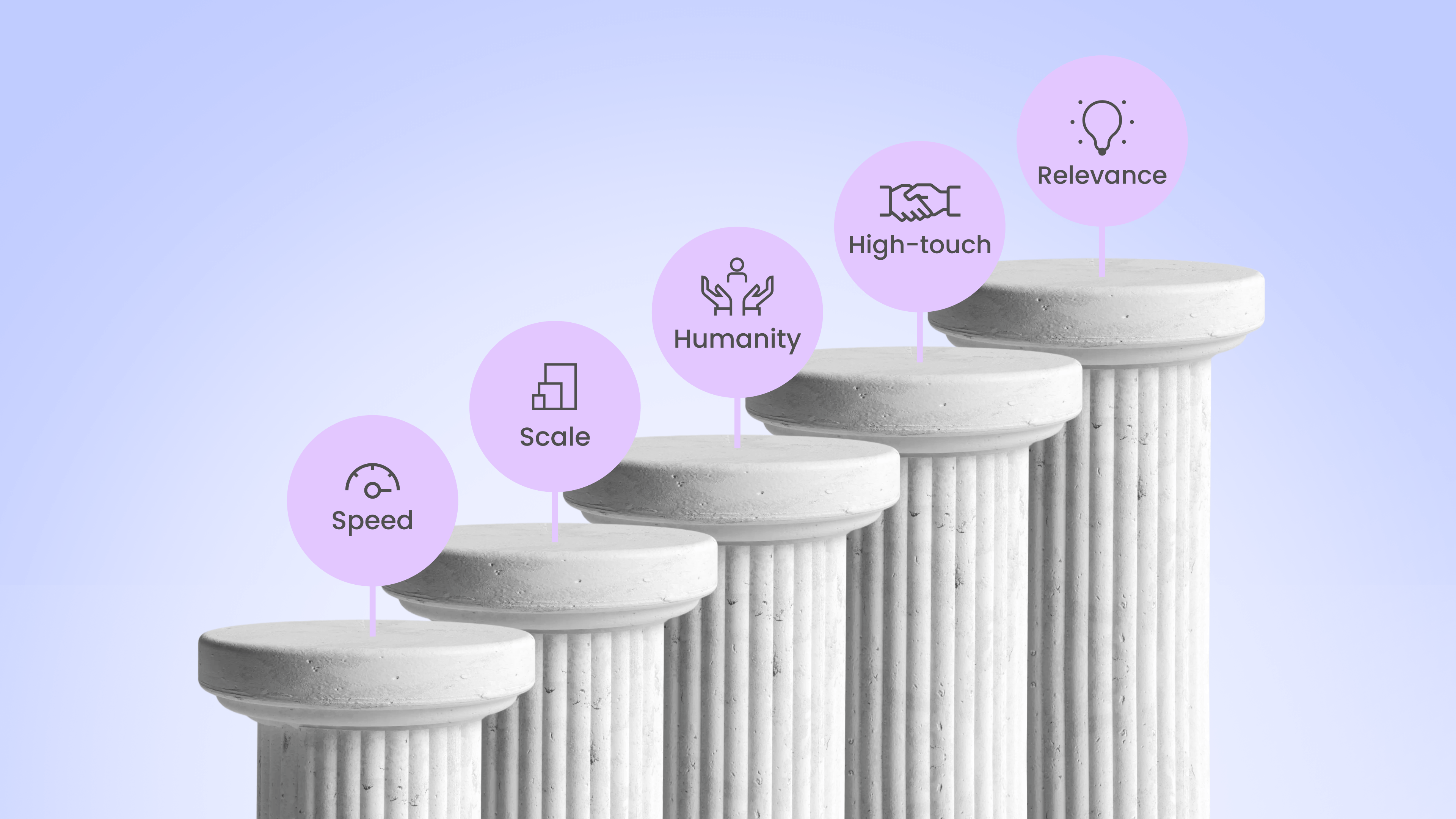
The five pillars of AI-native marketing: Why focusing on productivity alone isn’t enough
Learn more
4. Bring IT into the conversation early
Your CFO’s next question will be about governance and security. Don’t wait for them to ask. Share the calculator results with your IT stakeholders first. When IT confirms that marketing can operate safely within established guardrails, your CFO sees scale potential, not risk exposure.
WRITER’s Trust & Security: World-class enterprises trust WRITER
5. Position AI as infrastructure, not an experiment
CFOs push back on “experimental” AI spend. Roger approved our AI investment because I framed it as revenue engine infrastructure for 2027-2030, not a pilot program. Request multi-quarter commitment with clear milestones tied to the metrics CFOs already track.
Explore use cases: Agentic AI for marketing teams: Use cases from content generation to campaign orchestration
From budget defender to strategic partner
What started as another budget review became the blueprint for our partnership. Roger didn’t just approve our AI investment — he became its champion. Not because I convinced him AI was exciting, but because I showed him how it accelerated the metrics he already cared about: ROMI, resource efficiency, and measurable growth.
The two-bucket framework changed our entire relationship. We stopped negotiating over whether marketing “needs” more budget and started collaborating on how to make every dollar work harder. Roger now thinks about marketing investment the way I do — not as expense management, but as revenue acceleration.
Your CFO isn’t the obstacle to your AI transformation. They’re your potential champion — if you speak their language. The conversation doesn’t start with “AI will make us more efficient.” It starts with “Here’s how we’re going to spend more on growth while getting more strategic with operations.”
Start with the two buckets. The rest follows.
About the Author
Diego Lomanto is chief marketing officer at WRITER, where he leads go-to-market strategy for the company’s agentic AI platform. He works closely with CMOs and marketing leaders at Global 2000 companies, navigating AI transformation.
Read more from Diego:
• The five pillars of AI-native marketing: The five pillars of AI-native marketing: Why focusing on productivity alone isn’t enough – WRITER
• The conversation that drives AI adoption: The conversation that actually drives AI adoption: Three fears every CMO must address – WRITER
Continue the conversation:
→ Connect on LinkedIn: https://www.linkedin.com/in/diegolomanto/
→ Calculate your AI ROI: https://writer.com/ai-roi-calculator/
Common questions CMOs ask about CFO conversations
Start by pulling your last quarter’s marketing spend and categorizing every line item honestly. Bucket 2 (enablement) includes agencies, content production, creative services, martech subscriptions, and operational overhead. Bucket 1 (return drivers) includes paid media, events, sponsorships, and direct demand generation activities.
For most enterprise marketing teams, 40-60% of budget sits in Bucket 2. If AI delivers 30-40% efficiency gains on those activities, a team spending $2 million annually on agencies and production can reallocate $600 thousand-$800 thousand toward demand generation. That’s not hypothetical — use WRITER’s Marketing AI ROI Calculator to model your specific numbers based on your team size, current spend, and growth targets. Walk into your CFO meeting with their language: concrete dollar amounts, not percentage improvements.
The most common pushback after reframing is “prove it works before we invest.” This is where you need a different conversation strategy. Instead of asking for full transformation budget upfront, propose a staged approach tied to the two-bucket framework.
Phase 1 (Weeks 1-8): Pilot AI on two-three high-frequency Bucket 2 activities (e.g., social content variations, email campaign production, competitive intelligence). Track exact time saved and capacity freed.
Phase 2 (Months 3-4): Quantify the rebalancing opportunity. Show CFO: “We freed 40 hours per week. That’s $X in Bucket 2 efficiency. Here’s how we’re reinvesting it in Bucket 1 activities that generated $Y in pipeline.”
Phase 3 (Months 5-6): Scale what worked. Request budget rebalancing, not new budget. The pilot proves the thesis — now you’re de-risking the ask.
This staged approach addresses the “prove it first” objection while maintaining momentum. Most CFOs will approve a controlled pilot when you’re explicit about measurement criteria and decision gates.
If you’re starting from scratch, plan for two-three weeks of preparation before your formal pitch meeting. Here’s the realistic timeline:
Week 1: Audit your two buckets, model your rebalancing scenario, and identify which Bucket 2 activities have the highest AI automation potential. Use the ROI Calculator to run scenarios. Document current state: time spent, costs, outputs.
Week 2: Build your slides using the three-pillar framework (Visibility, Differentiation, Always-On). Translate each into CFO metrics. Get IT stakeholder alignment — your CFO will ask about governance and security, so preview those conversations. Pre-wire objections by meeting with finance team members who influence the decision.
Week 3: Formal presentation, Q&A, and iteration based on feedback. Budget approval cycles vary by company (some same-day, others require board approval), but your prep work determines success more than the meeting itself.
The CFOs who approve fastest aren’t hearing the best pitch—they’re hearing a pitch that’s already addressed their known concerns through proper stakeholder prep.
CFOs don’t care about “time saved” or “productivity gains” as end goals — they care about what those gains enabled. Track both the input efficiency and the output value.
Bucket 2 Efficiency (What You Track):
• Hours saved per week on production activities
• Agency cost reduction or scope expansion at same cost
• Reduction in average campaign production time
• Decrease in compliance review cycle time
Bucket 1 Value Creation (What CFOs Track):
• Marketing-influenced revenue growth
• Cost per acquisition (CAC) reduction
• Pipeline velocity improvements
• Campaign launch frequency increase
• Competitive win rate in deals where faster time-to-market mattered
The winning narrative: “We freed 160 hours monthly in Bucket 2. We reinvested that capacity into account-based marketing for our top 50 accounts, generating $2.4M in pipeline. That’s a 15:1 return on our AI investment, and we’re tracking toward 40% improvement in our overall ROMI this quarter.”
Frame AI as the catalyst for strategic redeployment, not the end state. The efficiency creates capacity. The capacity enables strategy. The strategy drives revenue. That’s the chain of logic CFOs want to see.
More resources

AI agents at work
– 17 min read
How to build an AI-native marketing engine: The platform capabilities that make it possible
Diego Lomanto, CMO

AI agents at work
– 17 min read
The five pillars of AI-native marketing: Why focusing on productivity alone isn’t enough
Diego Lomanto, CMO

AI agents at work
– 22 min read
Agentic AI for marketing teams: Use cases from content generation to campaign orchestration
Diego Lomanto, CMO