
Enterprise transformation
– 13 min read
How to make AI sound like your brand, not every other brand

It’s a familiar sight that AI makes even more common — marketing copy using the same cadence and the same phrasing, and making the same hollow claims across brand after brand. Tools can compress campaign cycles from months to days and produce 10x the content. But if organizations pump out AI content without a system to protect what makes them different, they gain speed and lose their identity.
The data backs this up. Forrester research shows 94% of B2B buyers now use AI search throughout their buying journey, and AI has twice the impact of other interactions in shaping their decisions. AI also surfaces 5 to 6 more vendors than buyers found on their own. Buyers show up more informed, validating rather than discovering. And they’re skeptical of what they find — 68% say they’re more skeptical of content they know was created using AI.
So the same AI that can scale content is also the filter deciding whether a brand gets seen at all. But here’s the exciting part — the brands winning in this environment aren’t the ones producing the most. They’re the ones whose content survives both filters — AI and human skepticism — because it carries something specific. That specific thing being deep expertise, hard evidence, and real proof points. And that’s something every organization can build.
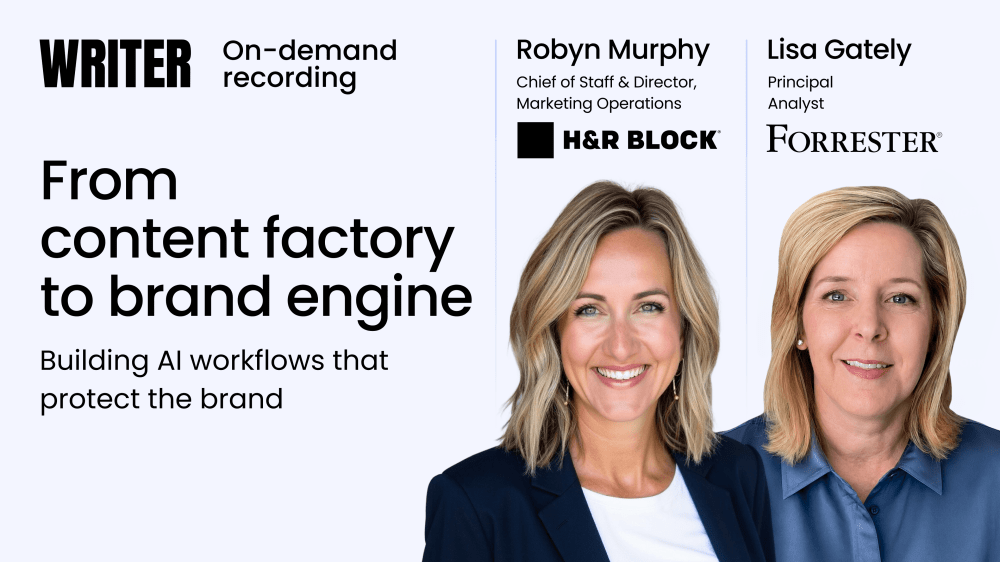
At a recent WRITER webinar, guest speaker Lisa Gately, principal analyst at Forrester, and Robin Murphy, chief of staff and director of transformation at H&R Block, laid out what the research shows and what it looks like to act on it. The good news? The playbook is clearer than ever.

Building AI workflows that protect the brand
Watch the full webinar
AI doesn’t experience a brand the way humans do
In the past, marketers could rely on human nature to overlook minor discrepancies across brand touchpoints — a website, a trade show, and a sales deck often told slightly different stories, yet buyers intuitively bridged the gaps. Unlike humans, however, AI treats every piece of data as part of a single, coherent narrative. It consumes and assesses the brand’s entire digital footprint simultaneously, leaving no room for fragmented messaging.
“AI is reconciling signals across everything that it finds from your brand in total, both on and off site,” Gately explained on the webinar. “We were able to absorb a lot of inconsistencies. No more.”
A brand is no longer a polished PDF or a single campaign page. It’s the cumulative signal across every asset AI can find — and AI finds everything. Thin claims, generic language, and unsubstantiated proof points don’t just underperform. They don’t get surfaced at all. “Anything that is generic, thin, unsubstantiated claims would not even be served up to them by AI,” Gately noted.
But here’s where that buyer skepticism — driven by the fear that AI content lacks accuracy and objectivity — becomes an opening. Buyers distrust generic AI content, but they’re hungry for content with depth, expertise, and proof. The brands that bring real substance don’t just survive the filter. They stand out precisely because so much of what buyers see is generic. That’s the opportunity.
This is exactly why GEO and AEO optimization — optimizing for generative and answer engines — has become essential. Traditional SEO helped brands rank for keywords. GEO helps a brand show up when AI synthesizes answers for buyers. And as analysis of how AI search is collapsing the inbound funnel shows, buyers are getting everything they need from LLM interactions — they only use traditional search for validation. The brands that adapt to this shift aren’t just keeping up. They’re pulling ahead.
💡 Key insight: AI doesn’t just find your brand — it reconciles it. Every asset, every signal, on- and off-site. Inconsistencies don’t get smoothed over. They get averaged out, and generic content gets filtered out entirely. But specific, proof-driven content? That rises to the top.
See how WRITER keeps every AI output on-brand
Read More
Bake in the decisions, not just the guidelines
Many AI vendors say “train AI on the brand rules.” Upload the brand guidelines, check the box, and you’re done. But Gately’s research shows that’s not enough — and the teams getting this right are doing something fundamentally different.
“A lot of people ask about whether you have 10-page or 200-page guidelines,” Gately said. “Some of your professionals who are setting up systems will also be tipping off on what does good look like? How do you have some of your best examples in addition to standards? Showing the decisions that you’ve made — being able to capture why did you do this? Why did you decide not to do that?”
This is the insight that separates AI output that sounds like a specific brand from AI output that sounds like AI. The guidelines tell the model what to do. The decisions tell it why — and what not to do. What was excluded. What trade-offs were made. What “good” looks like in practice, not just in theory.
LLMs think in context. The more organizational context provided to it — the reasoning behind the rules, not just the rules themselves — the more differentiated the output. This is how organizations get AI that produces content a brand would actually make, not content that merely avoids breaking the rules. And it’s a shift that’s already paying off for teams that have made it.
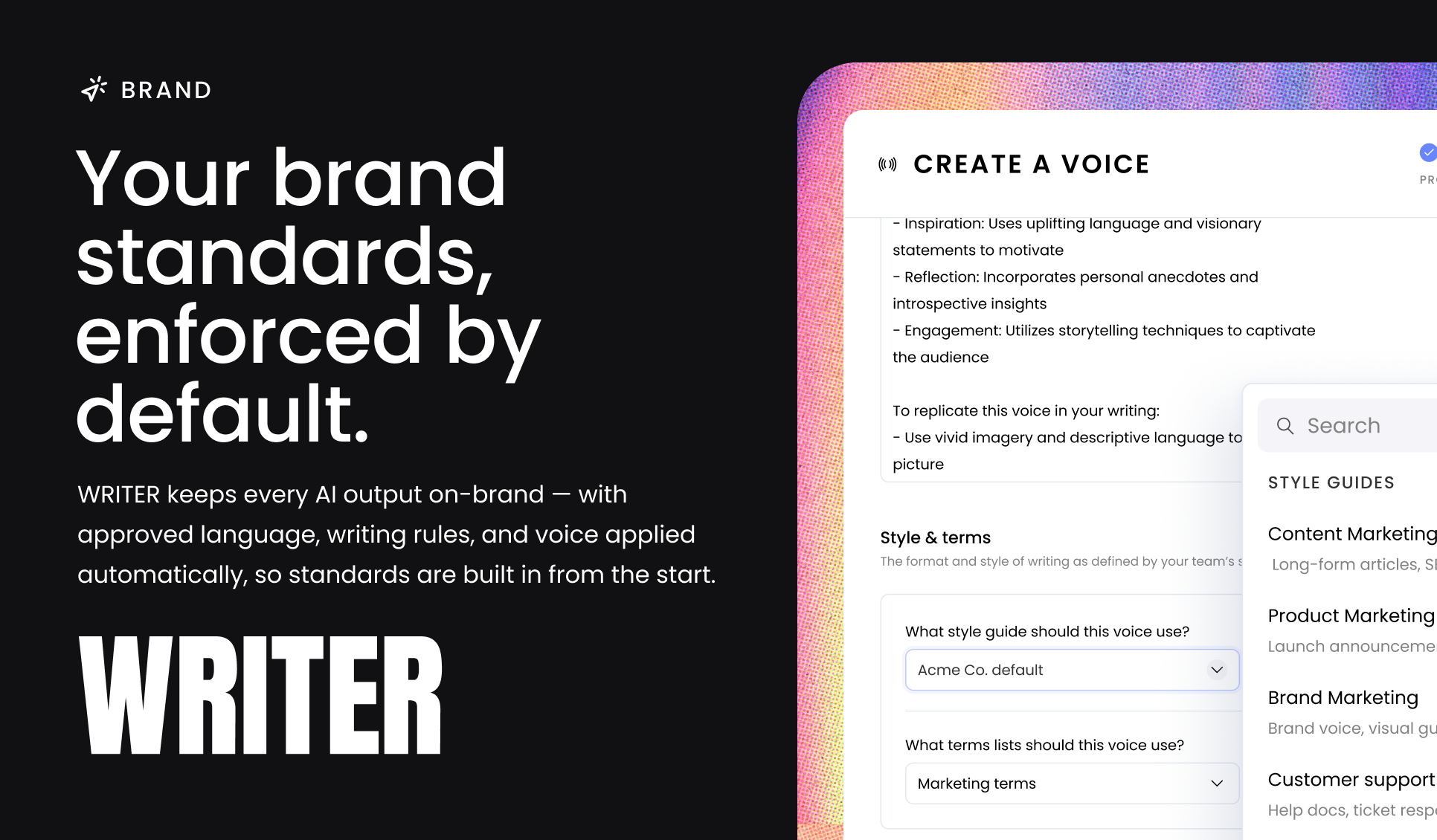
It’s also the core principle behind WRITER’s Voice feature. The system doesn’t just upload rules — it trains the system on a brand’s best examples, its phrasing, its tone, and the reasoning behind its choices. The result is AI output that sounds unmistakably like the brand, not a robot. And the brands investing in this kind of specificity are the ones building lasting competitive advantage.
What this looks like in practice: H&R Block’s before and after
Robin Murphy has been building this system at H&R Block for the past year and a half. Her team serves multiple audience segments — including small businesses, DIY filers, and tax professionals — across a 70-year-old brand built on trust. Getting AI-generated content wrong isn’t just a brand risk. It’s a financial one. But getting it right is where the magic happens.
The challenge: manual checks at every turn
Every piece of content required marketers to manually check brand guidelines, legal claims, compliance rules, and product-specific disclaimers before it could move forward. Legal and compliance teams sat in the review queue, backlogged. Content could take weeks to get through the process. Nobody wanted it to take that long — not the marketers, not legal, not the business. But the alternative was content that went off-brand or out of compliance.
The breakthrough: the context and knowledge graph as brand backbone
By baking brand guidelines, compliance rules, legal claims, and distinct tones of voice directly into the AI workflow, the system knows exactly what’s on-brand for every product from the moment a marketer starts writing.
“When you’re creating that piece of content, it’s just automatic. You don’t have to think about it,” Murphy said. Content that used to wait weeks for legal review now moves faster because the system catches issues before they reach the review queue.
“No one wants to feel like they’re talking to a robot,” Murphy said. “That shouldn’t ever be the goal for any company.” Context and knowledge graphs act as a brand backbone, embedding that institutional knowledge into the AI workflow. This ensures the system follows the rules while allowing humans the space to be creative.
H&R Block’s experience mirrors enterprises using WRITER — from Salesforce building agents that scale quality and consistency, to Uber creating a unified knowledge ecosystem, to Medisolv achieving 80% time savings. When brand DNA, compliance rules, and institutional knowledge live inside the AI system, content moves faster and stays on-brand. That’s the win-win organizations are looking for.

Explore WRITER for marketing teams
Read More
The system behind the system
Murphy’s approach reflects the framework Gately sees across leading organizations. But instead of implementing it as a consulting exercise, H&R Block built it into how people actually work. Here’s the framework we can all learn from — and it’s more actionable than you might think:
1. Classify work by risk and stakes
Not all content carries the same weight. Brand relaunches, core messaging, and high-stakes product claims demand human attention and professional oversight. Routine adaptation, repurposing, and localization can be system-enabled.
“You want to have extra care on that,” Gately said of high-stakes work. “And then you’ve got some relief — now our systems can help us as we reuse and adapt.”
This risk-tiered approach is something advocated as part of building an AI-native marketing engine — let systems handle the repeatable work so marketers can invest their judgment where it matters most. It’s not about replacing people. It’s about freeing them to do their best thinking.
2. Two creator types, one brand
Content and creative professionals build the system — templates, playbooks, brand guardrails that others can reuse. Domain experts contribute lived experience, situational insights, and proof points.
“You want the best of your team in total so that this becomes reused and it comes to life through so many of your efforts,” Gately explained. When domain experts stop reinventing from scratch and start working within a system, their expertise becomes reusable institutional knowledge — and that’s when scale really starts to work in our favor.
This aligns with what was found in the 2026 AI adoption survey. The marketing teams leading their markets aren’t just using AI tools — they’re encoding their enterprise DNA into AI agents, equipping super-users to build, and scaling expertise beyond the people who hold it. That’s the future leading brands are building toward.
3. Expertise and proof, built into the content
Quantified outcomes, original research, benchmarks, independent validation, customer stories with real decision-makers. These are the signals that both AI and human buyers use to assess credibility. The brands that show up strongest in AI-mediated buying journeys are the ones with the richest evidence base.
This is why detecting and destroying AI-isms in marketing copy isn’t just a quality exercise — it’s a visibility exercise. Generic phrasing signals generic thinking, and AI search filters treat it accordingly. But when marketers replace AI-isms with real proof points and specific expertise, the content doesn’t just read better — it surfaces higher.
Getting our people ready
Murphy kept coming back to one thing — habits. The tools were ready. The people needed a different kind of support, and that’s okay. Change takes time, and the best change starts small.
“Human habits is just hard to break,” Murphy said. “If we think about 10, 12 years ago, a new marketer coming into play, they start forming their own habits, their own tools that they like to work with, their own processes.”
Her approach — resist the temptation to throw too many use cases at the team at once. Pick one win, one use case that works for everyone, and let success build the habit.
“They have to get the dopamine hit,” WRITER CMO Diego Lomanto added. “That’s what forms a habit. You do something, you get success, it feels good, you want to do that.”
This mirrors the advice in Diego’s post on the three fears every CMO must address — start with the use case that proves the system works, then expand. The goal isn’t to overwhelm teams with AI. It’s to give them a win that builds confidence and momentum. And once that first win lands, the rest follows naturally.
Leadership signaling matters, too. H&R Block’s CEO, Curtis Campbell, reinforced the message from the top. “We will be human-led, tech-enabled.” When people hear from their leaders that human input still matters, AI transforms from a threat into a tool — and that’s when real adoption takes off.
And the cross-functional alignment Murphy built wasn’t about mandating participation. It was about showing each team the win for them. For legal and compliance, the win was a shorter review queue.
“If we can lighten their load, I found them to embrace it quite enthusiastically,” Murphy said. “You have to have the gift of influencing with little authority or no authority. It’s the ability to cast the vision and get people excited for how this is going to better improve either their work or the company.”
For more on building this kind of organizational readiness, check out Forrester’s own AIQ framework, which we explored in our conversation with J.P. Gownder, Forrester VP and principal analyst.
AI done right makes our brand stronger, not just protected
The impulse from boards is clear — use AI to cut costs and move faster. But the CMOs who are winning are reframing the conversation entirely. AI can make our brand show up stronger than competitors who are still pumping out generic AI content — and that’s the frame that changes everything.
“Search is no longer a marketing topic,” Gately observed. “AI has become this interpreter of your brand and why that really makes a swing in the importance of brand.”
When AI filters a brand out of consideration because signals are inconsistent or generic, that brand disappears from the buying process entirely — and the organization will never know it was in it. But when companies build systems that bake brand DNA, expertise, and governance into every AI-powered output, they gain an advantage generic competitors can’t replicate — content that’s unmistakably theirs, at a speed they couldn’t reach before. That’s not just protection. That’s a competitive edge.
Educating CFOs about how AI mediates buyer perception shifts the conversation from “how do we cut costs?” to “how do we make our brand the one AI surfaces and buyers trust?” And that’s a conversation worth having.
As explored in the guide to stopping the AI efficiency pitch to the CFO, the winning frame isn’t cost reduction — it’s competitive differentiation. And as Cannes confirmed this year, brand is the moat, and AI agents are the engine. The future belongs to brands that build both.
Calculate your marketing AI ROI
What to do next
Ready to move from generic AI to brand-differentiated AI? Here is where to start, one step at a time:
- Bake in the decisions, not just the guidelines. Work with an AI platform that can infer and learn from the reasoning behind brand choices — what was excluded, what trade-offs were made, what good looks like in practice.
See how WRITER captures your brand decisions → - Classify content by risk and strategic value. Put humans in the loop where stakes are highest. Let systems handle the rest.
Read our guide to agentic AI governance → - Separate system builders from domain experts. Give each group the tools and structure to do what they do best.
Explore the five pillars of AI-native marketing → - Start with one win. Pick the use case that proves the system works, then expand.
Assess your organization’s AI readiness → - Optimize for AI search, not just traditional SEO. Make sure your brand shows up when AI synthesizes answers for buyers.
Convert your SEO keywords to AI search queries →
Watch the full webinar recording to hear the complete conversation with Lisa Gately and Robin Murphy, including the Q&A on building brand governance at enterprise scale.
Building AI workflows that protect the brand
Watch the full webinar
More resources

AI agents at work
– 9 min read
Webinar recap: The agentic marketer playbook — a new playbook for the AI-powered team
Writer Team

Enterprise transformation
– 6 min read
Key findings from our 2026 AI adoption survey — and why CMOs should care

Diego Lomanto, CMO

AI agents at work
– 18 min read
The conversation that actually drives AI adoption: Three fears every CMO must address
Diego Lomanto, CMO