
Innovation
– 5 min read
New at WRITER: Playbooks built for quality, cost efficiency, and control

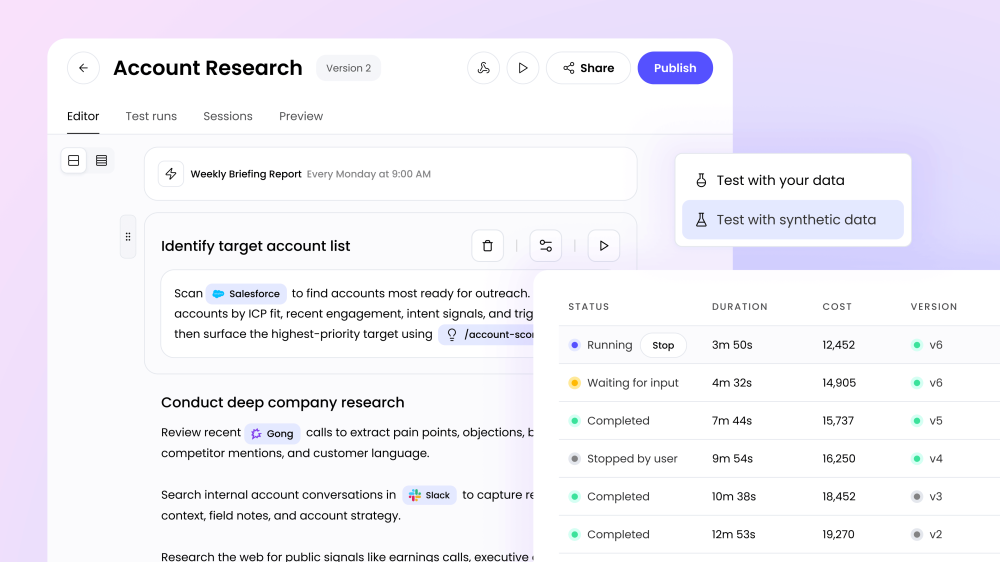
Playbooks started with a simple idea — AI won’t scale prompt by prompt.
When every marketer and seller uses AI in their own corner, quality is inconsistent, costs are unpredictable, and the best workflows get trapped in one person’s private chat history. The customer experience starts to fragment, as each team creates a slightly different version of your message, your brand, and your story.
Playbooks changed that by making the best ways of working with AI repeatable and reusable across the team. WRITER customers like Clorox, KPMG, and Metro Bank have created more than 28,000 playbooks to personalize campaigns, optimize content for AI visibility, generate account insights, and more.
Today, we’re rolling out an upgraded playbooks experience to help teams scale more complex, end-to-end processes with higher quality, greater cost efficiency, and more control. Users can now break playbooks down into modular steps, chain multiple playbooks together, test and optimize playbooks before rollout, and run them in bulk.
Build playbooks with modular steps
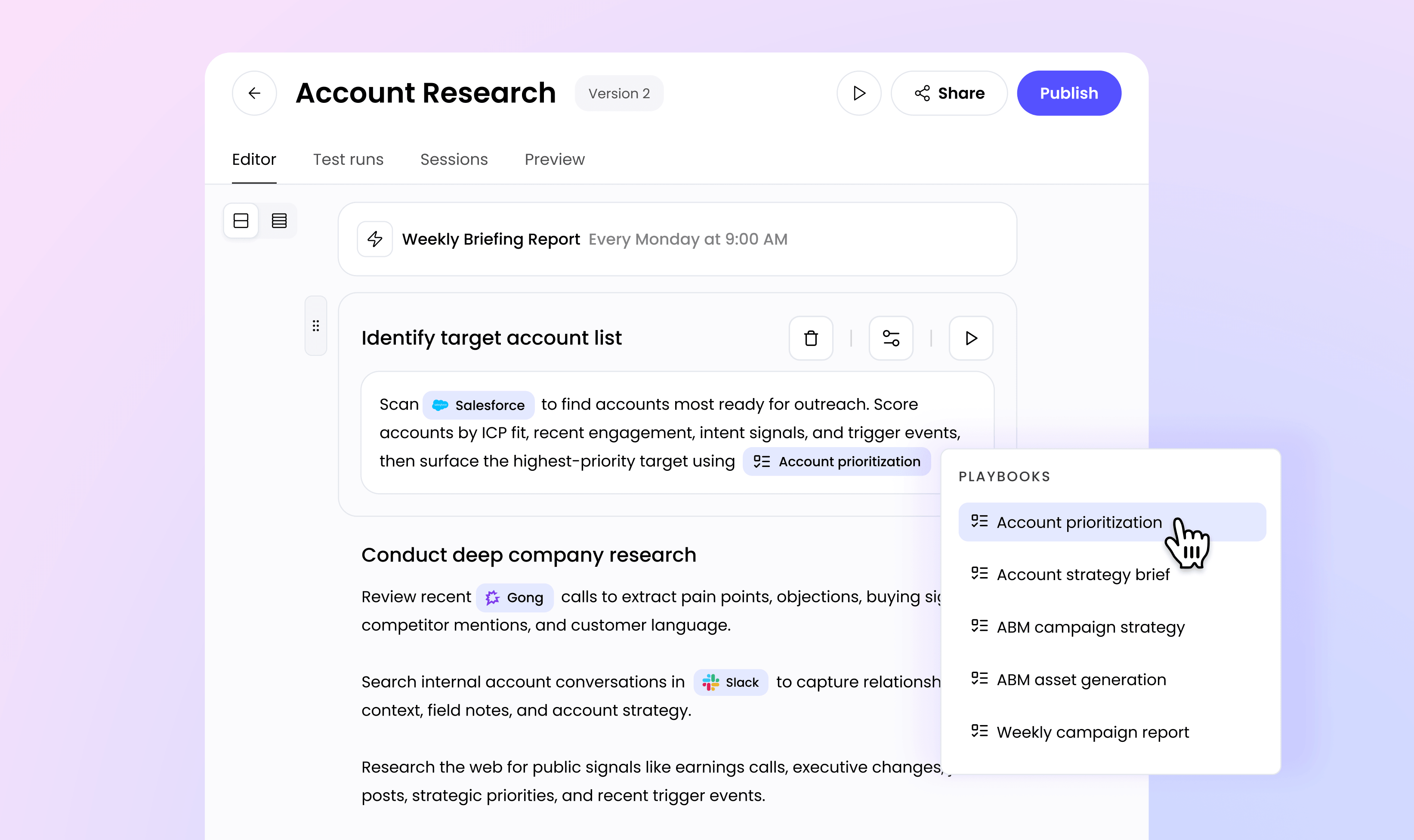
As teams automate more work, they often end up with multiple playbooks that support different parts of the same process. A marketing team might have one for research, one for briefs, one for drafting, one for review, and one for publishing.
Now, you can break down a playbook into modular steps, so each part of the workflow is easier to define, test, and refine. You can also chain playbooks together, so work automatically moves from one stage to the next without needing to manually run each playbook or copy outputs between steps.
With a modular approach, playbooks are easier to maintain and reuse. The team that knows the work best can own and improve its playbook over time, while other workflows can reuse it without rebuilding the same logic from scratch.
Test playbooks before rollout
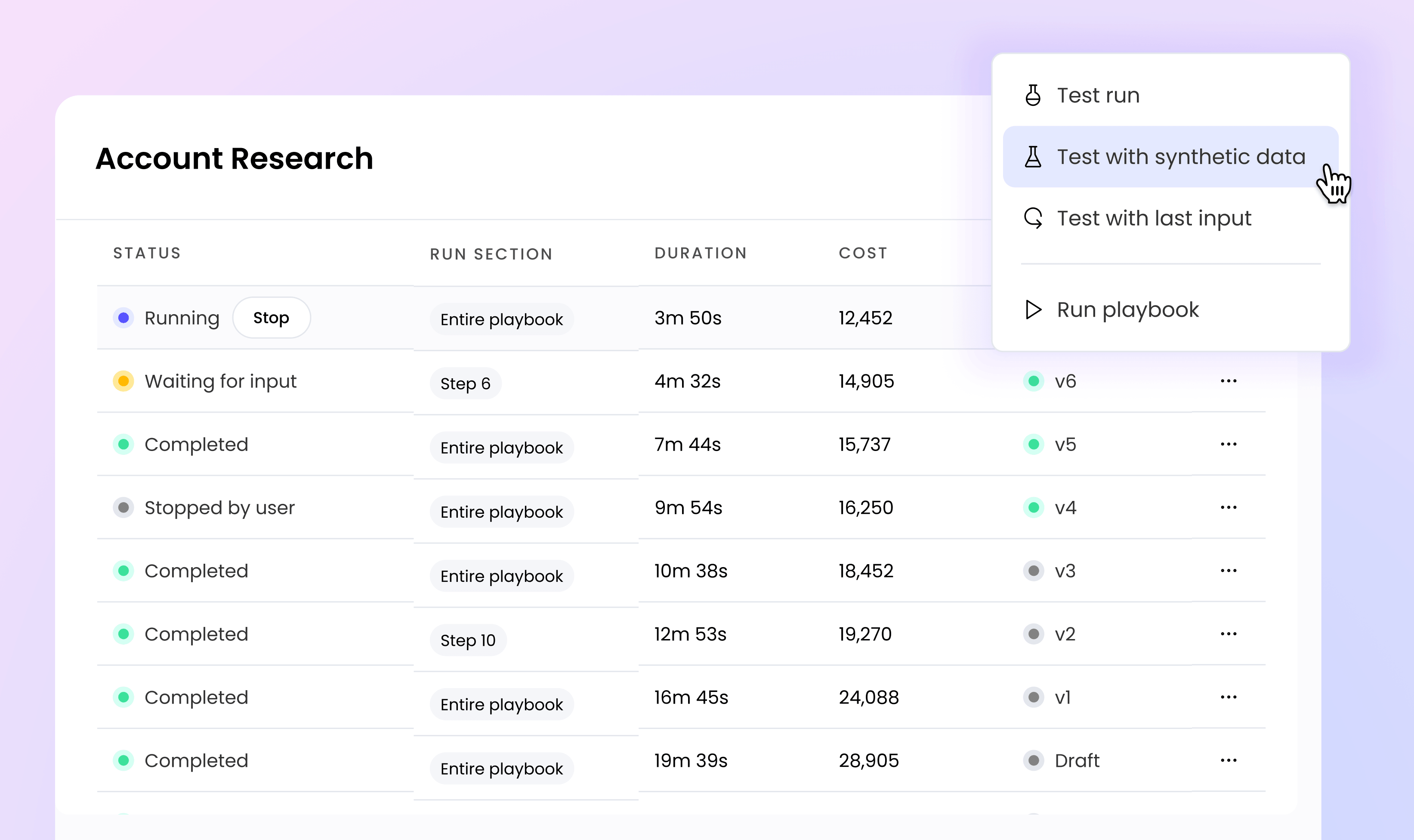
It’s one thing to create a great output once. It’s another to produce consistently strong work hundreds of times across an entire team. To scale with confidence, builders need a disciplined way to catch issues, compare versions, and refine playbooks before the rest of the team starts relying on them.
Now, builders can test playbooks directly in WRITER:
- Start testing right away: Use synthetic data generated by WRITER to check the playbook’s flow, instructions, and output formatting before live data is connected.
- Troubleshoot one step at a time: Isolate a specific step, test changes, and iterate faster instead of rerunning the full playbook every time.
- Pressure test across scenarios: Run tests in bulk to compare outputs, catch inconsistencies, and make sure the playbook performs across real-world variation.
- Track usage and cost: See token usage across playbook runs, steps, and versions, so teams can understand what’s driving cost and optimize before publishing.
Together, these tools help builders understand not just whether a playbook works, but what it takes to run consistently before it scales across the team.
Optimize how playbooks run
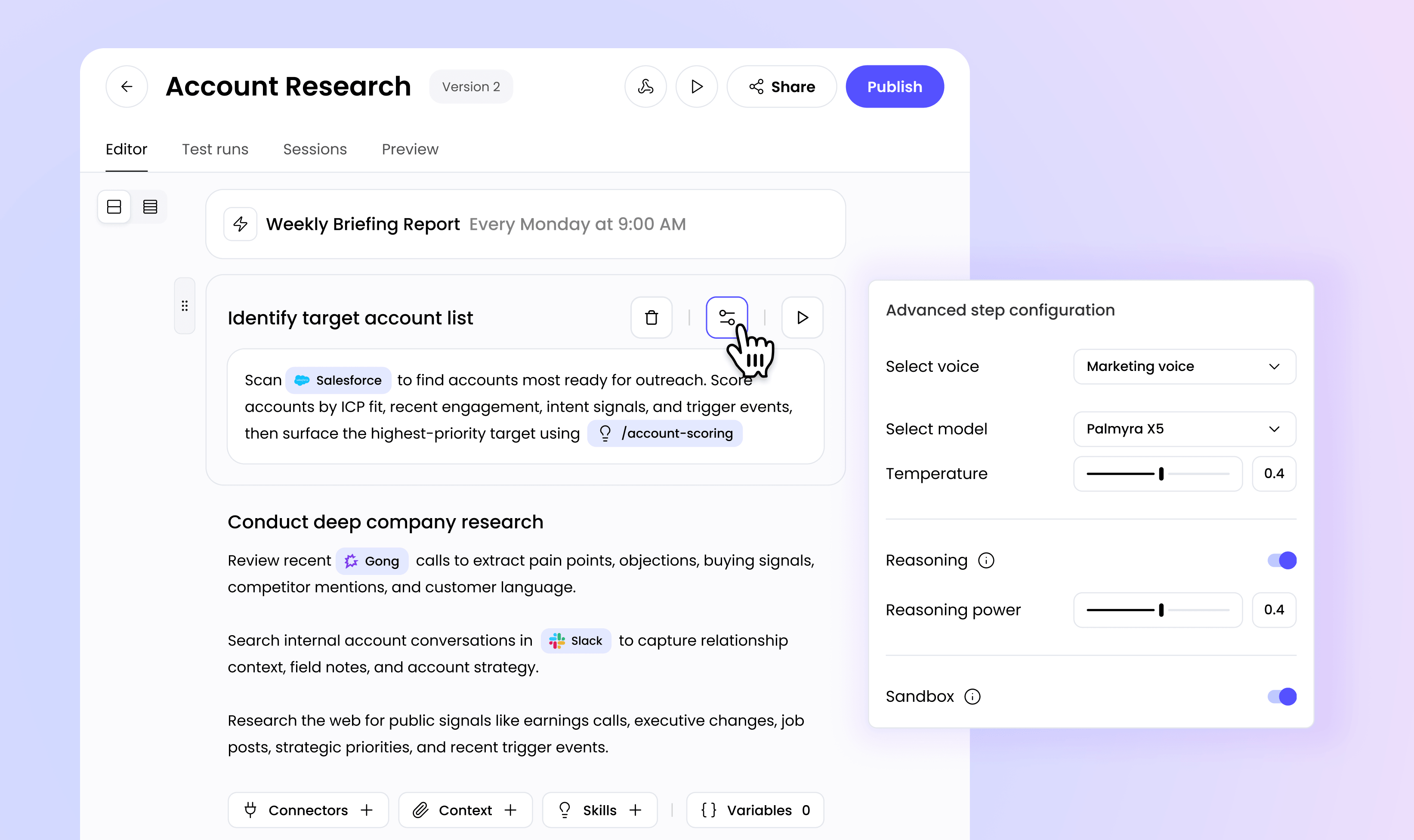
Not every playbook or step needs the same horsepower. Builders can now configure the playbook, or any individual step, to match the task at hand:
- Choose the right model for the task. Use Palmyra X5 as the cost-efficient default, or bring in specialized models for tasks like image generation.
- Control how much outputs vary. Lower temperature when outputs need to be more consistent, or increase it when the task calls for more creative range.
- Use deeper reasoning only where it’s needed. Apply deeper reasoning to complex analysis and lighter reasoning to simpler steps that need to run faster.
- Optimize execution for speed and cost. Turn off sandbox for routine steps that don’t require code execution.
- Keep outputs on-brand. Apply the right voice profile to match the brand, audience, or channel.
With more precision and control, teams can strike the right balance — adding more depth or creativity where it matters, while keeping the rest of the playbook fast and more cost-efficient.
Run playbooks in bulk
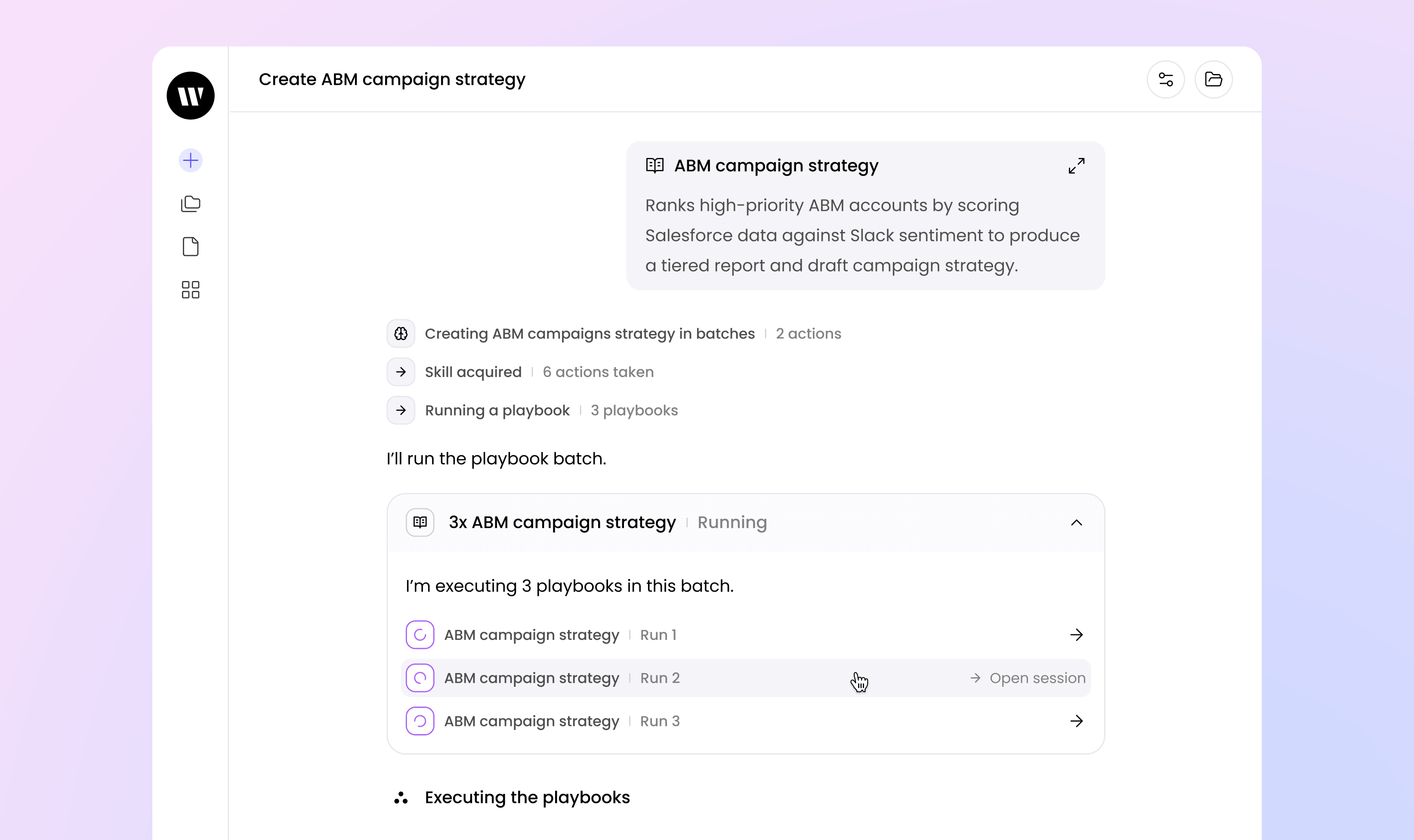
Once a playbook is tested and tuned, teams can scale it across repeatable work that would otherwise take hours to run one input at a time — like generating ABM strategy briefs from a target account list or optimizing copy across a repository of webpages.
With bulk runs, builders can upload a CSV or enter inputs directly, then run the same playbook across many inputs at once. Each row becomes its own run, so teams can review outputs, track progress, and understand what happened for every input.
For larger jobs, WRITER can also process work in batches as the playbook runs. For example, a playbook can analyze hundreds of rows in a CSV or extract insights from dozens of Gong calls by breaking the work into smaller batches and processing them in parallel.
Curate your team’s playbook library
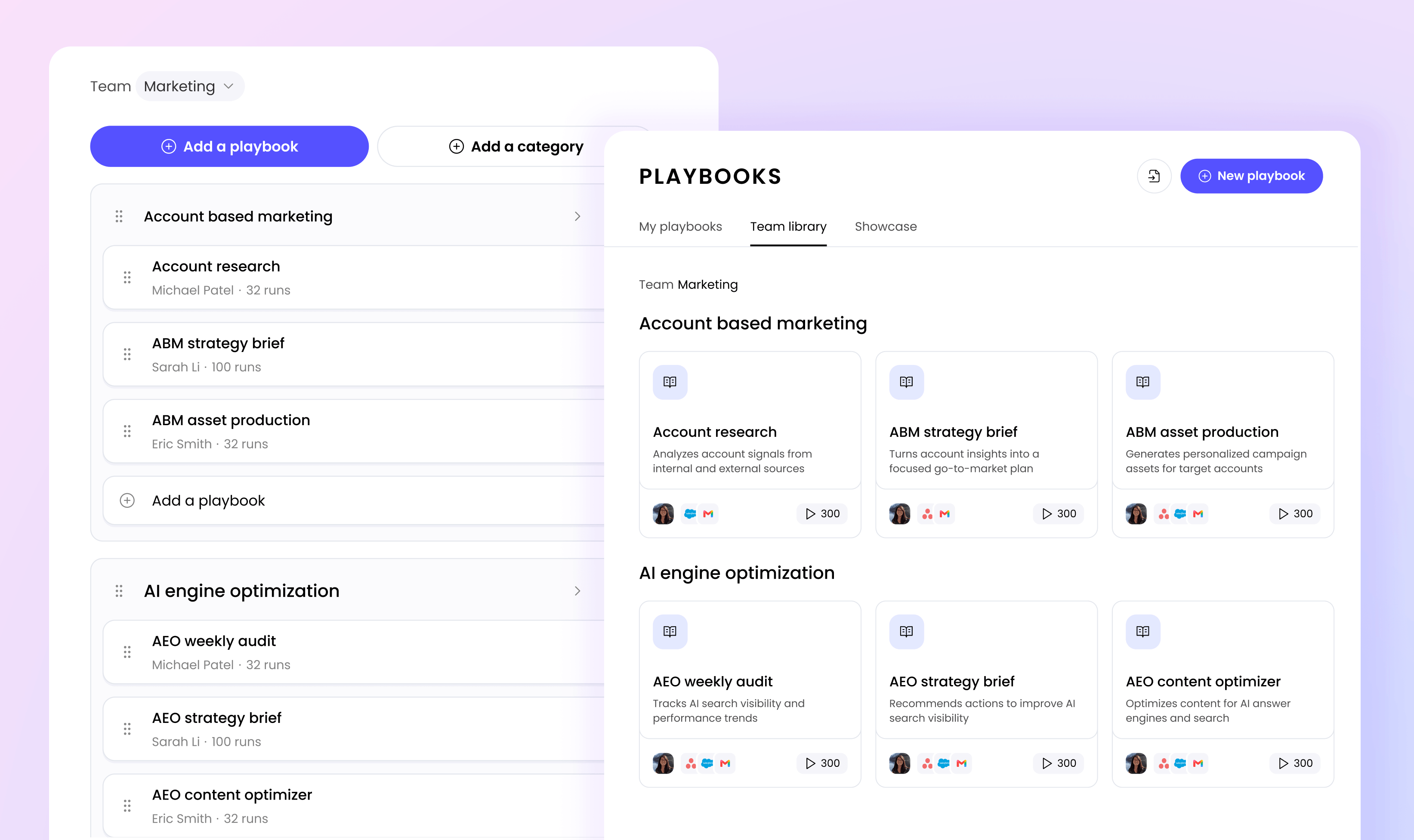
As more playbooks become ready for team use, teams need a faster way to find the ones they should actually use.
Admins can now curate playbook libraries by team, function, or workflow, so employees start from approved workflows instead of searching through a long list or creating another version from scratch.
The right playbooks are easier to find, and teams spend less time recreating playbooks that have already been proven.
Migrating playbooks
If your team already uses playbooks in WRITER, you can test them before they automatically migrate to the new experience on July 22, 2026.
When you open an existing playbook, you’ll have the option to create a draft in the upgraded experience. Your current published version will keep running while you test the draft, compare outputs, and make any updates.
Any questions? We’re here to help! Reach out at [email protected].
Not using WRITER yet? Book a demo to see how you can scale on-brand work with WRITER.
More resources
Innovation
– 10 min read
New at WRITER: More autonomy for agents, more control for admins
Writer Team
Innovation
– 17 min read
How WRITER Skills turn your team’s expertise into reusable AI capabilities

Marisa Almeida