
Enterprise transformation
– 26 min read
Marketing AI ROI calculator: Prove value to your CFO in five minutes

Your marketing team is faster with generative AI. You know it. They know it. But when the CFO asks “What’s the actual return on this AI investment?” — you’re stuck with anecdotes, not numbers.
Meanwhile, many AI initiatives struggle to deliver expected returns because teams measure productivity gains without capturing business outcomes. Despite heavy investment in AI, many firms are still waiting to see meaningful ROI from their initiatives. Many executives are investing in AI systems without a strategic approach to accurately measure ROI from AI. The solution? A human-centric approach to measuring AI ROI that focuses on employee productivity and business value creation. Calculate the complete picture in five minutes.
The problem: Why traditional ROI models fail for AI marketing
Traditional ROI models measure task speed: “We write blog posts 30% faster.” But they miss the strategic value: incremental revenue from launching campaigns weeks earlier, competitive advantage from entering new markets, compliance automation mitigating risk — and related costs — in regulated industries.
The task-level trap
Most teams measure the wrong things when investing in AI tools. They focus on task metrics instead of business outcomes.
What most teams measure (efficiency metrics):
- Email drafting time reduced by 20 minutes
- Social posts created 30% faster
- Blog writing down from four hours to three hours
What actually drives business outcomes:
- Incremental revenue from launching four new campaigns (previously impossible with team capacity)
- $1.2M from conversion improvements through 10x more A/B testing
- Market expansion to global campaigns (now economically viable with localization)
- $850K in compliance cost avoidance for regulated industries
- Lifetime value impact through personalized customer journeys
The math that matters:
When your team saves 15 hours per week on content creation, traditional ROI says “$75/hour × 15 hours × 50 weeks = $56,250 annual savings.”
The complete calculator projects: “$56,250 in productivity gains PLUS $180K from campaigns launching four weeks faster PLUS $45K in agency costs avoided = $281,250 total value.”
That’s 5x difference — the kind of impact that justifies investment. According to McKinsey, organizations investing deeply in AI see sales ROI improve by 10–20% on average when they measure comprehensively.
Analysis of customer implementations shows organizations achieve up to 333% ROI over three years — but only if you measure all five value drivers together, not just time saved. Many organizations struggle to quantify AI’s value beyond vanity metrics, risking investments becoming costly experiments.
Understanding generative AI vs. agentic AI for marketing ROI
Before measuring ROI, understand this critical distinction — it fundamentally changes your expectations and measurement approach.
Generative AI: Task-level automation
What it does: Helps with individual tasks like writing email drafts, creating social posts, or generating ad copy variations.
ROI characteristics:
- Productivity gains: 20-50% time reduction on specific tasks
- Easy to measure: Clear before/after on task completion
- Quick wins: Results in weeks
- Limitation: Requires human orchestration of multi-step workflows
Agentic AI: Outcome-level automation
What it does: AI systems complete entire workflows autonomously — understanding complex objectives, creating plans, and executing with minimal human intervention.
ROI characteristics:
- Business outcomes: Complete workflows from brief to published campaign
- Harder to measure initially: Requires tracking entire workflow cycles
- Transformational impact: Results in months but compounds over time
- Capability: AI orchestrates multi-step processes without handoffs
Why the shift matters
Generative AI example:
Process: Marketer writes brief → AI generates draft → Marketer edits → AI creates variations → Marketer selects → Marketer publishes
- Time saved: 40% on drafting step
- ROI driver: Productivity gains only
Agentic AI example:
Process: Marketer defines objective → AI creates brief, generates content —> Marketer reviews/edits/approves —> AI creates variations, tests performance, selects winner, schedules publication
- Time saved: 80% on entire workflow
- ROI drivers: Productivity gains + strategic capacity + faster time-to-market revenue
According to McKinsey research, only 10% of organizations currently see significant ROI from agentic AI, though many expect returns within one to five years as implementations mature. Organizations that successfully shift from generative to agentic AI can gain nearly insurmountable competitive advantage.
Are you organizationally ready? Self-assessment before investing
Before calculating ROI, assess whether your organization can actually capture it. Even with perfect numbers, organizational readiness determines actual results.
The three failure modes that kill ROI
Failure mode 1: Change management neglect
Treating AI as a technology project instead of organizational transformation. Organizations that lack proper change management plans, adoption incentives, or executive sponsorship see adoption stall even after successful pilots.
Failure mode 2: Wrong use cases first
Starting with complex, integration-heavy applications. Organizations that begin with use cases requiring integration across eight or more systems often see no results after 12 weeks, burning budget and credibility.
Failure mode 3: Misaligned incentives
Productivity gains without workflow redesign lead to more output without better outcomes. When teams are measured on volume rather than strategic impact, AI makes them productive at producing mediocre work rather than freeing time for high-value strategy.
The hidden cost: Review overhead
Many organizations experience overhead reviewing and refining AI output. Successful implementations invest in:
- High-quality data for AI pilot (preparation costs are real but necessary)
- Clear use-case definitions with quality standards
- Team training on output validation
- Platforms with built-in brand compliance and fact-checking
- Accuracy measurement as it impacts profitability
Organizational readiness scorecard
Executive sponsorship (critical)
Score one point for each:
- CMO or CEO champions adoption through month six resistance
- CFO sees AI as strategic imperative, not just cost
- At least one executive committed to weekly check-ins during pilot
- Leadership treats AI as core business capability, not IT initiative
Need 3+ of 4. Without executive air cover, middle management can kill adoption.
Change readiness (critical)
Score one point for each:
- Teams open to workflow changes (not just new tools)
- 12-18 month runway before needing results
- Fewer than two other major martech changes underway
- Clear use-case definitions established for pilot
Need 3+ of 4. Change fatigue and rushed timelines kill most initiatives.
Measurement culture (important)
Score one point for each:
- Clear baseline measurements for pilot workflows
- Measure business outcomes, not just outputs
- Finance trusts your numbers
- Strong data quality infrastructure
Need 3+ of 4. Can’t prove ROI without measurement discipline and baselines.
Team capability (important)
Score one point for each:
- At least 2-3 “AI champions” eager to adopt
- Team willing to experiment and iterate
- Strong relationship with IT/Data teams
- Investment budget for training and change management
Need 3+ of 4. Bottom-up adoption requires internal champions.
Your readiness score
12-16 points: High readiness. Calculate ROI and move forward.
8-11 points: Moderate readiness. Address gaps before full commitment.
0-7 points: Low readiness. Fix organizational issues first, technology second.
When you’re NOT ready:
❌ Marketing budget cut >20% this year (survival mode)
❌ <6 months tenure as CMO (build credibility first)
❌ Team morale in bottom quartile (fix culture first)
❌ Already implementing 2+ major changes (change fatigue)
❌ No executive sponsor willing to champion
❌ Poor data quality infrastructure
When you ARE ready:
✅ Marketing seen as growth driver, not cost center
✅ 12-18 month runway for results
✅ Executive champion driving the initiative
✅ Team open to workflow changes
✅ Finance asking “how do we scale without scaling headcount?”
✅ Strong data quality practices in place
The complete framework: Four strategic areas + five value drivers
The Marketing AI ROI Calculator measures across four strategic areas using five specific value drivers. Here’s how they connect:
The four-area measurement framework
Area 1: Efficiency gains — Operational efficiency through increased output, faster cycles, reduced errors
Area 2: Revenue generation — Revenue uplift from faster launches, improved conversions, market expansion
Area 3: Risk mitigation — Risk management through compliance automation, review cycles, error reduction
Area 4: Business agility — Strategic capacity and flexibility to respond to market changes
The five value drivers (what the calculator actually measures)
Driver 1: Productivity gains → Aligns with Area 1 (Efficiency)
Driver 2: Marketing agency savings → Aligns with Area 2 (Revenue)
Driver 3: MarTech stack consolidation → Aligns with Area 1 (Efficiency)
Driver 4: Governance efficiencies → Aligns with Area 3 (Risk)
Driver 5: Strategic capacity unlocked → Aligns with Areas 2 & 4 (Revenue + Agility)
How they work together
Most AI ROI calculators focus on Driver 1 only (productivity gains). Complete measurement captures all five drivers across the four strategic areas. Implementation data across 50+ organizations confirmed: Organizations measuring all five drivers achieved $12.02M net present value over three years with payback under six months.
Companies that treat AI as a core business capability rather than an IT initiative can achieve higher ROI by measuring these strategic dimensions. This isn’t just cost savings — it’s unlocking value across your entire marketing organization.
The five ROI drivers — How to accurately measure complete AI value
The calculator asks six simple questions about your team, industry, and current AI systems. From those inputs, it calculates personalized projections across five value drivers aligned with the four key measurement areas. Here’s what each driver measures and why it matters for your business case when investing in AI.
Driver 1: Productivity gains — Helping teams work smarter
What to measure for AI-powered productivity:
- Current marketing team size and structure
- Time spent on AI-eligible workflows (content creation, campaign ops, reporting, ad copy generation)
- Fully-loaded cost per employee
- Expected automation rate based on your use cases with generative AI
How to calculate value from AI tools:
Simple formula: Time saved × Team size × Cost per hour = Annual labor savings
Real example from AI campaigns:
Your team: 25 marketers
Your use cases: Content supply chain + Campaign orchestration + AI-driven ad copy
Estimate: 12 hours/week saved per person
Result: 25 × 12 hours × $75/hour × 50 weeks = $1.125M in Year 1
Important caveat — The “AI Tax”:
The calculator accounts for review overhead in its projections. Organizations using platforms with strong accuracy and compliance features minimize this overhead compared to generic tools.
Why this matters for measuring ROI:
Productivity gains are the foundation — the easiest to measure accurately and fastest to realize. But it’s only 25-30% of total value. High-quality data is essential for effective AI training.
Driver 2: Marketing agency savings — Bringing work in-house
What to measure when adopting AI:
- Current annual spend on agencies/contractors
- Type of work (content, creative, localization, marketing communications)
- Percentage that can move in-house with AI-powered tools
How to calculate value from AI applications:
Your agency spend: “$500K – Significant”
Realistic internal migration with AI tools: 30-50%
Result: $500K × 40% × three years = $600K savings
Real example from AI projects:
One software company eliminated $5M in agency spend over three years by bringing SEO content, scriptwriting, and campaign creative in-house using AI marketing tools. Quality improved because internal teams understood the product better. Speed improved because no back-and-forth with external vendors.
Why this matters for true value:
Agency savings often exceed labor efficiency savings for teams with high contractor dependency. Plus: faster turnaround, better brand consistency, and more control over the entire customer journey.
Driver 3: MarTech stack consolidation — Reducing tool sprawl
What to measure in AI systems:
- Current MarTech/AI tool stack size
- Tools that can be replaced by integrated AI-driven platform
- Total cost of investment including software licensing, hardware, and ongoing maintenance overhead
How to calculate value:
Your tool stack: “Moderate (3-5 tools)”
Realistic consolidation with unified AI platform: Replace 3-4 tools
Savings: $15K per tool × four tools = $60K annually = $180K over three years
Real example:
One tech company saved six figures by consolidating from scattered AI tools to a single platform, plus saved 0.5 FTE who previously managed integrations and ongoing maintenance.
Why this matters for total costs:
Tool sprawl creates security risks, integration nightmares, data quality issues, and hidden management costs. The total cost of investment includes upfront development, data acquisition, software licensing, hardware, training, and ongoing maintenance. Consolidation creates immediate cost savings and better data management.
Driver 4: Governance efficiencies — Critical risk management
What to measure in AI-powered compliance:
- Industry (affects compliance complexity)
- Current review/approval process
- Risk management requirements and violation costs
- Accuracy impact on profitability (calculators should account for the cost of errors)
How to calculate value for regulated industries:
Compliance value varies by industry. Financial services and healthcare see the highest returns from governance automation due to regulatory requirements. Technology and retail benefit primarily from brand consistency enforcement. General industries see compliance as quality control.
Real example from AI initiatives:
A financial services marketing team reduced compliance review cycles by 85% while improving accuracy through reduced errors due to AI. Every campaign launches weeks faster because automated checks catch issues before human review — a true game changer for marketing communications in regulated industries. Accuracy directly impacts profitability by preventing costly violations.
Why this matters for measurable ROI:
For regulated industries, one compliance violation can cost more than three years of platform investment. Automated compliance isn’t optional — it’s a strategic imperative for risk management.
Driver 5: Capacity unlocked — Enabling strategic approach
What to measure in agentic AI impact:
- AI maturity level (affects adoption speed and realized gains)
- Strategic vs. tactical time allocation
- Reinvestment of productivity gains into business objectives
- Shift from task automation to outcome automation
How to calculate strategic value from AI:
More mature organizations see higher ROI because they reinvest reclaimed time strategically, not just increase output volume.
Real example from AI campaigns:
EE’s copywriters moved from “processing content” to “thinking strategically” when AI handled production. Result: from 30% meeting quality standards to 100%, while launching 4x more product variations with better click through rates. That’s the 10x effect — not just doing the same work faster, but doing entirely new work that drives competitive advantage and significant impact on sales.
Why this matters for bottom line impact:
Teams that protect reclaimed time for strategy and innovation create compounding value. In 2026, only 18% of organizations collect ROI metrics, and 40% admit they aren’t sure what factors constitute AI success. By measuring the actual increase in strategic capacity — rather than just tracking basic adoption rates — marketing organizations can immediately separate from the pack. While competitors still struggle to define what AI success even looks like, you can use that unlocked capacity to launch campaigns faster, enter new markets, and drive measurable revenue.
Understanding the investment: What you’re actually spending
Let’s be transparent about the complete cost of investment. The ROI calculator balances these costs against the five value drivers. Here’s an example of what an enterprise’s AI investment could look like:
Year 1 investment breakdown (example enterprise)
Platform & Implementation:
- Platform licensing: $300-600K (based on team size)
- Implementation/onboarding: $50-100K (one-time)
- Integration costs: $20-80K (varies by stack complexity)
Change Management & Training:
- Training programs: $30-50K (critical for minimizing review overhead)
- Change management: $40-60K (often underestimated)
Data & Infrastructure:
- Data preparation/quality: $20-40K (essential for AI effectiveness)
- Technical setup/security: $10-30K
Total Year 1: $470-960K
Years 2-3 investment (ongoing)
Recurring Costs:
- Platform licensing: $300-600K annually
- Training refreshes: $15-25K quarterly
- Ongoing optimization: $20-40K annually
Total Years 2-3: $335-665K per year
Three-year total cost: $1.14-2.29M
Against this investment, we’ve seen customer implementations show $15.63M in total benefits for net present value of $12.02M and 333% ROI.
Why this transparency matters: Finance needs to see the complete picture. Hidden costs destroy credibility. The calculator uses these validated cost ranges to provide realistic projections.
The solution: Marketing AI ROI calculator
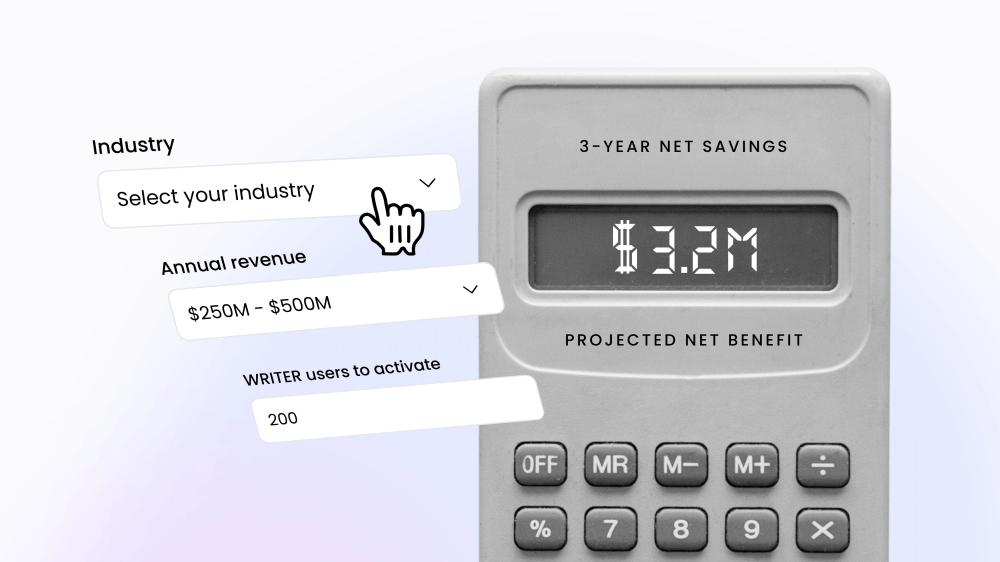
The WRITER Marketing AI ROI Calculator captures what traditional models miss. In five minutes, you get a personalized business case showing three-year net savings, payback period, and ROI across all five drivers.
Validated by documented results from 50+ enterprise marketing teams.
Full transparency: This is our calculator. But the framework applies regardless of vendor. Use it to think through complete ROI, not just task-level efficiency. Then evaluate AI-powered tools and platforms based on your numbers.
How to use the marketing AI ROI calculator
If your readiness assessment scored 8+, the calculator will help you build a defensible business case for your AI investment.
Five minutes. No complex spreadsheets. No financial modeling expertise required. Just answer six questions about your marketing team and current AI systems.
Step-by-step walkthrough for measuring AI ROI
Step 1: Tell us about your company (60 seconds)
What you’ll select:
- Industry: Affects compliance weighting and benchmarks for AI campaigns
- Annual revenue: For sizing context (companies of different scales see different ROI profiles)
- Team size: Affects per-person costs and scaling of AI tools
Why: Calculator uses industry patterns from 50+ implementations to model realistic outcomes for companies adopting AI.
Step 2: Choose your use cases (60 seconds)
Select all that apply for your AI-powered marketing:
- Content supply chain (blog, social, email, ad copy)
- Campaign orchestration & optimization
- Personalization & ABM (entire customer journey)
- SEO/AEO/GEO content
- Asset localization & translation (global campaigns)
- Brand compliance & governance (risk management)
- Marketing operations & reporting (actionable insights)
Why: Each use case has different ROI profiles and complexity levels. This affects both tangible value and implementation difficulty. Clear use-case definitions are critical for successful AI implementations.
Step 3: Refine estimate (60 seconds)
Additional context for AI projects:
- AI maturity level: Pilot/Active/Mature (affects adoption speed and measurable impact)
- Agency spend: For cost savings calculation
- Tool stack: For consolidation potential and ongoing maintenance reduction
Why: These factors affect how quickly you’ll see value and how much organizational friction to expect. Leaders need this for decision making about resource allocation and investment priorities.
Step 4: Get your results (instant)
Your personalized business case shows:
- Three-year net savings estimate (total costs vs. value across efficiency, revenue, risk, agility)
- ROI percentage estimate vs. industry benchmark
- Payback period estimate (typically 4-6 months)
- Breakdown across all five drivers aligned with four-area framework
- Quick wins recommendations based on your inputs
Step 5: Unlock full details (30 seconds)
Enter your work email address to receive:
- Detailed methodology document (accurately measure your investment)
- Exportable executive summary for business objectives
- Shareable link for stakeholders (no login required for viewing)
- Implementation quick-start guide for AI adoption with team training resources
What makes this calculator different from other AI marketing tools
1. Marketing-specific, not generic AI ROI calculator
Built for marketing workflows and measurements — not adapted from generic frameworks for artificial intelligence
2. Accounts for review overhead and total cost of investment
Risk-adjusted projections include data quality costs, training, and review overhead. Sets realistic expectations.
3. Industry-validated methodology for AI initiatives
Based on aggregated data from 50+ real implementations of AI projects and McKinsey research (20-30% higher campaign ROI)
4. Instantly shareable for decision-making
Get a unique link to circulate — no logins required for viewing. Share with executives and leaders. Justify budgets by providing evidence that AI initiatives contribute to bottom line.
5. Measures both generative and agentic AI value
Not just “what’s possible” but “what’s realistic for your maturity.”
From calculator results to CFO approval for AI investment
You’ve calculated your ROI. Here’s how to turn numbers into budget approval.
Present to finance — Handle the objections about investing in AI
Objection 1: “These projections seem aggressive for AI tools”
Your response:
“Actually, they’re conservative. The calculator uses risk-adjusted assumptions to accurately measure potential, including review overhead. Here’s the financial analysis showing that a composite organization representative of interviewed customers experiences a projected 333% ROI over three years using AI-powered marketing. Plus McKinsey research showing companies leveraging AI in marketing see 20-30% higher ROI on campaigns compared to those relying on traditional methods. Our projections show [X]%. Most teams exceed projections by 15-25% because they discover additional use cases.”
Objection 2: “Why not just use ChatGPT or other free AI? It’s cheap”
Your response:
“Free AI tools work for individuals, platforms work for teams. Generic AI can’t do brand compliance, workflow automation, audit trails for regulated industries, risk management, or integrate with our martech stack for the entire customer journey. The calculator shows $[X]K in compliance value alone — one violation costs more than three years of platform investment. Plus free tools have massive data quality and ongoing maintenance issues. According to Deloitte’s 2025 survey, treating AI as a core business capability delivers 2-3x higher ROI than point solutions.”
Objection 3: “What’s the risk if this AI investment doesn’t work?”
Your response:
“We’re piloting with [X] people for [Y] weeks with clear success criteria: match calculator projections ±15% on measurable ROI. Pilot cost is $[Z]K. If we don’t hit targets, we stop before scaling. Risk is capped at pilot investment. Upside is $[Total value]M over three years with tangible value across operations. This strategic approach ensures we deliver on business objectives before full deployment. Deloitte research shows most organizations take 2-4 years to see ROI from typical AI initiatives, but platforms like WRITER demonstrate <6 month payback when properly implemented.”
Objection 4: “Why can’t we build this AI ourselves?”
Your response:
“We evaluated build-vs-buy for AI systems. Build costs $2-5M Year 1, $1-2M ongoing maintenance, 12-18 months to production, dedicated engineering resources. Buy costs $[X]K annually, days to first value, no engineering required for marketing teams. Build payback is 24-36+ months. Platform payback is 4-6 months. We can revisit build decision if platform doesn’t demonstrate measurable impact. Most companies that build custom AI face ongoing maintenance nightmares and miss out on staying ahead with rapid AI evolution. Unless AI is our core product differentiator, buy wins on both speed and total costs.”
The executive summary slide (what CFOs actually read)
Financial impact from AI investment over three years:
- Total investment in AI: $[X]M (including software licensing, training, ongoing maintenance)
- Total return: $[Y]M (across efficiency, revenue, risk, agility)
- Net present value: $[Z]M
- ROI: [W]%
- Payback: [N] months
Value breakdown across AI applications:
- Productivity gains: [%]
- Marketing agency savings: [%]
- Tool consolidation (reduced ongoing maintenance): [%]
- Compliance & risk management: [%]
- Strategic capacity (business outcomes): [%]
Risk mitigation for AI projects:
- Pilot-first strategic approach (8-12 weeks, [X] people)
- Clear success criteria (match projections ±15%)
- No-regrets implementation (even partial success = positive ROI)
- Validated methodology (50+ implementations achieving strong ROI)
- Accounts for review overhead built into projections
Competitive context:
- 91% of executives plan to increase AI spending in the next 12 months
- 10% currently see significant ROI from agentic AI, with many expecting returns within 1-5 years
- Industry leaders already seeing 20-30% higher campaign ROI with AI
- Window closing for early-mover advantage
Plan your pilot — Avoid common AI project mistakes
Start with highest-impact, lowest-complexity use case for quick wins:
✅ Pilot-ready (start here for measurable impact):
- Content supply chain automation
- Brand compliance checking
- Campaign asset creation
❌ Avoid for initial AI pilot:
- Complex integrations across 10+ systems
- Use cases requiring organizational change first
- Workflows without clear baselines
Pilot structure that works best for AI initiatives:
- Duration: 8-12 weeks (long enough for learning curve, short enough to maintain urgency and save time)
- Team size: 5-10 people (meaningful data, manageable scope, contained risk)
- Success criteria: Match calculator projections ±15% to demonstrate real ROI
- Measurement: Document baselines → Track weekly → Compare to projections for actionable insights
- Team training: Budget 20% of pilot time for training on AI systems and output validation
Week 1-2: Onboarding and team training
Week 3-6: Active usage with support
Week 7-8: Measurement and documentation
Week 9-12: Results presentation and scale decision
Scale systematically — Month by month approach
Months 1-2: Pilot phase
- Prove ROI with 5-10 person team
- Document what workflows work (and what don’t)
- Identify your internal champions who can work smarter
- Compare actual results to calculator projections for measuring ROI
- Establish clear use-case definitions for scale phase
Months 3-5: Expand
- Roll out to 25-50% of organization
- This is where adoption of AI typically stalls (change management is critical)
- Build center of excellence from pilot champions
- Target: 60% active adoption among users
- Expect: Resistance from middle management
- Focus on delivering measurable impact to maintain momentum
- Invest in ongoing team training
Months 6-12: Scale + optimize
- Full marketing organization using AI-powered tools
- Advanced workflows and integrations across AI systems
- Target: 85% adoption, exceed projections by 10-15%
- This is where you start seeing Driver 5 value (strategic capacity and deeper insights)
- Shift focus from generative to agentic AI workflows for outcome automation
ROI realization timeline:
WRITER customers who fully implement the platform typically achieve <6 month payback. Industry-wide, Deloitte shows most organizations take 2-4 years, with only 6% reporting payback under one year. Organizations that invest in proper change management see faster results.
Accuracy & Methodology
Q1: How accurate is this calculator?
Based on aggregated customer implementation data (333% ROI validated), McKinsey research (20-30% higher campaign ROI), Deloitte 2025 survey of 1,854 executives, and 50+ enterprise implementations. Uses conservative, risk-adjusted assumptions. Most teams exceed projections by 15-25%.
What affects accuracy: Input quality (accurate baselines), use case selection, organizational readiness, data quality, training investment, and adoption rate (assumes 75% by month six).
Q2: What ROI should I expect for my team size?
ROI varies significantly based on organizational readiness, use cases, and implementation approach. Customer data validates 333% ROI for enterprise organizations. Your results depend on team size, AI maturity, change management investment, and measurement discipline.
Key insight from Deloitte: Organizations treating AI as a core business capability see 2-3x higher ROI than those taking a tactical approach.
Q3: What if actual results don’t match projections?
Results typically EXCEED projections (more common):
- Teams discover additional applications not in original plan
- Spillover benefits (sales teams adopt, customer success adopts)
- Tool consolidation exceeds estimates
- Strategic capacity value compounds faster than projected
- Average outperformance: 15-25% among successful implementations
Results below projections (organizational issues):
- Usually adoption challenges, change management gaps, misaligned incentives
- Sometimes inflated baselines or poor data quality
- Review overhead higher than expected due to insufficient training
- Calculator is conservative, so even “below projection” typically shows positive ROI
Cost & Investment
Q4: What if I don’t know exact numbers?
Calculator provides defaults based on industry benchmarks. Select closest ranges for agency spend, tool stack, team size. Results will be directionally accurate. Refine with exact numbers as you build detailed business case. The goal is insights first, precision second.
Q5: How does platform ROI compare to building custom AI?
Build custom AI:
- Cost: $2-5M Year 1, $1-2M annually ongoing
- Timeline: 6-18 months to production
- Resources: Dedicated engineering team, maintenance burden
- Risk: Technical debt, talent retention, evolving requirements
Platform approach:
- Cost: $300-600K annually typical
- Timeline: Days to first workflows
- Resources: No engineering required
- Risk: Vendor dependency, feature alignment
Payback comparison: Custom build = 24-36+ months. Platform = 4-6 months.
When to build: If AI is your core product differentiator. For marketing operations, buy almost always wins.
Timeline & Results
Q6: How long to see actual ROI?
For WRITER customers:
- Payback: <6 months
- First indicators: Week 1-2 (visible time savings on tasks)
- Measurable impact: Month 3 (faster workflows, better performance)
- Revenue uplift: Month 6 (campaign performance, improved conversions)
- Full ROI: Under 6 months
Industry average (Deloitte):
- Most organizations: 2-4 years to satisfactory ROI
- Only 6%: Payback under one year
- Only 13%: Returns within 12 months
Reality: Months 3-6 are challenging. That’s where initiatives stall without proper change management. Expect resistance. Plan for it.
Industry-Specific
Q7: Does this work for regulated industries?
Yes — especially valuable. Financial services, healthcare, and pharma see 30-40% of total ROI from compliance automation alone.
Critical requirement: Platform must have zero-data-retention architecture for HIPAA/FINRA compliance. Generic AI tools that train on your data are non-starters. Accuracy directly impacts profitability — calculators should account for error costs and compliance violations.
Q8: Can I use free AI tools instead of a platform?
Free AI like ChatGPT works for individuals. Platforms work for teams at scale.
What free tools can’t provide:
❌ Brand enforcement and compliance checking
❌ Workflow automation and martech integration
❌ Audit trails for regulated industries
❌ Team collaboration and organizational memory
❌ Enterprise security (SOC 2, HIPAA, GDPR)
❌ Managed maintenance and updates
❌ Training infrastructure for minimizing review overhead
ROI comparison: Free tools deliver individual productivity boosts. Enterprise platforms enable team transformation, strategic capacity, and revenue uplift.
Implementation
Q9: Can I share results with my buying committee?
Yes. After entering your email, you get a unique shareable link. Anyone can view (no login required). Use it to build consensus across the CFO, CTO, CIO, HR, and department heads.
What stakeholders care about:
- CFO: NPV, payback period, risk, total costs, revenue uplift potential
- CTO/CIO: Security, integration complexity, technical architecture, data quality
- HR: Change management, training requirements, team impact
- Department heads: How this affects their teams and workflows
- Sales leaders: Impact on enablement, lead generation, incremental revenue
The calculator results address all these perspectives.
Q10: What happens after I calculate ROI?
You’ll receive:
- Personalized business case summary (including total cost breakdown)
- Detailed methodology document (show your math, including review overhead adjustments)
- Implementation quick-start guide with training resources
- Shareable link for stakeholders
- Comparison to McKinsey and Deloitte benchmarks
- Optional: Consultation with WRITER team
No obligation. See your numbers first. Use the framework regardless of vendor. Decide next steps on your timeline.
Stop guessing, start proving ROI
91% of executives plan to increase AI spending in the next 12 months. Yet Deloitte research shows most organizations take 2-4 years to see satisfactory ROI. The difference isn’t the technology. It’s the measurement and organizational readiness.
Organizations that succeed measure complete value across four strategic areas: efficiency gains, revenue generation, risk management, and business agility. They assess readiness before investing. They take a strategic approach, not just technology deployment. They invest in training and change management. They treat AI as a core business capability. They start with realistic projections accounting for review overhead and data quality costs, then systematically exceed them.
This is the strategic imperative for modern marketing leaders in 2026: accurately measure AI ROI to stay ahead of competition and justify continued investment.
What you have now
You have a framework for complete measurement across efficiency, revenue, risk, and agility. You have a self-assessment for organizational readiness. You have verified results from enterprise implementations showing 333% ROI. You have a calculator built on this validated research.
The only thing missing is your specific numbers and your commitment to a human-centric approach to adoption.
Calculate your marketing AI ROI in five minutes
No complex spreadsheets. No pressure. No commitment.
Just answer six questions and get:
✅ Three-year net savings projection estimate (total costs included)
✅ Personalized payback timeline estimate (WRITER customers see <6 months)
✅ ROI percentage estimate vs. industry benchmarks
✅ Five-driver breakdown aligned with four-area framework
✅ Shareable business case for your CFO
✅ Organizational readiness recommendations
✅ Risk-adjusted projections (realistic expectations)
Based on 333% ROI from real customers. Verified by McKinsey research. Free to use.
Calculate your marketing AI ROI now →
This blog post is designed for CMOs and VPs of Marketing at Global 2000 and mid-market companies who need to build defensible business cases for marketing AI investment and demonstrate measurable impact. All customer metrics sourced from aggregated customer implementation data across 50+ enterprise marketing organizations(2025), McKinsey research on AI marketing ROI(2025), Deloitte AI ROI survey of 1,854 executives(2025), and Google campaign performance analysis.
IMPORTANT DISCLAIMER:
The return on investment (ROI) figures, cost savings, revenue projections, and payback periods described in this article and generated by the WRITER Marketing AI ROI Calculator are estimates based on aggregated data from past customer implementations, industry research, and specific assumptions. These figures are provided for informational and illustrative purposes only and do not constitute a guarantee, warranty, or prediction of future results.
Actual results for your organization will vary significantly based on numerous factors unique to your organization, including but not limited to: organizational readiness, change management execution, data quality, user adoption rates, existing technology stack, industry regulations, and the specific use cases implemented. The calculator’s projections assume successful implementation and adoption. We make no representation that any individual organization will achieve any specific results, including the specific financial outcomes or timelines discussed herein.
More resources



AI in the enterprise
– 29 min read
AI ROI calculator: From generative to agentic AI success in 2025

Matthew Olson