
AI agents at work
– 13 min read
Right-to-left thinking: A new framework for marketing AI transformation
How VOIS and Vodafone achieved 50% time savings and 2x engagement with outcome-first AI


While most CMOs are still planning their AI strategy, Vodafone UK has already eliminated 20 hours per week of manual work and watched customer AI-powered searches explode 9x in just 12 months. Here’s how they — and VOIS — are leading the transformation instead of being disrupted by it.
- Right-to-left thinking challenges traditional process optimization in favor of outcome-first transformation.
- Customer behavior has shifted dramatically—Vodafone UK saw AI platform searches jump 9x in just 12 months
- Co-creation empowers marketers with AI superpowers rather than replacing them
- Experimentation beats perfection — organizations achieving impact are those who started yesterday
- GEO is the new SEO — Generative Engine Optimization ensures discoverability as search becomes AI-assisted

The age of agentic AI isn’t on the horizon—it’s here. And for marketing organizations, the question is no longer whether to transform, but how to lead that transformation before being forced into it.
We sat down with Chris Meads, Chief Commercial Officer at VOIS, and Alex Pott, Consumer Digital Director at Vodafone UK, in our latest webinar to explore how they’re navigating this shift.
Their conversation revealed a fundamental truth: in this new era, optimization isn’t enough. Real transformation requires reimagining what’s possible.
The proof is already in production
Vodafone UK’s demand generation team has eliminated 20 hours per week of manual banner creation. VOIS has cut campaign production time in half while improving quality scores. And both organizations report that their marketers are spending more time on strategy, not less — precisely because AI handles the tactical execution.
The data behind the shift: The numbers tell the story
The data tells a compelling story. Vodafone UK witnessed customer searches through AI platforms explode from 0.5 billion to 4 billion in just 12 months — a 9x increase that signals a fundamental shift in how customers discover and purchase products.
“Our customers are more tech savvy than ever,” Pott explains. “They’re changing how they search for products that they want to purchase. They’re changing how they want to buy and they’re really changing how they want to be served and cared for.”
Research backs up this shift in consumer behavior. Industry data shows zero-click searches surged from 56% to 69% between May 2024 and May 2025 — a 13 percentage-point jump in just one year. During the same period, organic traffic to news sites dropped from 2.3 billion visits to under 1.7 billion, while 34% of consumers now report using AI assistants like ChatGPT and Claude for product research before turning to traditional search engines. The impact is substantial: when AI-generated summaries appear in search results, click-through rates for top organic links can drop by as much as 79%.
What this means for marketing operations
This isn’t a future trend to prepare for. Customers are already living in an AI-assisted world, and marketing operations need to keep pace.
This shift isn’t isolated to Vodafone. Gartner projects that by 2028, companies deploying AI agents across the majority of their customer interactions will significantly outperform competitors. Marketing organizations that haven’t optimized for AI discovery risk becoming invisible to the next generation of buyers.
The organizations that recognize this shift and act on it now are the ones positioning themselves for success.
Vodafone’s response: Optimizing for AI discovery
Recognizing that customer searches had fundamentally shifted to AI platforms, Vodafone UK took a strategic approach to the discovery problem. Instead of asking “How do we improve our SEO rankings?” they asked “How do customers discover us in an AI-assisted world?”
The answer: They built a GEO (Generative Engine Optimization) agent using WRITER’s platform — an AI agent that automatically optimizes their content to appear in AI-generated search responses from ChatGPT, Claude, Perplexity, and Google’s AI Overviews.
“I believe those search engines are going to transition to AI assistance,” Pott explains. “Therefore, we also have to be discoverable in the AI assistance, which is what GEO does.”
The GEO agent actively optimizes their content for AI search, keeping Vodafone visible where their customers are increasingly looking: ChatGPT, Claude, and other AI assistants.

Customer discovery has fundamentally changed—and VOIS and Vodafone are ahead of the curve
See how they're navigating this 9x shift in search behavior
But recognizing the shift is only the first step. The real question facing marketing leaders is: How do you actually transform your organization to meet this new reality? The answer, according to Meads and Pott, lies in a fundamental rethinking of how transformation itself works.
Framework: Right-to-left thinking
The core of their transformation approach is what Meads calls “right-to-left thinking”—a framework that starts with desired customer outcomes and works backward, rather than incrementally optimizing existing processes.
What is right-to-left thinking?
Right-to-left thinking is a strategic framework that starts with the desired customer outcome and works backward to completely redesign how that outcome is achieved—rather than incrementally optimizing existing processes.
“It’s all too easy to think very traditionally about optimizing a business process,” Meads explains. “We go left to right in our thinking and we go, ‘well, there’s the process. How do we make it a bit quicker?'”
In the age of agentic AI, that incremental approach isn’t enough. “We need to think about things the other way round, go right to left,” Meads says.
The difference in practice
What does this mean in practice?
Traditional left-to-right thinking asks: “How can we make our content creation 10% faster?”
Right-to-left thinking asks: “What content experience do we want to create for our customers, and how can AI help us get there in an entirely new way?”
The difference isn’t just semantic — it’s strategic. One approach yields incremental gains; the other unlocks transformation. One optimizes existing processes; the other reimagines what’s possible when you question every assumption about how work should be done.
Here’s what this looks like in practice: Before applying right-to-left thinking, Vodafone UK’s content team spent two weeks planning and executing a quarterly campaign refresh — mapping existing workflows, identifying bottlenecks, making incremental improvements.
After adopting the right-to-left approach with WRITER’s AI, they started with the desired customer experience (personalized, real-time campaign content across 15 audience segments), then reverse-engineered the system to deliver it.
Timeline: 3 days instead of two weeks. Research on digital transformation outcomes shows that this pattern holds: outcome-based approaches like right-to-left thinking typically deliver 10-15% performance improvements compared to the 1-3% gains from incremental optimization alone.
Another example: Remember Vodafone’s GEO approach? Traditional left-to-right thinking asks: “How do we improve our SEO rankings?” Right-to-left thinking asks: “How do customers discover us in an AI-assisted world?” (the outcome), then works backward to build a GEO agent that ensures discoverability in AI search platforms.
Why this matters: The cost of waiting
That 10-15% advantage might not sound dramatic — until you consider compounding effects. Organizations adopting outcome-first transformation today aren’t just moving faster; they’re widening the competitive gap with every quarter that passes.
Meads frames this in stark terms: “We made the decision we needed to self-disrupt. If we don’t self-disrupt, someone else is going to do it for us.”
Right-to-left thinking is how organizations lead their own transformation rather than having it forced upon them by market pressures —or worse, by competitors who moved first.
How co-creation empowers teams
Right-to-left thinking provides the strategic framework—but how do you actually implement it within your teams? For VOIS and Vodafone, the answer was co-creation: empowering marketers to build AI solutions to their own pain points rather than imposing solutions from above.
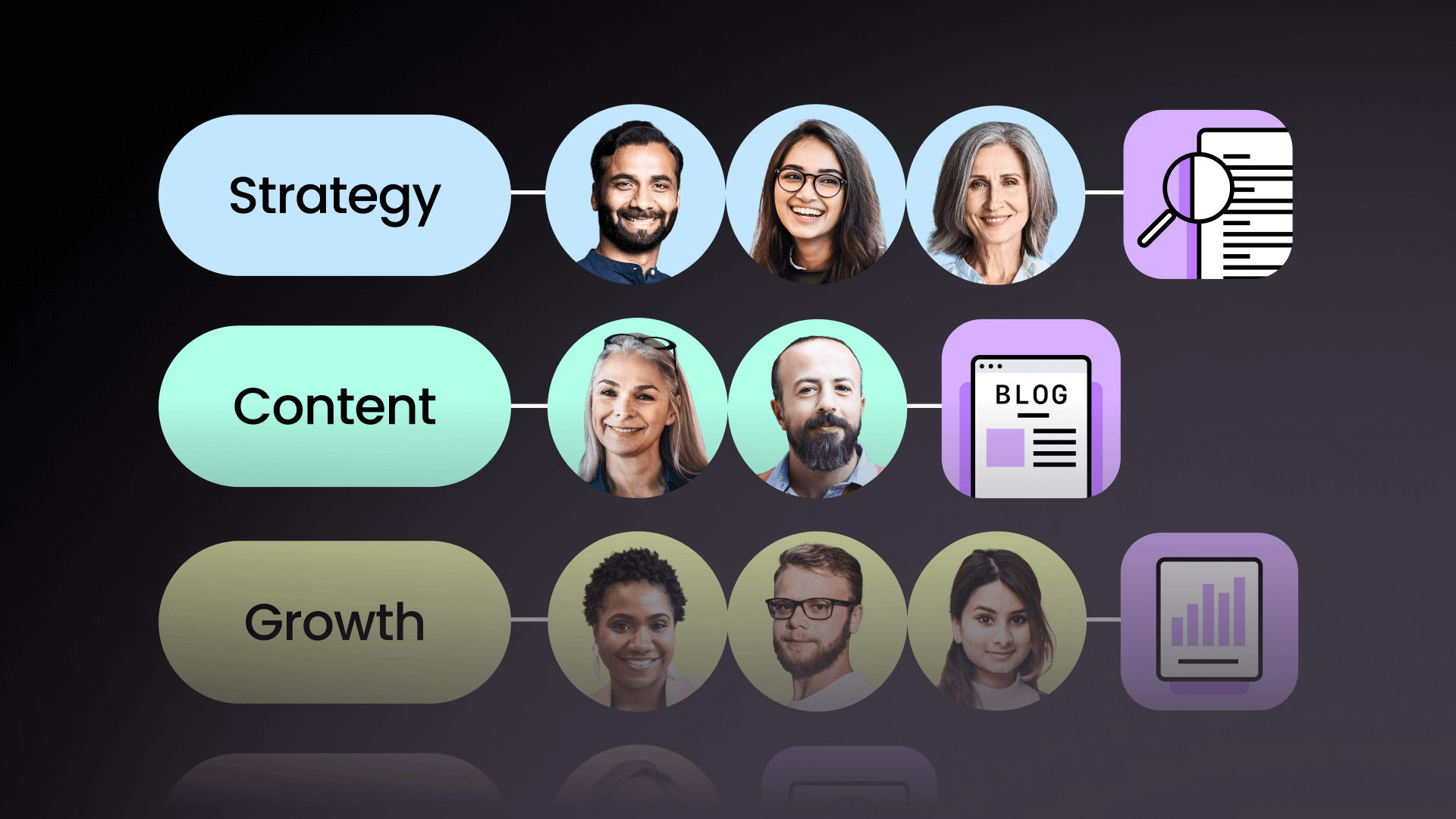
Learn how other marketing teams are using agentic AI to transform their workflows
Read More
One common concern about AI in marketing is its impact on creative professionals. But VOIS and Vodafone’s experience shows that co-creation empowers rather than replaces.
“We’ve got great marketers,” Meads emphasizes. “How are we giving them that superpower in Writer to be able to just do things significantly quicker, significantly better? This isn’t about replacing people. It’s about unlocking that creativity and unlocking that superpower.”
Pott shared a powerful example of this co-creation approach in action. “The best agent my team has built came from my head of demand generation having a problem to solve that he felt acutely himself in his work.”
The most impactful solutions came from the people closest to the problems—not from top-down mandates.
This resonates with a widespread pain point in marketing: 85% of marketing leaders want to launch campaigns in one to two weeks, but 69% report they can’t get multi-channel campaigns out in less than three to four weeks. The bottleneck? Creating personalized campaign variations across multiple channels and audience segments—work that consumes 15+ hours per week on manual tasks that could be automated.
Real impact: The skinny banners example
At Vodafone UK, those 15+ hours of manual work had a specific name: skinny banners. Pott’s team was spending 15-20 hours per week creating campaign banner variations across different platforms and audience segments — exactly the kind of tactical, repetitive work that drains creative energy and compounds into the 3-4 week campaign delays cited in the research.
Now, AI handles the heavy lifting while humans focus on the final quality check. Time to final approval: 2 hours instead of a full day, with marketers freed to focus on strategy rather than pixel-pushing.
“You’ll never take the human away from that final copy check because that’s important for professionalism and quality,” Pott notes, “but the pace at which they can get to that quality check is unbelievable.”
These efficiency gains demonstrate the power of right-to-left thinking — but implementing this approach came with its own challenges that required the same outcome-first mindset to solve.
What are the biggest challenges in AI marketing transformation?
The biggest challenges in AI marketing transformation typically fall into three categories: team resistance and adoption, technical integration with existing systems, and maintaining brand consistency at scale.
For VOIS and Vodafone, these challenges played out in specific ways—and both organizations used right-to-left thinking to solve them.
Team adoption: Meads notes that initial team skepticism was their biggest hurdle: “Marketers worried AI would make their roles obsolete.”
Instead of asking “How do we convince teams to use AI?” they asked “What outcome do we need?” (enthusiastic adoption) and worked backward: “What would make teams want AI?” (solving their most painful problems).
“We identified the work our teams actively disliked—the repetitive, soul-crushing tasks,” Meads explains. “When they saw AI handling those tasks, the resistance evaporated. This wasn’t about replacing creativity; it was about unleashing it.”
Technical integration and governance: Pott’s team faced different obstacles: integrating Writer with their existing tech stack and ensuring brand consistency across AI-generated content.
Again, they applied right-to-left thinking: Instead of bolting governance on reactively as problems emerged, they started with the desired outcome (consistent, on-brand AI content) and worked backward to what that required from day one.
“You can’t bolt governance on later,” Pott advises. “Build it into the system from day one.” Governance frameworks, brand guidelines, and approval workflows were designed into the AI processes upfront — the result of asking “What does success look like?” before asking “How do we get there?”
The business case: Proven results
Marketing performance: The VOIS and Vodafone experience
The marketing-specific impact from VOIS and Vodafone’s transformation speaks directly to content performance and team efficiency. Here’s what they achieved in their first six months:
- 50% reduction in copywriting time — VOIS marketing team, measured across campaign brief to final copy
- 30% improvement in search rankings — Vodafone UK, analyzed across 50+ priority keywords in competitive categories
- 2x content engagement — Vodafone UK campaigns optimized with Writer
- 8 hours saved per marketer per week — Average reported by VOIS marketing team members
Making the CFO case: Enterprise-wide returns
Marketing performance metrics prove value to your team. But to secure budget and executive buy-in, CMOs also need to demonstrate broader business impact to CFOs and leadership.
A Forrester™ Total Economic Impact study analyzing WRITER customers across industries quantified the enterprise-wide returns—the kind of metrics that matter in the boardroom:
- 333% ROI over three years — With payback in less than 6 months
- 200% improvement in marketing labor efficiency — Tasks that took 22 hours now take 6 hours
- 50% reduction in agency costs — Projects brought in-house, saving $5 million over three years
- 85% reduction in compliance review time — Fewer bottlenecks, faster approvals
- $12.02 million net present value — Total quantified benefits across the composite organization

Calculate your own AI ROI potential
Read More
Your roadmap: Where to start
Three clear imperatives emerged from the conversation for marketing leaders navigating their own AI transformation:
1. Start now, don’t wait for perfection.
As Pott puts it: “If we hesitate, if we wait, if we try to write the perfect business case in the perfect spreadsheet and get 85 stakeholders to approve it, we’ll have missed the train. We all just need to start.”
2. Think outcome-first, not process-first.
Design for the customer experience you want, then reverse-engineer how AI helps you get there. This right-to-left thinking unlocks transformation that process optimization alone cannot achieve.
3. Trust your teams to co-create.
The best innovations will come from the marketers who feel the pain points acutely. Give them the tools and the permission to experiment, and empower them to build solutions that truly address their challenges.
Enterprise considerations
For Global 2000 organizations like VOIS and Vodafone, success also required enterprise-grade governance from day one. Both organizations needed assurance that deploying AI at scale wouldn’t create new risks or compliance gaps.
WRITER’s platform delivered the controls they needed: ISO/IEC certifications for security, privacy, and AI management (27001, 27701, 42001), plus SOC 2 Type II compliance including HIPAA.
The governed agent access through Writer’s MCP gateway enforces identity validation and permission-based controls across every system interaction, while built-in supervision tools give IT teams visibility into agent behavior through session logs and explainability features.
Critically, Writer’s full-stack approach eliminates the security risks of stitching together third-party platforms, and models are never trained on customer data—essential for regulated industries and data-sensitive organizations.
Ready to start your own agentic AI transformation?
Download our complete adoption guide
Looking ahead: The path to transformation
The organizations winning in this new era aren’t the ones with the perfect plan. They’re the ones who started experimenting yesterday.
Key takeaways:
- Organizations experimenting now are widening their lead
- Right-to-left thinking unlocks 10x gains, not 10% improvements
- The gap between leaders and laggards expands with every quarter of delay
As customer behavior continues to evolve and AI capabilities expand, the gap between leaders and laggards will only widen.
The full conversation with the leaders from VOIS, Vodafone, and WRITER provides a practical framework for putting these principles into action.
Next steps: Stop planning. Start empowering.
Explore real-world use cases across marketing, sales, and operations to spark ideas for your own transformation.
The organizations winning with agentic AI didn’t wait for the perfect strategy—they started iterating yesterday. Get the complete implementation framework from VOIS and Vodafone’s transformation.
In this 30-minute conversation, you’ll learn:
- The exact agents Vodafone built first (and why those use cases drove fastest ROI)
- How to structure co-creation between marketers and AI (without chaos)
- The metrics both teams track to prove business impact
- GEO implementation: how to optimize for AI citations and discovery
- What they’d do differently if starting today
Watch the on-demand webinar from VOIS, Vodafone UK, and WRITER
From pilots to performance
How enterprise marketers scale AI and prove ROI
The 12 marketing agent systems driving real ROI at leading enterprises
See moreMore resources
AI agents at work
– 9 min read
Webinar recap: The agentic marketer playbook — a new playbook for the AI-powered team

Writer Team

AI agents at work
– 22 min read
Agentic AI for marketing teams: Use cases from content generation to campaign orchestration

Diego Lomanto, CMO

Enterprise transformation
– 13 min read
Beyond SEO: The triple-threat optimization strategy for visibility in the AI era

Alaura Weaver